Last Updated on April 25, 2023 by Audrey Scott
Georgian food is arguably one of the world’s most underrated cuisines, featuring flavors from Greece and the Mediterranean, as well as influences from Turkey and Persia. This Georgian food guide is drawn from experiences traveling across the country — visits to local markets, meals in family homes and restaurants, and even an impromptu cooking course. It offers an extensive list of traditional Georgian dishes as well as tips on what to eat and drink when you visit the Republic of Georgia.
Georgian food is quite appropriately an expression of the culture. Warm, gooey comfort food like khachapuri (cheese-stuffed bread) finds balance with matsoni (yogurt). Herbs like tarragon, flat parsley, dill and coriander combine with walnuts and garlic for rich fillings and sauces.
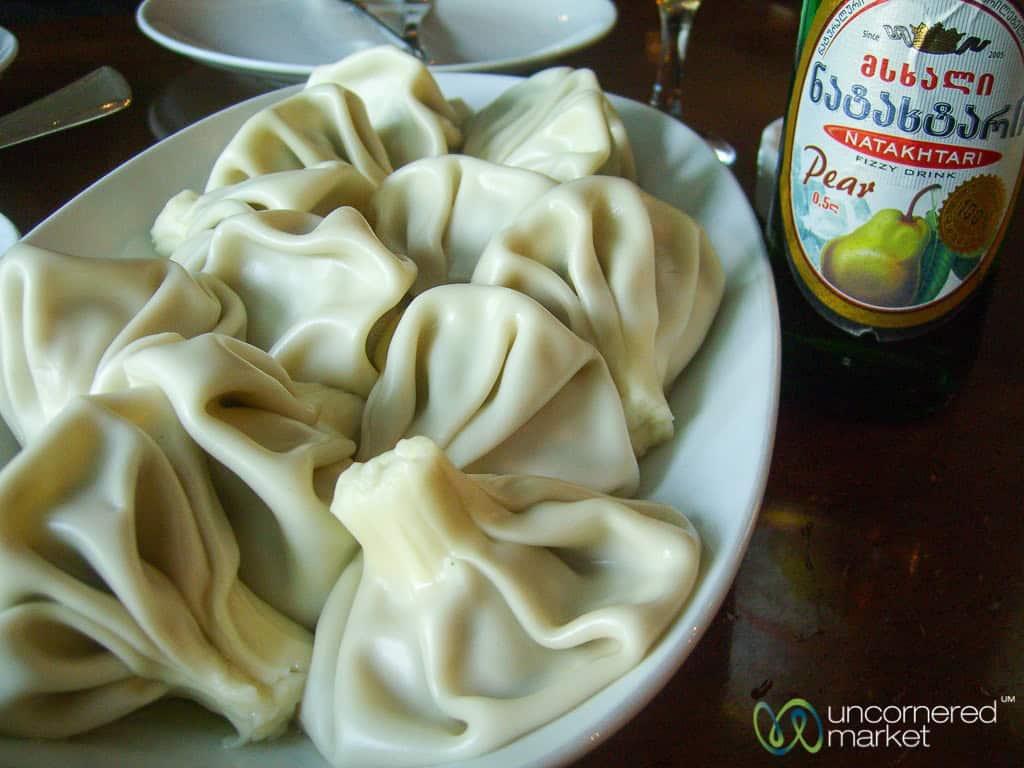
Table of Contents
Understanding Georgian Food
Eating, hospitality, toasts and the supra bind family and friends and snare visitors to Georgia into long, table-bound interludes. Georgian food and hospitality surrounds you…and can sometimes suffocate you under its weight.
We developed a deep appreciation for Georgian food during our travels there, particularly due to helpful friends and host families who enjoyed providing us a quick and tasty education in Georgian cuisine and dishes.
The following is just a taste of Georgian food and some of our favorite dishes from almost two months of traveling throughout the country, from the capital city of Tbilisi to Kahketi, Svaneti, Borjomi and other areas in the east. We sampled Georgian food in restaurants, markets, street food stands, and family homes. In other words, we dove deep into Georgian cuisine during our visit to this fascinating, unusual destination.
If you do visit the Republic of Georgia and can't find a particular dish, just ask local people where you can find it and they will be more than happy to help you discover their cuisine. Georgians are proud of their cuisine and culture, and happy to share it with curious visitors. And, you'll likely have a great story to tell about that experience and meal.
Note: This post was originally published on July 20, 2007 and updated on October 19, 2018.
Traditional Georgian Food
Khinkali (Georgian Dumplings)
Beautifully twisted knobs of dough, khinkali are typically stuffed with meat and spices, then served boiled or steamed. The trick with khinkali is to eat them without making a mess or spilling the hot broth inside all over yourself.
How best to eat khinkali: sprinkle with black pepper, grab the dumpling by the handle and turn upside down. Take small bites from the side, slurping some broth as you go.
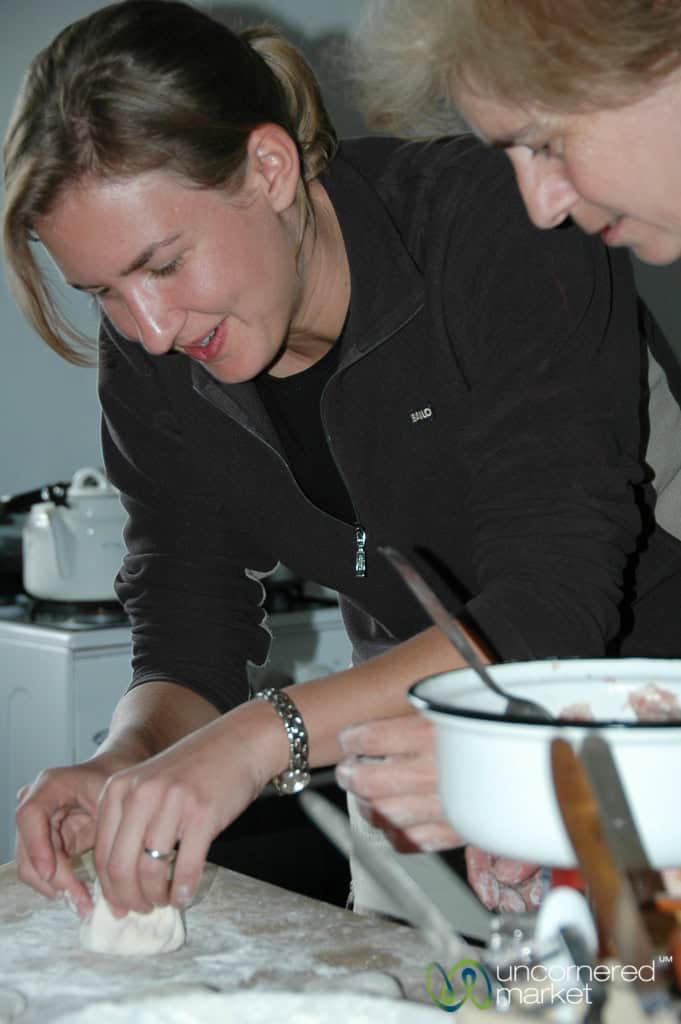
Lali taught us how to make khinkali from scratch when we stayed in Kakheti. After a few disastrous attempts, we finally got the hang of how to turn and tuck the dough around the meat. Remarkably, our dumplings maintained their form as they boiled and the broth remained inside. We’re told our khinkali-making certificate is in the mail.
Although traditional khinkali typically features meat, vegetarian khinkali featuring fillings of mushroom and cheese/curd are often available if you ask for them.
Badrijani Nigvzit
Roasted eggplant (badrijan) strips, served flat and topped with walnut paste. Sweet and savory, this dish is one of Audrey’s favorites.

Lobio (Bean Soup)
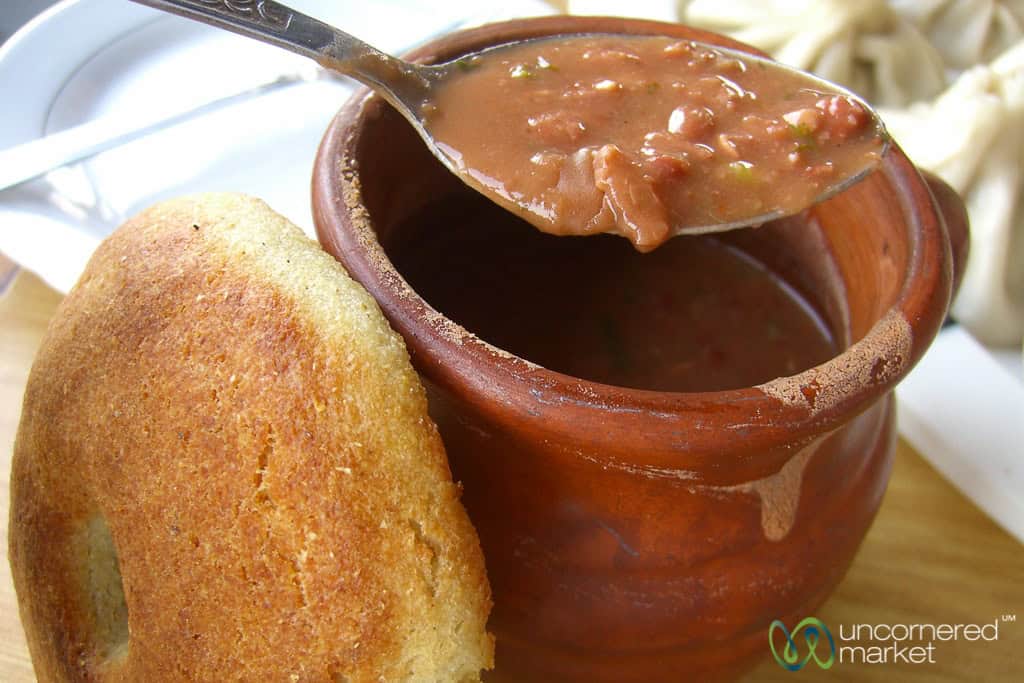
A cross between bean soup and refried beans. The consistency and taste of lobio varies widely. That it often bears a resemblance to Mexican bean dishes is almost always satisfying.
For full effect, the traditional way to eat lobio is with a round of mchadi, Georgian corn bread. We often searched for lobio after we'd been exhausted by meat and bread, and found it quite often, including in some unusual locations.
Qababi (Kebabs)
Grilled minced meat sprinkled with sumac and onion slices, wrapped in a thin lavash-like bread. In some small Georgian towns, this was the only dish available. We were surprisingly never disappointed by it.
Dolmas
Steamed, roasted, or boiled vegetables or leaves stuffed with minced meat, herbs and rice. Though we don’t especially associate dolmas with Georgia, our friend Rusiko's rendition — featuring stuffed fresh grape leaves from her garden — was something special and tasty.
Chakapuli
Traditional herbed lamb stew from Kakheti, chakapuli is typically eaten around the holidays (e.g., Easter). Chakapuli typically features a meat like veal or lamb, and is further flavored by onions, tkemali (sour plums), white wine, garlic and mixed herbs.
Mtsvadi (Shashlik, meat skewers)
Fire-roasted chunks of pork, salted. For the perfect mtsvadi, cut some fresh onions and place in a metal bowl, then stir it over a fire. We were lucky to have mtsvadi in an impromptu barbecue in the mountains. It was among some of the best barbecued meat we’ve ever had.
Be careful, chunks of the prized chalahaji (or back meat) are usually in limited amounts and meant to be shared with the group. Audrey learned this after unknowingly taking the whole skewer for herself to shrieks of objection. She then shared.
Satsivi
Poultry (chicken or turkey) served with a thinned paste of walnut, garlic and herbs. Considered a winter dish (“sivi” implies cold in Georgian), satsivi is usually eaten around the Christmas holiday and the New Year, particularly in the region of Adjari. Though we’ve enjoyed this at Georgian restaurants abroad, we unfortunately didn’t have an authentic opportunity to try it this time around.
Mashed potatoes and lots of cheese
Mashed potatoes are the traditional Svanetian farmer food. We’ll never forget waking up at our host family's in the town of Adishi to a giant plateful (for each of us) of the stuff. We took a few spoonfuls and could barely move.
Georgian Breads
Khachapuri (Georgian Cheese Bread)
No visit to Georgia would be complete (or possible) without a few tastes of khachapuri, the warm, gooey cheese-stuffed bread that oozes and drips with heart-stopping goodness. In addition to the standard round pie stuffed with cheese, other variations include egg-topped (Adjarian khachapuri), the four-fold filo dough pocket, and tarragon, mushroom and rice-stuffed pies.
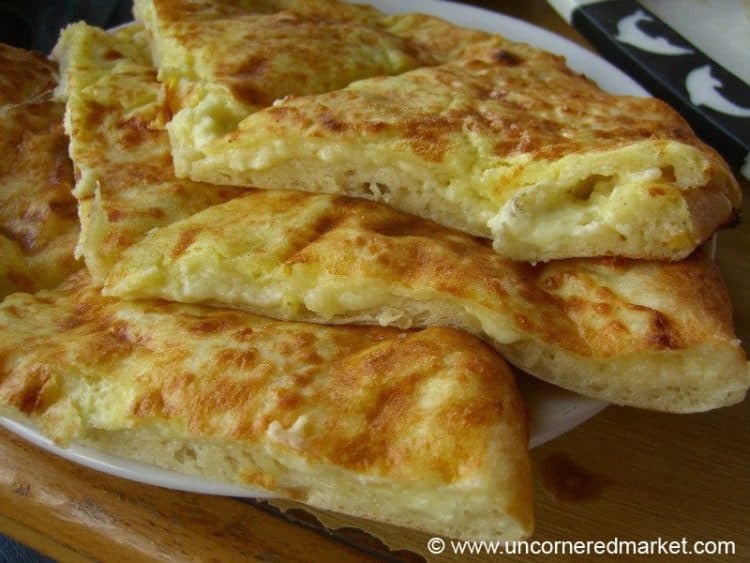
Arguably the best khachapuri can be found at a home stay when it’s made fresh for breakfast – just as we enjoyed it in Tbilisi and Kisiskhevi. You can also find khachapuri in the Svaneti region, where you may also find it stuffed with leek. If you aren’t staying with a family, don’t despair – you can find khachapuri stands on almost every street corner in Tbilisi.
Puri / Tonis Puri (Georgian Flatbread)
Tonis puri is the Georgian bread staple. Baked in a ceramic circular hearth oven with the dough stuck to the side (like Indian naan), puri comes out moist, with a tinge of sourdough flavor, and perfectly tainted with black bits from inside the oven.
You'll notice that the edges of tonis puri are often browned and taste faintly of matzo. The most memorable version of tonis puri we tasted was in the town of Borjomi, next to the bus station. This might not come as a surprise, as Borjomi is famous for its water, a key ingredient in Georgian bread.
Lobiani (Bean-stuffed bread)
Lobiani is similar to khachapuri-, except that it is stuffed with bean paste rather than cheese. Lobiani is typically quite moist and is just slightly healthier than its original cheese cousin, khachapuri.
Kubdari
Kubdari, a bread specialty originally from the Svaneti region, is a khachapuri-like dough stuffed with small chunks of meat, spices and onions. The best versions of kubdari that we tasted were in restaurant stops along the road between Zugdidi and Mestia, as well as in home stays along the hiking route from Mestia to Ushguli.
Chvishtari
Cheese corn bread (a Svanetian version of mchadi with cheese). This will stick to your bones for days. It makes excellent trekking food.
Georgian Cheese and Yogurt
Matsoni (Georgian yogurt)
A rather sour fresh yogurt that usually shows up topless (well, without a lid) at the table. Trial and error usually works to suit your taste. You can eat it savory served with warm meat, vegetables, or khachapuri. For a sweeter version at breakfast-time or for dessert, you can blend matsoni with fresh honey or fruit.
After matsoni straight from the farm, store-bought yogurt will never taste the same. Matsoni is a culinary and cultural Georgian staple. Since it's made from boiled fresh milk and a bacterial starter, matsoni is certain to have medicinal qualities.
Sulguni (Georgian cheese)
As far as we could tell, sulguni is *the* national cheese of the Republic of Georgia. A salted, water-soaked cheese that features a stringy shell and moist middle, sulguni is typically eaten by itself or with a round of tonis puri bread and a plateful of herbs and tomatoes.
Georgian Condiments, Pastes and Sauces
Adjika (Chili Paste)
Adjika, a spice paste condiment, is best compared to spicy Indian pickle-like paste. We were always served adjika with cucumber and tomato salad.
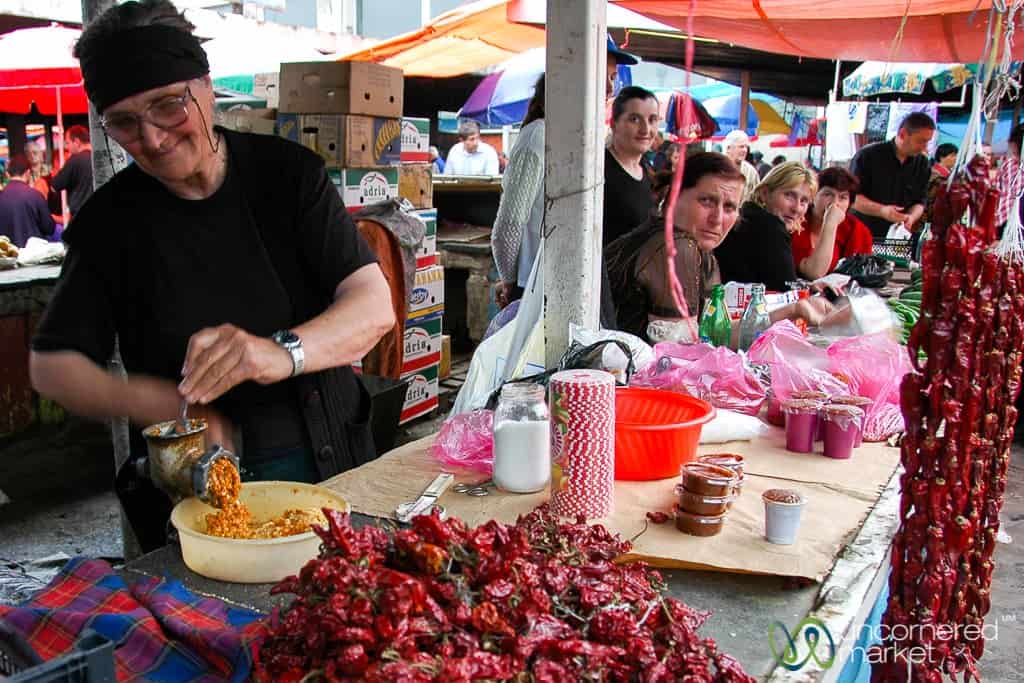
Tkemali Sauce (Sour Plum Sauce)
Taken in small doses alongside cheese, khachapuri, or meat, this sour plum sauce is said to be a cleanser. Whenever we had a meal with a family, out came the canning jar of tkemali sauce.
Pkhali
A paste made from spinach, walnuts, and garlic. Excellent with tonis puri or khachapuri. Typically served as an appetizer, or mezze-style with other small, flavorful dishes, the fresh, local flavor of pkhali made it another of our favorites.
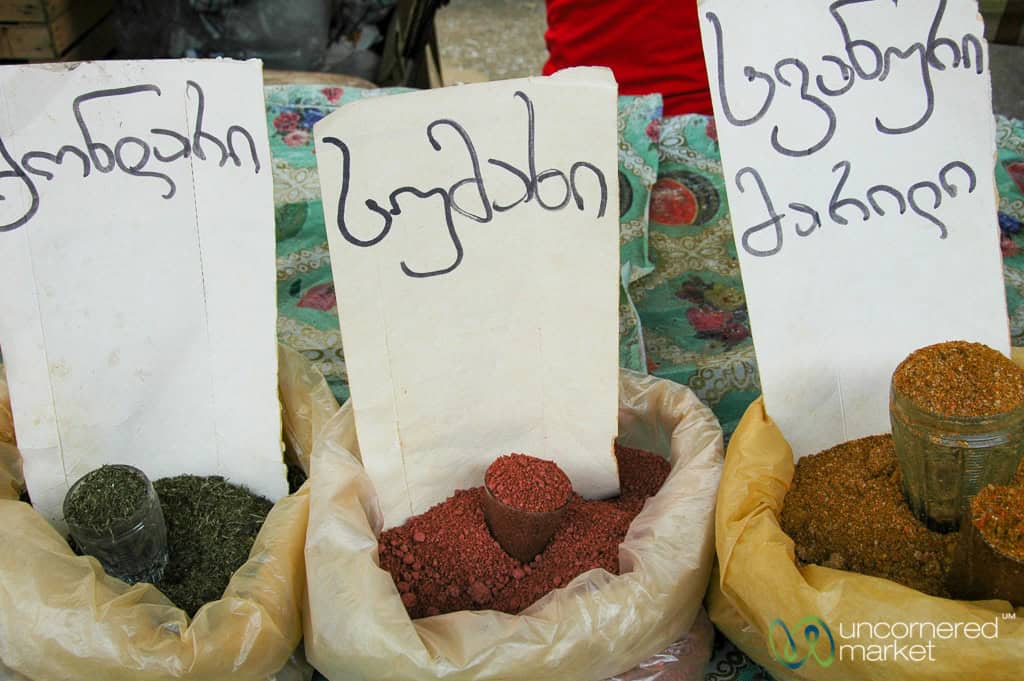
Svaneti salt
So-called Svaneti salt serves as a perfect complement to vegetables, cheese or salad. Made from salt, dried garlic, chili pepper and a blend of various spices and herbs like fenugreek and coriander, Svaneti salt and its aroma will have you thinking you’re inching closer to Persia or India.
Georgian Sweets
Tatara or Pelamushi
Confection made from boiled, pressed grape extract. Can be eaten as a sort of pudding as dessert. The liquid is the sweet coating used to make churchkhela.
Churchkhela
Brown rubbery truncheons made from strings of walnuts dipped in tatara and dried. Sometimes referred to as “Georgian Snickers.” Don’t eat the string!
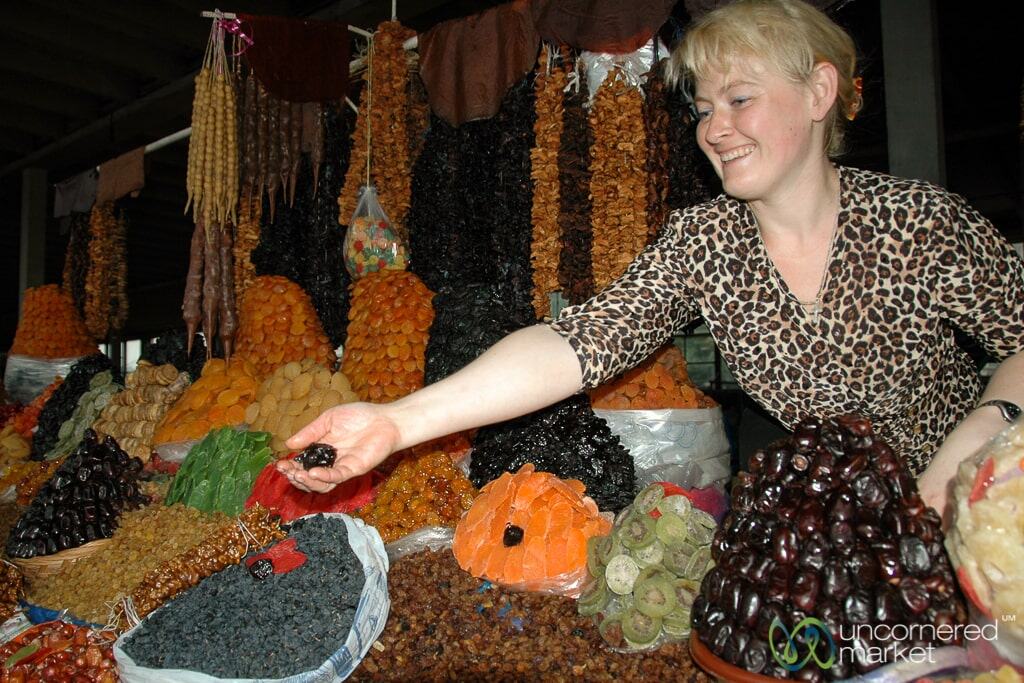
Mushmala
A juicy, persimmon-colored fruit about the size of a walnut. It’s dark, shiny seeds look like tiger-eye jewels.
Georgian Drinks
In no way does Georgia suffer from a lack of alcohol…or the endless toasts to go with it. Here's a quick rundown of Georgian wines, brandy, and grappa.
Georgian Wine
Georgia is believed to be the birthplace of wine, with the oldest evidence of winemaking dating back 8,000 years. Traditional Georgian winemaking used qvevri, terra-cotta containers that are buried underground to store and ferment the grape juice after it has been pressed and stomped.
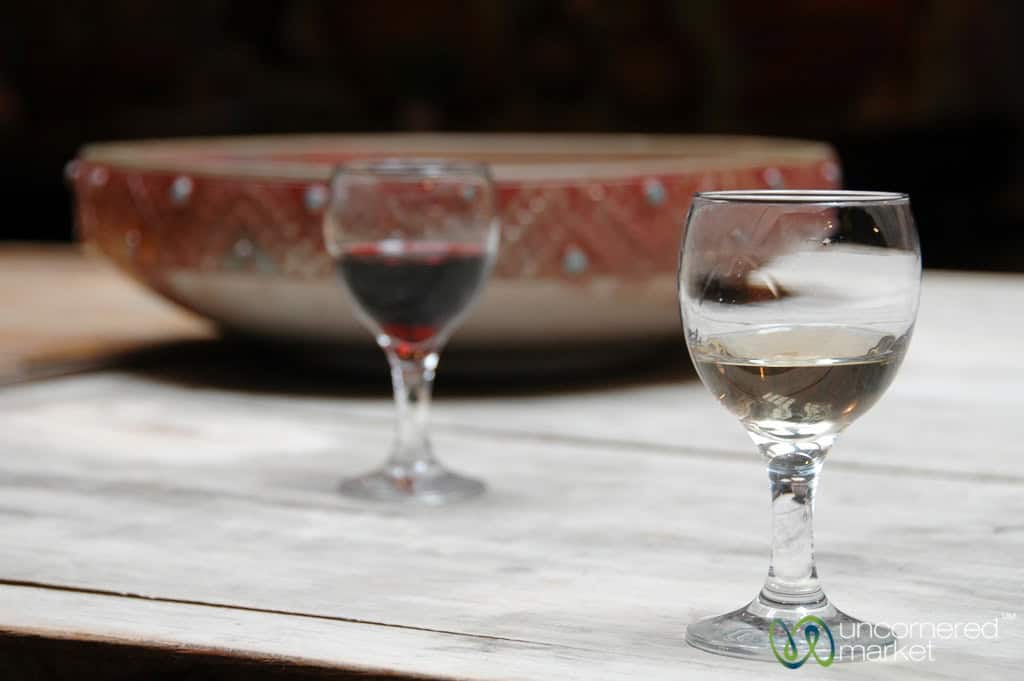
Georgia's wine landscape features many different unique and ancient grape varietals. Our recommendation: opt for the Saperavi (red wine). Saparavi is the most famous of all Georgian varietals; when it's of quality, it can be really good. But Saparavi often needs a bit of time to come into its own, so be sure to decant it in advance and let it breathe for a bit of time.
If you're curious about Georgian wine, consider booking a walking tour of Tbilisi that includes wine tasting, a one-day wine tour around Kakheti or drop in on a Georgian wine bar in Tbilisi and fashion your own wine-tasting to learn about the various Georgian wine varietals.
Georgian brandy
Surprisingly smooth and easy to drink, Georgian brandy is worth seeking out. Though Armenian brandy gets a lot of press, Georgian brandy is under-appreciated.
Chacha (Georgian Grappa)
The drink of sadists and masochists throughout the Georgian countryside, the Georgian grappa-like firewater called cha-cha is the choice of toast-makers, particularly as the night or occasion advances. Oddly enough, it's common practice to have a small drink of cha-cha in the morning, apparently to ease the effects of traditionally heavy morning meals in the countryside.
Raki
A lower octane version of hooch/moonshine that makes frequent appearances at the table and in the streets of Svaneti.
Where to Eat in Tbilisi
Many of our eating experiences took place with friends or host families. Below are a few restaurants and cafes worth a visit in Tbilisi.
- Chashnagiri Restaurant (25 Leselidze street): Used to be called Shemoikhede Genatsvale Restaurant, but changed its name recently. It serves artful khinkali. Some of the nicest looking khinkali we've had. And very tasty.
- Salobie: Located near Mtskheta, this large outdoor restaurant is a Georgian institution. Apparently, it’s always been dishing out great lobio, even during the civil war times of the early 1990s. Our friend, Lena, and her family introduced us to many of the greats of the Georgian table here – khinkali, lobio, qababi, mchadi.
- Hole-in-the-wall deli and bakery (Vashlovani street): That's not really its name, but we know it's located near the Chinese restaurant Picasso between M. Kostava and G. Akhvlediani streets. Offers trays of pkhali, badrijan and tomato ratatouille dishes to go. Each dish is 3 lari. Next door is a bakery with lobiani and various forms of khachapuri. Perfect for assembling a picnic or light evening meal.
- Mitropane Laridze on Rustaveli: The site of our first khachapuri experience. Once a Tbilisian institution, this underlit mosaic-lined soda fountain on Rustaveli makes for an inexpensive mid-afternoon break of khachapuri and gaz voda (egg cream-like syrupy soda).
Georgian Cooking Courses and Foodie Tours
To go even deeper into Georgian cuisine, consider a home-cooked meal in a family home, a food tour, or get your hands dirty and take a Georgian cooking course.
Our friend had a great experience with this home-cooked family meal experience in Tbilisi. It's not only delicious, but also lot of fun with a warm and personable host. For a more comprehensive experience you can also book a Georgian cooking class in Tbilisi.
Alternatively, opt for the “best of” Georgian food by sampling nine traditional dishes by booking this food tour around Tbilisi's Sololaki neighborhood, one of our favorite areas of the city.
Oh, man! All of a sudden my lunchbox is sounding less and less appetizing. Know of any Georgian restaurants in Montana? 😉
After eating the same 4-5 Central Asian dishes (all very heavy on meat) for the last 3 weeks, we’re dreaming of lobio and pkhali! We found a Korean restaurant in Tashkent with delicious bimbimbap and wifi to boot! Heaven for our tastebuds and we’re loving the fast connection : )
Hello! I was interested in getting a recipe for Kubdari. If you have one and are willing, please send it to my e-mail address: [email protected]. Thanks. – Neil S. McShane
Neil, unfortunately, we don’t have a recipe on hand for Kubdari. I’ve asked a friend in Georgia to see if she can send the recipe. I’ll be sure to pass it on to you if she has one! It is delicious stuff!
Hello, I was wondering if you had the recipe for “adjika”? I will be going overseas for 2 years and I can’t go without this for 2 years. Please let me know if you are willing to give this up to me? You can email it to my home email :[email protected].
Thank you in advance!
T Moritz
Tony: Unfortunately, we don’t have our own personal recipe for adjika, yet.
After a quick search, this recipe seems to one of the better ones out there:
Adjika Recipe
I doubt the consistency will be what we had become accustomed to in Georgia, however.
these are some great photos and resepies as I come from georgia I know how they taste and I just love every one of them. gagimarjot
Giorgi: We are always searching for Georgian food these days! I wish it was easier to find khajapuri in other countries!
OH my GOD HInkali is my favorite food ever!
Ia: We too love hinkali (or khinkali, khingali if you like). We were just talking about them (again) yesterday. We may even try to make them in our own kitchen one of these days.
Originally Kubdar was made from bear’s meet(i have tasted it when my neighbour returned from Hunting in Svaneti). It is something you will never forget. But other variations of Kubdari are more spread(with beaf and meat). I will send you the recipe for it as soon as i have one. As for my favourite Georgian dishes – Mtsvadi is a reall winner!!! But do not forget to serve it with pomegranate sauce 🙂
P.S. And yes, thank you for such a great articles about Georgia. I am glad you enjoyed time here!
Irakli: Kubdar from bear’s meat – that would be interesting! We’d love to have the recipe. We’ve talked about trying to make Georgian food at home, but haven’t tried just yet…there has always been a Georgian restaurant around and this has made us lazy. Georgian cuisine really is special and it warms the soul. I’m glad you’re enjoying our stories about Georgia!
@Diana: Oh, khinkali are SO tasty! They are bigger than xiaolongbao and the seasoning/herbs are a bit different. Just make sure to take a little bite out of it first on the side to let the steam out, slurp up the broth and then leave the knob behind (you can eat it, but you’ll fill up quickly!).
The khinkali looks so good…reminds me of a thicker-skinned Shanghainese xiaolongbao. Now I’m so curious to try them.
Hi Dan, hi Audrey! I had Georgian food while I was in Moscow and fell in love with it – unfortunately there are no Georgian restaurants in NYC! I was googling for recipes and saw that you guys might have a few – do you have recipes for khachapuri, Badrijan Nigzit, and Chakapuli? I would appreciate any advice or resources you guys had to offer, thanks!
Cristina
@Cristina: Oh, I really miss Georgian food a lot. There’s nothing close in Central America. I asked one of our friends in New York City who also loves Georgian food whether she knew of any Georgian restaurants there. Here’s what she wrote:
“I know of 3 places but I haven’t eaten at any of them. In Brighton Beach, there’s Georgia 21 on Brighton Beach Ave. There’s also a place on Coney Island Avenue near Kings Highway that might be called Tamada, but I’m not positive – it’s the friendliest looking of the 3. The last is on Avenue U near the Q train station, maybe between 16th and about 20th streets.”
I’m afraid we don’t have any of our own recipes, but this website has some great recipes and mouthwatering photos. Good luck finding Georgian restaurants nearby and cooking Georgian dishes at home!
really nice articles, thank you! khinkali forever!!!!!! I can’t think of anything more delicious
Hello ! I am searching, in vain thus far I fear, for the recipe for that lovely flat bread you can buy at just about any neighborhood store in any town anywhere in Georgia. It is flat, elongated, brown on bottom and sort of crisp,
looks sort of like a ping pong paddle but with a handle on both ends – sort of like an ” O ” with the sides stretched out. Generally there is a slight depression in the center of the loaf. It is served at most meals in and around Tbilisi and is either cut into sections with a knife or just pulled apart with the fingers. Usually in every section of town on side streets, there is a baker
who makes this bread. He has a very dimly lit cavelike little shop with a wood or gas fired oven and bakes these loaves all day . . . I don’t remember the name of it – perhaps Lavosh ? or Puri ?
Hello. This bread called Shoti, or Shotis puri.
Lavashi we call the round one. Hope this helps 🙂
I loved seeing your website. I have a page on Georgian cuisine that you might like and find helpful. Feel free to share with others. You’ll find some Georgian recipes there too. We also accept recipe requests and will do our best to get them online as soon as we can. and thanks for such a nice write-up about our country!
@Salome: Glad you are enjoying our site and enjoying Georgian cuisine and culture.
I am an Armenian, originally from Iran, and delight at reading all the recipes and their names to see the simialrities between thos we use and those of surrounding regions.
There are far more similarities than differences, so travel must have been quite abig thinkg over the centuries for these ot have spread so far and wide.
The world is shrinking, so thanks for bringing a smile to my face via your post and the opporyunity of commenting here too.
@Charles: While we were in the Caucasus, it was always fascinating to see the similarities in so many things (food being just one of them) throughout the region. Food in general (and Georgian food specifically) provides us a lesson in sharing at a distance and the constructive use and application of differences!
I really enjoyed reading about your experiences and the food of course!! My wife and I are hosting a young lady from Georgia and would like to prepare some of her traditional food as a surprise and wanted to know what you thought would be good to make. Let me know!
Thanks!
@Chris: If you are going to try making Georgian food for a visitor from Georgia, I’d go for khinkali. We just made some for the first time last week. Photos of the raw khinkali dumpling and the cooked khinkali. I’ll send you an email with some details. It may be worth trying them once to perfect the recipe. Or, better yet, you might have your guest help you. Sounds like fun regardless.
I have Georgian friends in NY, they said that food in Georgian restaurants are not good. I wanted to take my son for his birthday, he is missing Georgia and I thought it would be a nice surprise for him, but my friends said we would be very disappointed.
We cook Georgian very often, I invited my American and friends and I am going to make Chakapuli. By the way who ever tries eggplants with nuts and spices love it!
Thank you very much for your beautiful story!!!! I am missing Georgian bread so much!!!!
@Rusudan: We are also missing Georgian bread (kachapuri) a lot as well! I am glad to hear that you are cooking Georgian food at home and sharing it with your friends. I am sure the food you cook at home will be much better than any Georgian restaurant in NY 🙂
Hello , i am georgian and give you recipes , i hope you enjoy it http://sisauri.tripod.com/ref/cuisine/cuisine.html
@maria: Thank you for the link to Georgian food recipes!
Hello, I am originally from Georgia and I live in US, for over 8 years now. I have been cooking all day today for new years, I made badrijani nigvzit, pkhali, vinigreti,tolma, satsivi and khachapuri is on the way, I am having some Georgian and American friends over. I brought lots of spices from Georgia with me, that’s the key ingredient in Georgian cousin. there are few Georgian restaurants in Brooklyn,NY and they are pretty good. there is also a store were they sell pre made Georgian food and the are very very tasty and they make lavashi there as well.
@Tamuna: Wow, you are making all of our Georgian food favorites. Sounds like a terrific New Years feast. All the best to you in the new year!
I am from Georgia and I live in Georgia. I’m happy… :D:D:D:D most i like hkinkali and acharuli hkachapuri. I am 10 years old.
@Tako: Great to hear from you! Acharuli kachapuri — that’s the kachapuri from Ajara, with the egg inside?
We love, love, love khinkali, too. Some of our favorite food in the world.
Thanks for your comment. Lucky for you to live and eat in Georgia!
Hello….we are planning a trip to Georgia sometime in June. We are travelling with our one year old son. We are looking for rustic places to stay among the vinyards and the mountainous regions. Do you have any suggestions? We are real foodies, so a place that could cook up some nice local cuisine as well would be great.
@Anya: Sounds like you have a great trip planned for yourself. My suggestion would be to contact the tourism office or a tour company in Kakheti or Telavi. They could probably direct you to bed & breakfasts in the area where you could learn local dishes as well. The place we stayed was owned by a friend, so it was a private affair. Good luck and enjoy your trip!
How about kharcho? That was my first introduction to Georgian food and it tastes like moooore! 🙂
@Iris: I’m not sure that we tried kharcho when we were in Georgia. I just looked it up and the soup sounds delicious. We’ll have to seek it out now!
Awesome article, Well written, beautiful pictures. I feel like you did understand the Georgian culture
@Valeria: Thank you! We really did enjoy the almost two months we spent in Georgia and tried to understand as much of the culture as we could.
Going to Georgia in Nov. Already excited about trying out this awesome food! Wonderful pictures of the different foods and the spices & veggies in the market. I look forward to reading more of your blog posts and seeing more pictures of your travels.
Thanks so much, Colleen. Have a great trip. Georgia is a special place. If you have questions, just let us know. We’ll keep the stories, food round ups and thought pieces coming.
I just came back from a trip to Georgia and still can barely move! I loved the khachapuri way too much, and the khinkali… just if they made things without cilantro, my life would be much easier, because otherwise I have to pick it out 😀 There was too much wine and chacha on my Georgian trip, though… :))
Georgian food is pretty hard to resist, especially the way that Georgians always force feed you at supras and ever other dinne roccasion. It’s hard not to have a trip to Georgia without too much wine and chacha 🙂
I’m so impressed that you guys were in Georgia as far back as 2007! I lived there from September 2017 until June 2018 (with a Georgian host family and so had a pretty authentic culinary experience). I now have my own blog about travel in the former Soviet Union and stumbled across this guide when doing a bit of research for my own article about Georgian food. I am so glad that you guys were able to try so many different dishes and not just khachipuri and khinkali (as delicious as they both are!)
Thanks, Tara. Glad to hear that you had such a terrific experience with a Georgian family and the food. Right on — khachapuri and khinkali are really only the beginning. Georgian cuisine seems as though it’s finally getting its due.
Thanks for this article, I’m so glad I came across it!
I’m off to Georgia in a few days time (Tbilisi and Batumi and surrounds) and was really intrigued about the gastronomy there.
Mashed potatoe and cheese? I think I’m in heaven!
Bex, I hope you had a wonderful — and delicious — journey around Georgia. The cuisine is really incredible. We recently traveled in Ukraine and gravitated towards Georgian restaurants – just as flavorful and rich as we remember from our travels around the country.
What a great article!
I just got back from back from Georgia myself, and I can confirm that not only was Georgia a really pleasant surprise, but the food was very tasty.
Thank you, Victoria. Glad you enjoyed it. Any favorites?
Is there some place from which you can order Georgian foods and products?
Richard, without knowing where you live specifically, it’s hard to advise. However, it’s likely that if you live in North America or Europe there is likely somewhere that you can get Georgian food and products delivered to you. I’d start with a search on Google for ” Georgian food products delivery” + location of where you are. Or, try searching on Google maps in your home area for something that might be more local. Hopefully, you’ll find something nearby that can deliver Georgian food products!
Just returned from a trip to Georgia with my oldest son, who lives in Jordan. I am vegetarian and was happy to find so many options throughout Georgia–bean soups (lobio) served with delicious breads were available everywhere, and always a little different. Lobiano (bean-stuffed bread) was available hot and fresh on most street corners. Khinkali (dumplings) could be found stuffed with potato or mushrooms. Vegetable stews with eggplant, peppers and onions were delicious and found on many menus. One host cooked a buckwheat porridge for breakfast–and served fresh sliced cucumbers and tomatoes with every meal! Churchkhela (dried fruit puree-covered walnuts on a string) and wonderful dried fruits made perfect desserts. Vegetarians won’t go hungry in Georgia!
Nobody ever mentions Georgian Lemonade – fabulous flavours – very addictive!