Last Updated on June 26, 2026 by Audrey Scott
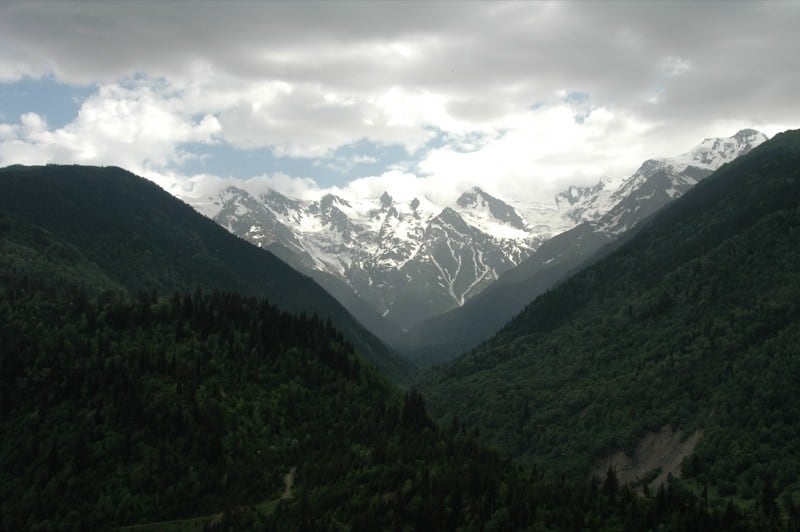
Trekking in Svaneti, an area the high Caucasus mountains of the Republic of Georgia, is so much more than just a physical experience. Yes, you are surrounded by stunning mountain landscapes and vistas. But the Svaneti trekking experience is one steeped in Svan culture, history, cuisine and all the people you meet along the. Here is our experience trekking from Mestia (Mulahi) to Ushguli in Svaneti.
When you get there, you'll meet the Afghan at the telephone pole.
These instructions given to us in Mestia by the Svaneti Mountaineering Tourism Center left us baffled. Is our mountain guide a member of the Mujahideen who’d lost his way and made his home in the mountains of Georgia? After all, in Svaneti just about anything seems possible.
Meeting our Svaneti Trekking Guide
The Afghan at the telephone pole happened to be a compact, blue-eyed, gold-toothed Svan named Avgan. His crooked nose hinted that he’d seen his share of conflict, but his gentle smile suggested something more thoughtful than a mountain brawler. Equipped with a walking stick and a leather military rucksack, he would guide us over mountain passes the next four days as we hiked 40 miles from his village of Mulahi to Ushguli.
Our journey here would be as much mental as physical. Avgan’s path took us surprisingly deep into the psyche of the region, whose nostalgic desire to re-capture its past is underscored by its current economic uncertainties. The beautiful mountain landscape that draws most visitors here became almost secondary for us, providing a dramatic backdrop and linking together our most memorable moments of Svaneti and its people.
Hills and a Struggle with Death
As we followed Avgan into the hills that first day, Audrey attempted to absorb, in Russian, Avgan’s continual shower of Svaneti mountain trivia. He was once a full-time mountain guide in Soviet times leading tourists from the bordering Russian republic of Kabardino-Bulkaria to Svaneti. Audrey, in her ignorance of Soviet geography, thought he was saying “Bulgaria” until she realized how difficult it might be to walk from Bulgaria to Georgia in one day.
Avgan spoke nostalgically of Soviet times when 40+ tourists used to cross the pass near his house and stay in his village each day during the summer high season. In Mestia, nearly 200 tourists would arrive daily. Hotels were packed, subsidies were flowing, petrol was cheap, roads were paved and life was good. The old days stand in stark contrast to today’s tourist trickle and deteriorating infrastructure.
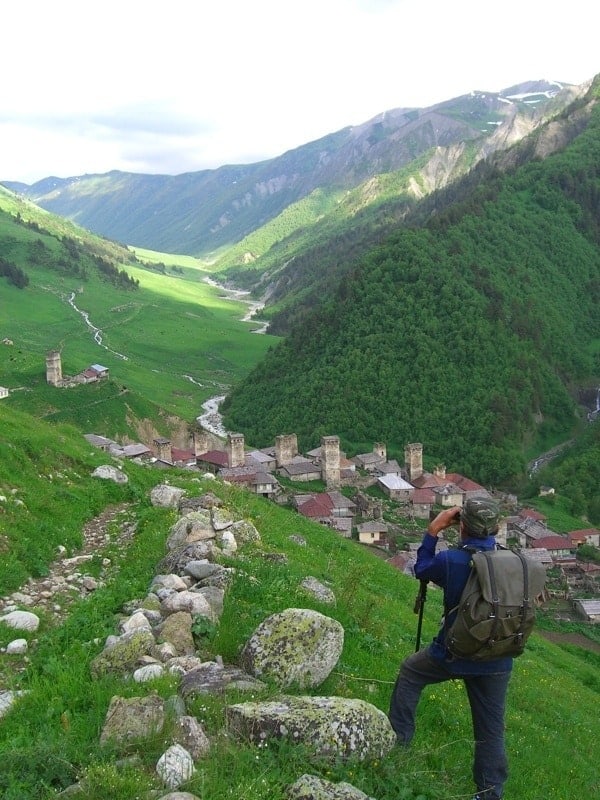
As we made it over our last pass in the early evening, we glimpsed our reward: a magical view at the base of a mountain where the village of Adishi and its iconic Svan towers marked our first stop and home stay. Although our hosts, husband and wife farmers, didn’t know we were arriving, they quickly assembled a feast in minutes – sulguni (cheese), puri (flat bread), meat, potatoes, and matsoni (Georgian yogurt). Everything was homemade and farm-fresh. Once the rachi (low-octane local vodka) came out though, the tempo changed and Avgan quickly assumed the role of tamada (toastmaster).
We had noticed a look of chronic sadness and exhaustion – a sort of depression – on the husband’s face. During an early toast we learned the cause, the death of his daughter several years prior in a car accident. A memorial hung on the wall behind us as we each poured a few drops of our drinks on the table in a nod to her and the deceased.
The mood eventually lightened as Avgan became more poetic. He led toasts to Svaneti being remembered for its mountains and not its guns, to future tourists, to his sons winning more mountaineering competitions, and so on. Audrey struggled to keep pace with the 10-minute long toasts, roughly translating Russian into English for Dan’s benefit.
At one point, Dan tried to explain how he couldn't possibly squeeze in any more food or drink because he had eaten enough for 2-3 days. Audrey's charades and attempted translation gave Avgan the impression that Dan was constipated. For the next laughter-filled fifteen minutes, Dr. Avgan listed a host of natural remedies such as warm milk and enemas in order to cure Dan's “problems” and get things moving again.
Approximately ten shots later, we tried to excuse ourselves to our room. As we prepared to go to sleep, we were called next door into the daughter’s bedroom. Shrine-like and eerie, it remained as it was just before her death. Her clothes were laid out across the bed in the shape of her body, as if she were still there sleeping. In one final toast of sadness where a drop of liquor is poured on the floor to those that have passed, the father shared his continued grief with us.
When Avgan awoke the next morning, he kindly allowed an extra 15 minutes and gave a knock on our door at 6:30 AM. Considering how much rachi we’d consumed the night before, we were certain he was joking. After the third knock, we reluctantly extracted ourselves from bed and dragged ourselves to the breakfast table.
Heaping plates of Svaneti cheese mashed potatoes awaited our arrival. Stringy and paper-weight worthy, the potatoes loomed, almost mocking the rachi-carved pits of our stomachs. Our hearts began to palpitate at the thought. We could only manage a few spoonfuls of potatoes and yogurt and we were on our way to the clearest of the available mountain passes accessible from the valley.
Amazing Vistas and Abandoned Villages
The most difficult climb lay just ahead. A steep snow chute was followed by thick wild mountain rhododendron. We could feel new muscle groups coming into use as we pulled ourselves up with their roots. Once we reached the top, we were exhausted. Our reward: spectacular 360 degree views and a chance to nap in the passing sunshine. Avgan even gave us a lesson on how to make natural Svaneti Viagra from the roots of purple flowers. Even while resting it seemed that we were always learning something.
We descended next into Khalde, the village known for holding off Russian forces in 1876. Mention of Khalde evokes a spirit of pride and tough independence, but highlights one of Svaneti’s contradictions. Everyone is proud of Khalde's resistance, but they seem to secretly hope for the return of the Soviet Union one day so that life may be good again.
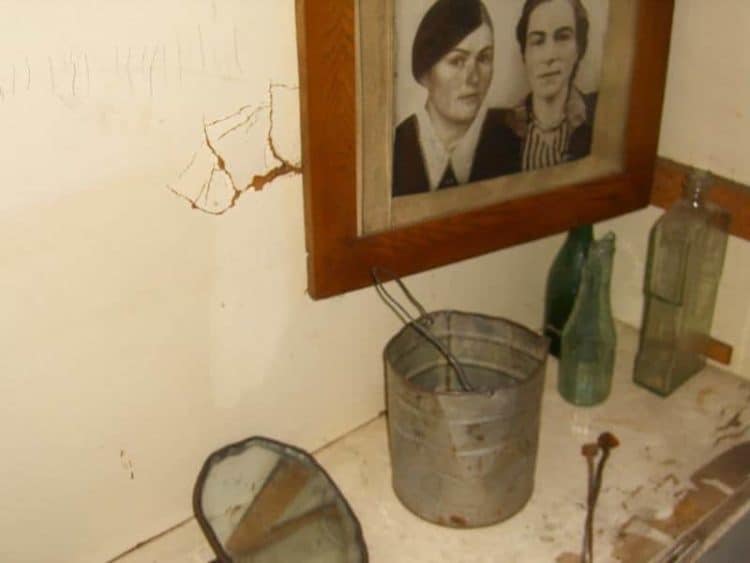
Most of Khalde’s homes were in surprisingly good condition, particularly for having been abandoned ten years ago. After dislodging the front door to one, we entered what was once Avgan’s mother’s home. Photos remained on the wall, furniture was still in place, but no one lived there. The whole thing was eerily and morbidly fascinating. Finding some dusty plates in the cupboard, Avgan suggested we take our remaining food for lunch, but no one was hungry. It was clear that Avgan was intent on leaving all that remained of our aging food stash to the spirits of the house and to his mother.
We followed the cows home to the village of Iprari and encountered a young woman on horseback – in command and on the search for a few of the herd that lost their way.
Later that evening, we find out that the woman on horseback was one of our host family’s six daughters. Peaceful and sophisticated, the father seemed to reflect a lifetime of experience surrounded by women. Three daughters were still on the farm while the others had moved away because of marriage, studies or work. This story seemed to encapsulate the nature of life in this village, where young people move away when they have the opportunity. The village population was 150 people about a decade ago; only a mere 20 remain today.
The girls seemed wary of us at first, serving us food efficiently without much engagement. Later in the meal, Dan thanked one of the girls in Svan, “ivas suhari.” A foreigner attempting to speak even the most meager bits of the local dialect opened things up. The daughters couldn’t contain their surprise…or their laughter. All barriers seemed to fall at once.
After lunch the next day, which included some of the best khajapuri(cheese-stuffed bread), matsoni (yogurt) and honey in all of Georgia, one of the girls brought out a small stringed instrument and sang traditional Svan folk songs for us. Her voice seemed to carry all of Svaneti’s emotions at once – strength, sadness, pride, and a glimmer of hope. We were mesmerized.
We decked ourselves out in rain gear for the remaining ten kilometers to Ushguli. Audrey protected her camera bag under her windbreaker, giving the impression of a large belly. Everyone started pointing and cheering when they saw her – the hint that maybe one day that bulge would be a baby instead of a camera proved exciting for our host family. It was hard to pull ourselves away from their warmth, but Ushguli was calling.
Ushguli: The Highest Village in Europe
Because of the wet weather, the only path open to us was the main road to Ushguli, famed as the highest inhabited village in Europe. This label is confirmed by every second person you meet here. “Do you know…?” “Yes, I know…Ushguli is the highest village…”
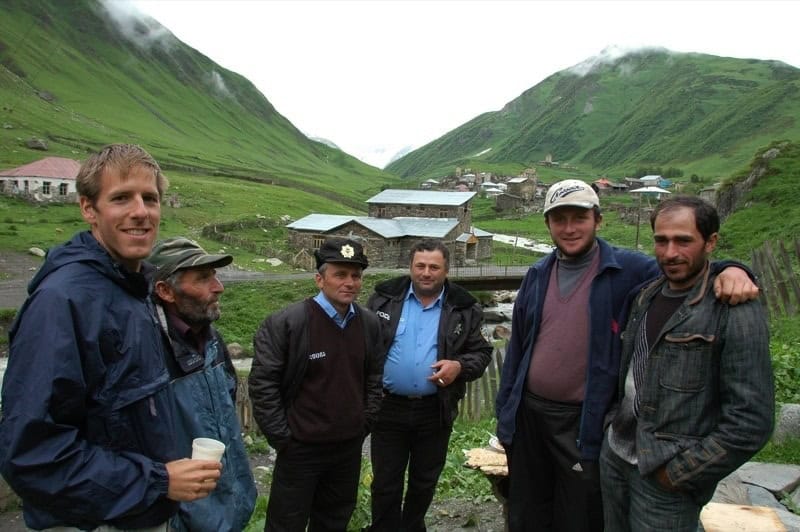
About halfway there, a Russian jeep pulled up and greeted Avgan. We piled into the back seat where we're introduced to representatives of Svaneti's remarkably friendly police force. Their jackets, most likely a gift from a foreign donor, were embroidered “Criminal Police.” With a rifle poking out from the front seat, our jeep gave us an odd feeling of safety.
Once in Ushguli, we were stopped three times by different groups inviting us for a snack in the 200-meter walk from our home stay to the Ushguli Museum. Not wanting to offend Ushguli's local police force, we accepted their invitation and shared beer and khachaapuri in the day’s drizzle while taking in the rich, rain-soaked mountain landscape around us – Svan towers, patches of glacier, green hills and plenty of cows.
Because of the rain and all the cows, Ushguli's paths were a mixture of mud and cow puddles. With little success, we tried to hop around from one rock to another. Audrey's reaction upon being engulfed in cow poop soup captured the moment, “I don't think I've ever seen so much cow shit in my life!” Our hiking boots will never be the same.
Later as we huddled in our hosts’ kitchen to share dinner with Avgan, an older woman shuffled in. Dressed entirely in black and lugging buckets of fresh milk, she seemed to carry the sadness of the world in her dark eyes. Avgan greeted her warmly. She was his cousin from Khalde, the abandoned village we’d visited the day before. They hadn't seen each other in over a year, so it was an emotional greeting. As Avgan described the condition Khalde was in, they both began to cry. As if to justify his actions to us, he explained that Svan men are allowed to cry. Not a surprise, given that sadness and nostalgia feature so prominently in Svan life.
Eventually, Avgan snapped out of his dark mood and resumed the role of tamada at our makeshift supra. The effects of the bad white wine hit us the next morning as our livers pickled around the edges. Avgan's knock at 8 AM – with a bottle of beer to cure our hangover ills – didn't help. We wondered how this 63-year old – appropriately nicknamed “the wolf” – could feel so good after so many successive evenings of drinking.
I made a promise to himself. Next trip to Svaneti, I'm a Mormon on antibiotics.
Home to Mestia
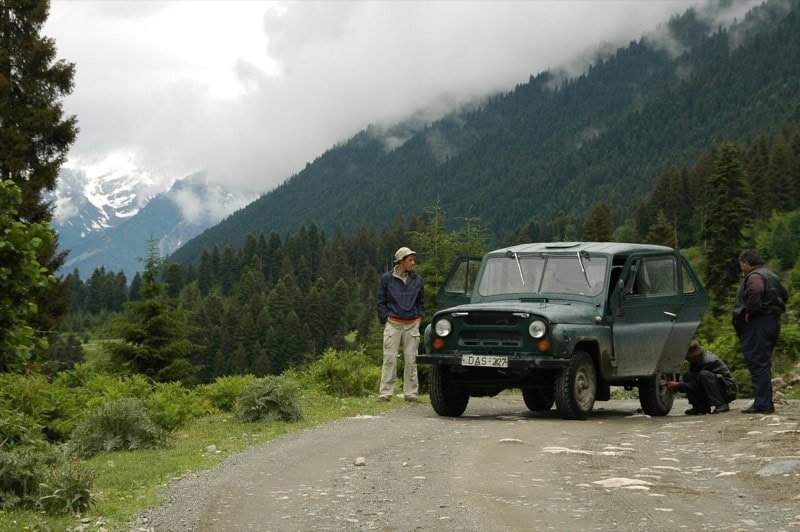
There is no public transport between Ushguli and Mestia, so we hired a jeep. As a result, we were the public transport that day and four additional opportunistic local guys jumped in with us. Invoking God's protection, they crossed themselves; we began to wonder what we’d gotten ourselves into. Fortunately, our driver knew the area well and we stuck to the “no looking down” rule as our jeep veered toward the cliffside. To describe the paths that jeeps take through Svaneti as “roads” is generous. Comic relief came in the form of large inebriated men singing (shouting?) Svan songs. Ringing ears aside, the ride to Mestia was relatively uneventful and included only one curious stop to tighten the wheels on the jeep.
Strangely enough, we ran into the same policemen on the street in Mestia. Again, all smiles as they asked us how our journey went. As we told others in Mestia about our trek and rattled off the names of the villages we’d visited, we received approving nods and invitations to go drink some more. We would graciously decline, but appreciated the warm invitation all the same. Apparently, we were beginning to be truly accepted in this unique place.
Photo Essay: Hiking Across Svaneti
Organizing a Trek in Svaneti
- How to get there: See the post Svaneti: How and Why To Go
- Where to stay: The Svaneti Mountaineering Tourism Center (SMTC) can arrange home stays in Mestia and the surrounding villages. Their website [used to] feature a listing of families. We stayed with Jora Kaldani in Adishi and Ucha Margvelani in Iprari. Home stays are clean. Toilet facilities tend to be simple, usually meaning an outhouse in the garden. Ucha's house in Iprari (Kala) has a hot water shower, a welcome luxury after an exhausting hike. The agreed cost for accommodation and three meals is 35 Lari/person. You pay the families directly.
- Where to eat: You will never go hungry, but if you are lactose intolerant or a vegetarian, eating to your needs may be a challenge. The food at the village home stays is all fresh from their farms, meaning cows and pigs. There is lots of cheese, khachapuri, matsoni, chunks of meat, kubdari (meat stuffed bread) and potatoes. Vegetables are in short supply, except at meals in Mestia. Read more about Georgian cuisine.
- Arranging a mountain guide: Unless you are an experienced mountaineer and can read old Soviet maps, we would recommend taking a mountain guide until SMTC is able to clearly mark all of the trails. Contact SMTC and they will find a guide for you. English speaking guides are also available. Cost: 50 Lari/day.
Ahhhh, I really enjoyed that story. Thanks for taking us along with you on this journey! Really amazing!
Brian,
We’ll keep ’em coming as fast as we can.
Svaneti is amazing…we hope stories like this motivate people to check it out. It’s a unique region in a beautiful country.
Dan
i am georgian and live in borjomi. thank you for tshis nice story:)
salaga: We’re glad you enjoyed this story. We really enjoyed Georgia and wrote 15 different stories about our experiences there:
https://uncorneredmarket.com/travel/georgia/
We also highlighted Borjomi as not only having the best water, but also some of the best bread (tonis puri):
https://uncorneredmarket.com/georgian-food/
@Cameron: Glad we could be of service.
I can’t tell you how thankful I am for your comment. These posts seem like so long ago (in the grand scheme, they are not). And your comment helps restore them rightfully to the fore, bringing back memories. And if you carve out a travel schedule, I can highly recommend the Republic of Georgia and the little-understood region to the north, Svaneti. “I NEED TO GO THERE” meter — I absolutely love that!
Ok, that’s it, Georgia has moved up like 15 clicks on my “I NEED TO GO THERE” meter. Of course I’ve been your blogs at work and find myself daydreaming about cheesy bread stuffs and flowing wine instead of working! Such is life…
Hello Audery and Daniel,
Thats was a very nice trip report (and a very long one!) Its strange how political situation changes people’s lives so much. I bet the villages are not that dependent on the central government, but this drawing of borders and setting up of barriers makes a big impact on their economy. It’s interesting to note that large number of words in Russian and Central Asian languages are similar or exactly the same as Indian languages (Sanskrit relation I guess).
Priyank.
@Priyank: When the political situation determines the jobs and subsidies, then a change can really turn everyone’s lives upside down. And it takes a long time for people to adjust and learn new skills that are relevant to the new situation. I really do hope that Svaneti finds a way to energize its economy so that young people don’t continue to leave it for bigger cities.
It is interesting that many words in Russian and Central Asian (Turkic) languages have some similarities with Indian languages. Perhaps these cultures were more connected in the past with migrations and trading patterns.
@Gordon: You lived in Ushguli for four months? I’d love to hear more about that experience. We found Georgia fascinating and Svaneti even more so. It’s always funny to hear that readers know people in these photos. I wonder how our guide Avgan and his family are doing.
Johndo! Haha that police officer with the open jacket and blue shirt is the Dad of the family in Ushguli I lived with for 4 months hehe. The other police are Gayla and Neri lol 😀 😀
Yes indeed I did! Just over this winter, from October to the end of January. I spent two months in Tbilisi, and just got home to Canada 1 month ago. It was a fabulous experience in Ushguli and really a great way to learn about the Svani culture. Ushguli is by far the most fascinating place I’ve ever been (out of a lot of places) and I wish I was still there 🙂 Add me on Facebook to check out my pictures or so I can tell you a bit more in detail about living in Ushguli over the winter
@Gordon: Ushguli (and Svaneti in general) is an unusual part of the world. Not one of those places that draws a lot of people. I’d be interested to know what brought you to choose to spend time in Georgia and Svaneti. At any rate, I’m glad to hear that your Svaneti experience was a fabulous one. Good people, the Svans and the Georgians. One of our favorite spots in the world.
Hello Dan and Audry,
Thanks for your posting with splendid experiences in Svaneti region.We (I and my husband) are planning to travel in Georgia this coming summer and make trekking for 5 days in Svaneti. While navigating here and there, I found your posting is the most useful and moving. Thanks again !!
I have some questions. we are in late fifties. So I’m afraid we could make the same treks as you did without any physical problem even though we were good trekkers while we were in 30s and 40s. We have just 5 days in Svaneti before leave for Batumi-Travzon-Erzurum to take a plane in 2 days.
If you give some advices, it will be highly appreciated. With my best, Kyunga
@Kyunga: The only route we know first-hand in Svaneti is the one that we took from Mestia to Ushguli, but I’m sure there are other treks in the area that would be less physically challenging. My suggestion would be to contact the Svaneti Mountaineering Tourism Center for advice on best routes. You could maybe do day treks from Mestia or do a shorter 2-night trek from around Mazeri. Good luck and sorry we can’t help with more details!
Thanks for your quick reply.
I have already sent an email to the SMTC 2 days ago but there’s been no answer. I will wait for it.
Thanks anyway.
I will go to read other articles about Georgia and Armenia in your blog… Kyunga
Hi
We are landing in Tbilisi on Saturday 9th April (we are 3 friends, 40 years old)
Our prefer plan is to trekking in Mestia area for a 3 days.
is it possible in that season? can you please advice?
if yes, can you please recommend about a local guide?
Hi Yaniv,
I believe that with the improved roads it’s possible to reach Mestia in April. As for how the conditions are this year for trekking right now, that I’m not sure as each winter is different. You’ll have to see how things are in the high mountains when you arrive.
The trekking organization that we used for our trek no longer is operating in Mestia, so probably the best thing is to go by the Tourist Information Office on Seti Square (main square) to ask about local guides or to ask at your hotel/guesthouse for a guide. Good luck and enjoy your trip!
Hi Audrey,
Thanks for sharing your experiences.
I am thinking of doing the same route that you took with a friend of mine in early-mid August this year. We were interested in camping. Do you have any tips re camping? Also, regarding a guide- is it almost certain we will be able to find someone if we enquire once we arrive? Also- is the language barrier a problem? We both only speak English. Lastly, I imagine it is safe to travel in Georgia for two 23 year old girls…please let me know though if you think there is any risk in this.
Thanks
Shira
Not sure how we missed this, Shira. Though camping in the Svaneti region would be challenging, it would be doable. However, some of the tourist infrastructure (organizations) that were operating in Svaneti when we were there no longer do. So I’m not sure we’d have been in a position to answer accurately. As for only speaking English, you could get around in Svaneti, but it would be challenging since the locals speak Svan and Russian. If you ended up going to Svaneti, and if you camped, we’d be curious to know about your experience.