Last Updated on April 22, 2024 by Audrey Scott
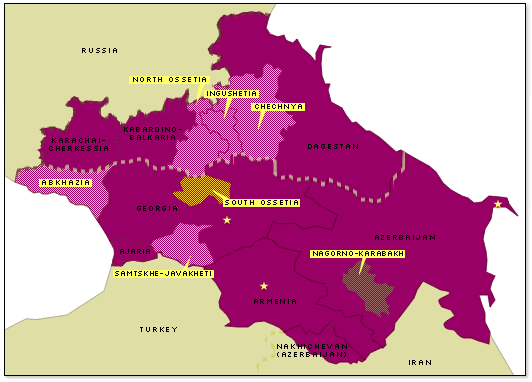
Before this journey, our experience with the disputed regions in the Caucasus – Abkhazia, South Ossetia, and Nagorno-Karabakh – amounted to a few news articles and flashpoint body-count news tickers drifting across the bottom of our television screens.
Something bad had happened, people had died, but we never truly appreciated or understood the details.
Laundry lists of personal concerns and modern media’s facile compartmentalization of just about everything made it easy for us to become desensitized and stow it all away. These were simply areas of conflict someplace far away.
Although we didn't venture into Abkhazia, South Ossetia, or Nagorno-Karabakh, we did meet some people displaced and affected by the disputes. For us, their personal tales conveyed a human face to areas that previously only amounted to just another set of flashpoints halfway around the globe.
Abkhazia
The only thing everyone seems to agree about Abkhazia is that it is a beautiful place – the Caucasus Mountains on its one side and the Black Sea on the other. After that, agreement yields to chaos; nothing is black and white about the war, who started it and how it might someday be resolved. The reality is that an estimated 200,000-300,000 refugees from Abkhazia are now spread throughout Georgia. We met just a few.
Abkhazian Refugees at Hotel Telavi
Our first encounter with Abkhazia occurred in the opposite corner of Georgia, in the Eastern region of Kakheti. In search of great views of Telavi and the surrounding countryside, we found ourselves climbing the crumbling steps of the Hotel Telavi, a once-desired address now inhabited by Abkhazian refugees driven from their homes more than ten years ago.
Common rooms on the ground floor are gutted and scattered with trash and rusted Brezhnev-era remains. Extended families are squeezed into old, decaying Soviet hotel rooms. Children have turned the grand ballroom into a velodrome and cycle the long hours of uncertain days away while their parents hang out of the windows, drawing smoke from cheap cigarettes as they watch time drift by. Uncertainty seems certain here; no one knows when or if he’ll ever be able to return home.
So Close, Yet So Far
We met Lena after enjoying an impromptu feast at the Zugdidi market. She was forced to flee her home in Sukhumi (regional capital of Abkhazia) 15 years ago and subsequently settled in nearby Zugdidi. Tears welled up in Lena's eyes as she drifted into the past and described her beautiful home and her former life. She eventually grew silent and her eyes dropped as she returned to the reality of the present. Her hope to one day return home was also waning. All we could do was nod empathetically.
Unexpected Caretaker
A friend in Tbilisi told us about how she used to spend summers as a child at her grandfather’s house in Sukhumi. After the war, borders were closed and her family could obviously no longer take advantage of the summer home.
When phone lines were reconnected a few years ago, our friend dialed the phone number of her old summer home out of curiosity. A man answered the phone and explained that he was a Chechen and now living in the house. He wanted to know whether there was a car that went with the house. He’d found some car parts in the garage and wanted to take full advantage of all the house had to offer.
To reassure our friend, he said: “Don't worry. I'm taking good care of the house. If politics change, it will be in good condition for when you return. It's a nice house.”
Nagorno-Karabakh
In Azerbaijan, it would be an understatement to say that feelings run strong regarding Armenia and Nagorno-Karabakh. The continual pain and anger from this conflict finds expression in so many – often bizarre – ways, from the moment you enter the country until the moment you leave.
Offending Guidebooks – Rip Out the Maps!
One of the teams from the Mongol Rally that we met in Uzbekistan shared an apt tale of the Azerbaijani attitude towards this disputed territory. The drivers carried a Lonely Planet Caucasus guidebook with them. The Lonely Planet's characterization of Nagorno-Karabakh as distinctly separate from Azerbaijan apparently did not fit with the Azerbaijani government’s view. As they entered Azerbaijan from the border with Georgia, the Azerbaijani guards confiscated the book, citing the offending map and characterization of Nagorno-Karabakh as an entity separate from Azerbaijan. After considerable discussion, the guards showed their generosity by allowing the Mongol Rally team to continue their journey into Azerbaijan.
We also had our guidebook and map examined by several Azerbaijanis in Baku, Shaki and Lahic. Each paid special attention to how Nagorno-Karabakh was depicted. Fortunately for us, our Trailblazer guidebook and its especially pro-Azerbaijani view (it was, after all, primarily a guidebook for Azerbaijan) and the Avis map (given to us by the Azerbaijani embassy in Tbilisi) both passed the test. We were kindly allowed to keep our materials and were not forced to travel blindly.
Offending Photos – Hide Them!
Just when we thought we were in the clear as we departed Azerbaijan, one of the border guards pulled us aside. The Armenian visas in our passports drew his ire. Our exit from Azerbaijan included 45 minutes of questioning regarding our activities in Armenia. We assured him that we hadn't visited Nagorno-Karabakh. He insisted that we show our photos on our laptops to prove we were never there. Impeccable logic, eh? Given his tone, we worried that he would force us to delete all photos from Armenia as punishment for visiting the offending country. Luckily, we received a brief lecture instead about Armenian-Azerbaijani relations and were allowed to board the ferry to Turkmenistan.
Although our engagement with these disputed regions was relatively superficial, our encounters with refugees and others affected lend gravity to the conflict and humanity to those involved. This also demonstrates another reason why we choose to travel the way we do. When a place has a face, desensitization begins to wear off. Human connections make these places more difficult to dismiss as “some war, some place, and some people halfway around the world.”
I read your story with great interest and it touched me a lot. Thank you for letting other people know about the situation in those countries through people’s eyes who live there and through your own experience.
Sirje, thanks for your meaningful comment. Learning through talking with people and through personal experiences is the best way for us to understand a situation and a place. We hope others may learn from our experiences as well.
This conflict is really big pain in Azerbaijani history. You just have to understand such attitude,attention to Your maps. How would You feel yourselves if Your land had been occupied for many years,the blood of Your ansectors was spilled,and after this You would be told that hey,you,it’s not your land,it’s ours! If people in Your villages were violently killed without any warning,in the night by Your enemies?
@Cheryl: I appreciate that because of who am I, where I’ve lived and what I’ve experienced, I can probably never truly understand the pain connected to the conflicts between Azerbaijan and Armenia. Having both Azerbaijani and Armenian friends, all I can say is how sad and unfortunate it (and any conflict, really) is.
Hello Daniel and Audery,
Wonderful narration again. The only place I’ve been to is Sochi in Russian Caucasus. I fail to understand the rationale of security personnel investigating our passports and belongings – be it in Tibet under China or sensitivity of the Nagorno-Karabagh zone or an Israeli visa in your passport. What is removing the maps or confiscating the books going to achieve? These publications are not a political statements by foreign government afterall. Anyway, such conflicts are sad indeed.
Priyank.
@Priyank: What’s really a shame is that many of these borders were drawn arbitrarily for political purposes and families were split on either side of the border. Yes, these conflicts are indeed sad and go from generation to generation. Not quite sure how to stop the cycle.
Being from that region, all I can say is that this behavior by Azerbaijanis doesn’t surprise me. It was a crazy world living there. I am glad they didn’t hurt you!
Hi Lina. We personally never personally felt threatened, but did find the attention to maps a little overdone. If I understand the history of this region (and other frozen conflict and disputed regions in the former Soviet Union), a lot of it goes back to borders drawn deliberately by Stalin to cause trouble between various ethnic groups. Really unfortunate for everyone involved.
We’re traveling to the Armenia, Georgia, Azerbaijan this summer. Do you have any advice on Americans traveling to Abkhazia? Would you advise against it?
We didn’t try to visit Abkhazia so don’t have any first-hand experience. I’ve read reports from other travelers who traveled from Georgia into Abkhazia and back to Georgia again without any issues. You might want to post a question on a travel forum like Lonely Planet Thorntree to get a response from travelers who have been recently. And, be sure to check whether travel insurance covers the area as sometimes places that appear on government travel warning lists aren’t covered. Good luck and hope it works out!
Abkhazia and so called South Ossetia are parts of Georgia.