Last Updated on April 26, 2024 by Audrey Scott
You know you are in trouble when the only people in the place who smile at you are the missionaries.
A trip to the post office in each country we visit is pretty standard for us. We dread it because of the time it usually eats up, but we always find ourselves making the journey in order to mail backup DVDs of our photos or an occasional postcard. From a cultural anthropological point of view, however, a trip to the post office affords us another slice of real life and provides a window into how a country actually works (or doesn’t).
Shakedown at the Kiddie Painting
Almaty, Kazakhstan was no different. We stood in a line of three people at the main post office and awaited our turn as a possessed animatronic postal worker repeatedly stamped letters drawn from a stack about two feet tall. As she ignored the growing line of people in front of her, customers lingered for services and formed the typical Central Asian cloudlike queue, cutting in line while pretending to form new friendships with other postal workers behind the desk. Like an episode right out of the film Brazil, the scene reeked of inefficiency and inhumanity and the air was thick with bureaucracy.
I decided to take a break from the queue and strolled around to admire the postal aesthetic. Whether they are dim and dark or brightly adorned with Soviet Realist mosaics, post offices in the former Soviet Union are always worth a look.
On my mini-tour, I happened upon a lighthearted exhibition of elementary school artwork posted on a wall. The theme appeared to be “draw a picture of what the post office means to you.” Sunny images of postmen walking with their mailbags were hung aside remarkable sketches of postal clerks. The drawings were well done and looked likely to end up on a series of stamps someday.
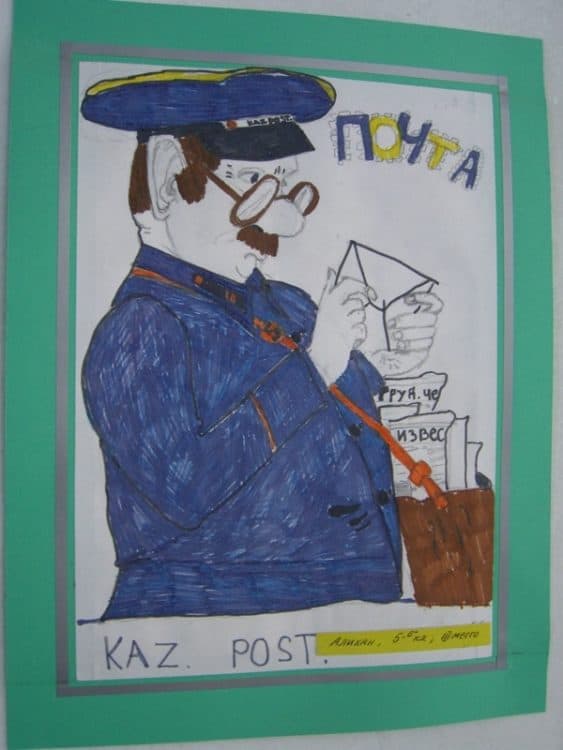
I thought, “What a pleasant image, colorful and human. I think I’d like to get a photo of this to use in one of our stories.” He pulled out his pocket camera, sized up his drawing of choice and snapped a photo. The light was not ideal, so he made some adjustments and snapped another.
Not five seconds later, two men dressed in drab mono-color security wear approached him.
(Note: The conversation below originally took place in broken Russian.)
Security: “Who are you?”
Me: “A tourist.”
Security: “Why are you here?”
Me: “I’m a tourist.”
Security: “What organization do you work for?”
Me: “I’m a tourist.”
Security: “Are you a journalist?”
Me: “No, I’m a tourist.”
Security: “Where are you from?”
Me: “America.”
Security: “Why are you taking this photo?”
Me: “I think this [drawing] is nice. It’s beautiful.”
Security: “Are you a journalist?”
Me: “No, I’m a tourist.”
Security: “Well, you know we don’t take photos here…in our country, in Kazakhstan.”
After a few grumbles, neck rolls and shoulder circles, the men brushed their sleeves and left me in front of the drawing, stunned and shaken from the experience.
Who knew that taking a photo of a drawing from a 5th grader was considered a breach of high security? What a welcome.
We’ve taken photos in plenty of places where we were not supposed to, usually without being aware of it. In most cases, an official approaches us or gives us a wave or sign indicating that photos are not allowed, and does so without making us feel like we’ve broken the country’s most sacred laws.
This particular episode at the Almaty post office not only verged on the absurd, but the security guards' approach was as close to a shakedown as we’ve received on our journey thus far. No smiles, all bile.
They succeeded on one front. No, they didn’t make me delete the photo, nor did they confiscate his camera. Worse, they snatched from him the simple joy that he sought in appreciating an innocent drawing of a postal worker. If, in the furthest reaches of their suspicious view of the world, he was doing something questionable, there were better ways of communicating it.
This was unbridled paranoia at its best.
However, on a more important front, the goons’ approach backfired. When I first took the photo, he wasn’t acting as a journalist. However, the confrontation turned the experience into a journalistic opportunity of sorts, which is what the security guards were afraid of in the first place. If only they hadn’t fingered me as a potential journalist, the photo would float amongst the many in our Kazakh photo sets. Instead, you’re now reading the result of the Law of Unintended Consequences.
Almaty’s Many Faces

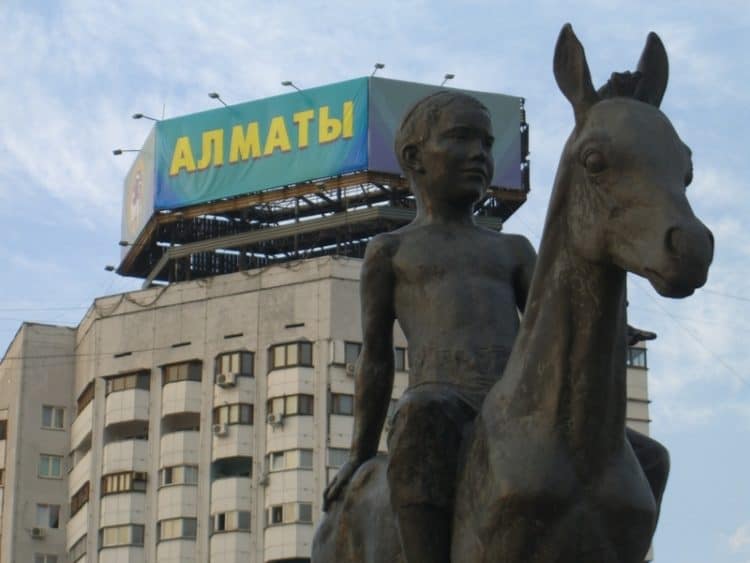
Almaty, Kazakhstan’s now unofficial capital (the official capital has been moved to Astana), appears to be trying very hard to become cosmopolitan. Shiny buildings are going up at a clip, international boutiques are consuming ever more street space, and spiffy malls are drawing looks and crowds. The SUV and luxury car per capita ratio is probably higher than that of most major cities and swish restaurants serving international cuisine seem to well outnumber traditional food stands downtown. Along the path to modernity, Almaty fails to hide the fact that it takes itself a bit too seriously.
Though polished and boutiquish, Almaty’s lingering air of suspicion seems to stem from both its Soviet past and its Nazarbayev (the current President) family-controlled present. Kazakhstan expends a great deal of effort in evincing its modern business sleekness and it succeeds with many of its foreign business and tour agency visitors. However, when you travel independently like us and don’t have companies or tour agencies taking care things for you, a suspicious side seems to emerge.
“Well, you know we don’t take photos here…in our country, in Kazakhstan.â€
Someday you will be hailed as a hero for having taken the only photos in existence of life in late-2007 Kazakhstan.
Hello Dan and Audrey! Your site is fabulous. I love that I can keep up with where you are in the world through beautiful pictures and amazing stories. Although, I must confess, I am pretty jealous. If only my life were as interesting! I just got back from Madrid though, which was great. I was there for the OSCE Ministerial, where Kazakhnstan was a big focus of discussion. Let me know if you will be in the U.S. any time soon. Otherwise, maybe I can meet up with you somewhere in the world!
Ciao,
Susan Corke
Nicole: More proof that some people will say anything, no matter how absurd, to support their case. The whole scene was bizarre (but frightening nonetheless) and in stark contrast to the cheery, pastel Kazkakhstan tourism bureau ads that run on CNN in the surrounding Central Asian countries. At any rate, I was glad to send my postcard and keep my camera.
Dan’s time reminds me of when Scott Slankard and I were in an Estonian department store taking photos of products for a marketing seminar that we had to deliver the following week. Armed security guards caught Scott and took him to a back room. I was able to sneak out. Scott of course told a tall tale of his awful detention and how I deserted him.
Susan, a business trip to Madrid – doesn’t sound like you’re living a bad life either! Keep us updated on your travel plans, especially if they are in the direction of Asia or Africa in the next six months. It would be really fun to meet up…and continue our wine bar practice from Prague days.
Given what we saw and heard when we were in Kazakhstan, I’m a bit surprised Kazakhstan will take presidency of the OSCE in 2010. But, maybe the responsibility and attention help change things in the country…
Steven, I’m trying to imagine a scary Estonian security guard. Another fun story.
When we noticed a cool mosaic at the post office in Bishkek, we asked permission to photograph it from the postal workers. They all thought we were crazy, implying “why wouldn’t it be allowed?”
Hi! I stumbled upon your website. I’ve lived in KZ for the past eight years, and your experience at the post office is just daily par for the course for those of us who live there all the time. People in KZ like to have their little circles of power, and like to remind anyone who enters into that circle that they are in charge, and you are not. It’s true in government facilities or in the bazaar.
And I think that you used the right word about so much of life in KZ, that you are often treated as if you are “inhuman” – like you don’t matter a hill of beans. And if you are not a foreigner, it’s even worse.
The irony is, if you break down that wall, people will treat you like a king – foreigner or not!
It’s either hot or cold, and it’s not easy to do deal with, even after eight years.
Nate: Thanks so much for commenting. When I experienced this, I wondered for a moment whether it was a figment of my imagination. But I actually took notes.
I’m surprised to hear that it’s equally difficult in the bazaar. On second thought, I’m not. There was a shopkeeper in the main bazaar who also told us that us that we were not allowed to take photos!! We were taking photos of his neighbor (competition) and he became offended. In retaliation, he pointed to a sign that indicated that photo-takers could be fined. Fortunately, an Uzbek vendor interceded, set us straight and said “go ahead.”
I spent four months in Almaty in 2005, and I loved every minute of it. But, I saw that constant paranoia on the part of the locals all the time. Just walking around in the mall caused the eyes of security guards to be on you at all times (being American we didn’t look Kazakh). But after a while we got used to it and we didn’t care anymore.
I took a picture of a building once while out for a walk, and a man ran up to me speaking very sternly in Russian and pointing at my camera. I just shrugged my shoulders and said I didn’t understand, and he eventually went back into the building. We took lots of pictures anyway, probably over 1,000 pics during those four months, but learned to be discreet while doing so.
Jack
@Jack: We were accustomed to paranoia throughout Central Asia, but this took the absurdity to a new level.
When we were later in Dushanbe, there was a CIS/former Soviet state conference taking place. While taking a photo on the streets, we were given a similarly stern warning. In those circumstances, I appreciate it a bit more. In this case, we were asking for it. The streets were crawling with uniformed and plain clothes police.
Most Kazakh Government Officials are very territorial,and a tad greedy.Don’t take it the wrong way,its been like this for several years.Most Kazakhs are nice,just stay away from Mall and Street securities,building securities are good tho(most of the time).
Thanks for your opinion and perspective, Kaskyr. Appreciate you sharing your experience and tips!