Last Updated on April 22, 2024 by Audrey Scott
When we talk to people about our travels in China, we sense their fear.
No, not political or economic fear:
Didn’t you have trouble with the language? How about the food? Chinese food in China is terrible, isn’t it? Don’t they eat a lot of dog?”
All fair questions and sentiments, particularly if you've never been to China. We have a real story to tell about food in China. Armed with frighteningly limited Mandarin language skills and a sincere disinterest in dining on dog or innards, we managed to eat like kings on a pauper’s pence during the three months we traveled across China.
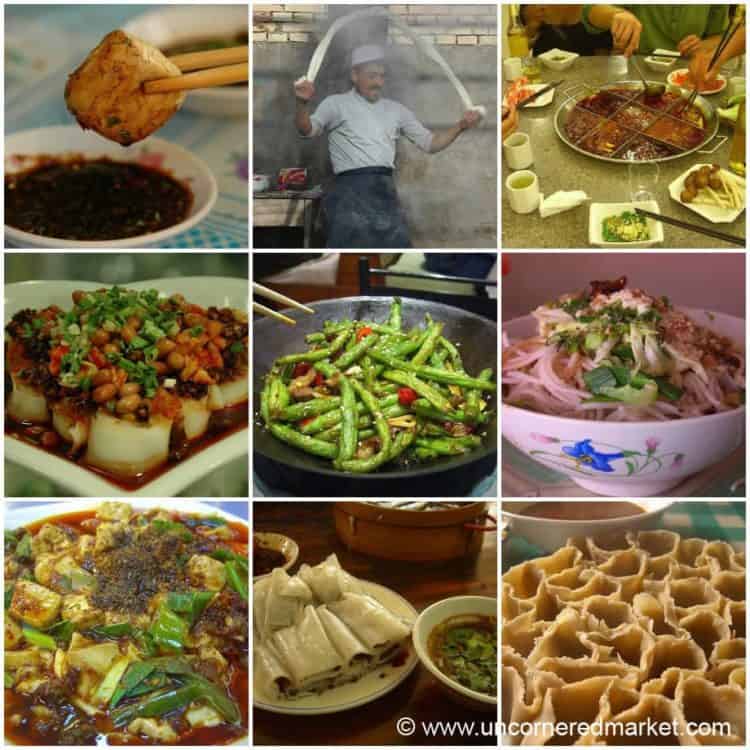
So how did we eat – on the street and in inexpensive local restaurants – so well without knowing the language? A few tips:
- Picture Menus: They are cliche in the West, but a godsend in China. Same goes for restaurants with food photos plastered everywhere. Take your waiter and point to what you want.
- Keep Your Dictionary Handy: Translating a dish from the menu into English with most pocket dictionaries is an exercise in the absurd. Instead, we kept our dictionary dog-eared to the page with “We are vegetarians.” Eating meat is a sign of wealth in China, so our request for vegetarian food often struck people as odd. However, aiming to please, folks complied; we almost always ended up with something new…and something tasty.
- Go Into the Kitchen: Walk into the kitchen and point to the ingredients you want. This may sound strange and intrusive, but it works in China. It will also earn you a few laughs from wait staff and cooks along the way.
Food in China Series
In our five-part series, we aim to give you a taste of what people in China eat with the 45 billion disposable chopsticks they consume each year.
Note that when entered China from Central Asia, we adopted a defensive eating philosophy in the form of the mantra, “Mystery vegetables are better than mystery meat.” So, vegetarians rejoice: you’ll notice vegetarian dishes highlighted throughout the series. Meatatarians, don’t fret. Pork, beef, chicken and fish all make appearances across the following segments of our Chinese food series:
- Xinjiang Cuisine – rather un-Chinese food of the Uighur people in Western China
- Hot Pot Fever – the beauty of boiling cauldrons of fiery broth
- Dumplings – could man live on dumplings alone?
- Sichuan Cuisine – there's a good reason it's known the world over
- Chinese Grab-Bag – a catch-all for Beijing bites, tofu and other dishes from throughout China
If your interested in photos of Chinese food go straight to the Around China on a Plate Photo Set.
The photos of the food make my mouth water. I have ever been a fan of Chinese food but your photos make me think Chinese food in the States is very different!
Diane: You’re right – the food we ate in China was really so much more varied than what you find in restaurants in the States. We also didn’t find a lot of heavy, gooey sauces with tired vegetables. The stir fry dishes in China were fresh, lightly cooked with flavorful and spicy, but not heavy, seasoning. Our pictures make me hungry too!
That all looks delicious, I look forward to more in the series.
Did you ever try food from street vendors or did you stick to restaurants?
Austin: Good question.
We are big street food fans. To the extent that street food is available, we try it. In China, our dining ratio was probably 40/60 street food to restaurants (i.e., a place with a roof). That we ate in restaurants a bit more often than on the street during our first go-round in China (late fall-early winter) was primarily a function of the season/weather.
The street food scenes in Urumqi (Xinjiang Province), Beijing and Xi’an expand with the warm weather. However, we found Beijing’s Wangfujing and Donghuamen markets and Xian’s Muslim Quarter street food scenes to be somewhat contrived and clinical. I suspect that the Chinese authorities are trying to pull off what Singapore has done with its street food hawker centers. In the process, the Chinese authorities seem to have sacrificed a bit of authenticity and diversity for the sake of “cleaning up†street food. Regardless, we still found some great street food snacks on the back streets of both cities.
The most diverse, full-blown street food scene we experienced belonged to Kashgar’s night market (Xinjiang Province).
The “restaurants†that we tended to visit were informal, small, family-run hole-in-the-wall establishments where the kitchen is the dining room and the whole thing spills out onto the sidewalk and into a street market. We did eat in some larger, more sophisticated places, especially in Beijing, but we generally prefer eating in local low-key restaurants when we travel.
Unless you’re willing to splurge or take the risk of eating the dodgiest worst smelling shit you’ve ever looked at in your life, most Chinese food in China is fucking rancid pig shit.
@Jimbo: Wow, that’s an extraordinarily strong opinion with which we obviously wholeheartedly disagree. I’d love to see some more information regarding where and when you had your experiences so we might have a more data- and detail-filled discussion about the subject.
Well, I have just come from a one month long trip to China. Even though I got bored with the food, it was in no way at all bad. Most of it was really excellent and well prepared. It was a bit tiresome because somehow, along the way, it all tasted a bit the same to me but that is my personal opinion and besides, I have never been such a big fan of Chinese food. Still, I never sat in front of something smelling bad and I must say I have never tasted ¨rancid pig shit” so, I wouldn`t be able to compare. So, Jimbo, I wonder where you went.
@Mariflor: Thanks for your comment. One of the objectives of this series is to decode what Chinese food is, or at least what Chinese food can be (in contrast to the slop you might get in most Chinese restaurants outside of China).
I’m sorry to hear that food in China grew tiresome for you after a while. For us, trying to find interesting Chinese cuisine was a priority. It just so happened that when we went looking for food, we usually found other interesting experiences and people.
I suspect that our food experience in China was especially good because of the different geographies and cultures that we visited (Uighur cuisine in Xinjiang, Tibetan cuisine in Xiahe, and the various specialties of places like Pingyao, Chengdu and Xishuanbanna). So when we found ourselves in a place like Shanghai, we knew we probably couldn’t go wrong, for example, in a hole-in-the-wall restaurant labeled “Xinjiang cuisine” where a Muslim guy was hand-throwing noodles.
As far as I know, well I have Chinese blood running in me, in China what they can cook and soft enough to be chewed will be considered foods no matter how “not normal” and “outrageous” the foods are such as monkey’s brain, dogs or so. But well even though now things have started to change but careful though in smaller village or suburb area.
leave alone those weird foods, actually Chinese foods are fabulous I think, dumplings, noodles, and many more especially the spiciness and variations of preparing foods, they are great!
I must admit you are very brave.
For me the initial fear of miscommunication in China has triggered a six years (and counting) process of trying to master Mandarin – A language I fell in love with.
By the way, now there are apps that might save you the walk into the kitchen and help you find what you are looking for.
@RanE: Not so brave. Chinese food in China was fun. Equipped with Mandarin language skills, especially fun.
I’m sure the apps are great (thank you for the link and recommendation), but I have to admit it made for great story walking around China searching for Chinese food, without much in the way of Chinese language skills.
Next time!
What I like about Chinese food menus is that they have pictures of almost everything in the menu, so all you have to do is point at what you want and the waiter would understand that it’s the food you want to get. Another thing to always have handy is a dictionary because it is going to be so much easier to communicate with the wait staff when you can at least speak a little of their language. While I haven’t had Chinese food in a good long while, just the thought of it is enough to make me hungry so I might get me some take-out in a bit.
Exactly, Adrian — look for menus with photos, carry a dictionary to be able to communicate by pointing to words. I’ll also add: look at what other people are eating, and pay a visit to the kitchen if you can!