Last Updated on October 29, 2017 by Audrey Scott
We begin our Chinese food series in the same place we entered China: in the city of Kashgar in China's western frontier province of Xinjiang. Like the native Uighur people and their culture, food in Xinjiang province resembles Central Asian and Turkic cuisine more than stereotypical Chinese food.

Thankfully, however, Xinjiang’s food scene did not feature a culinary repeat of Central Asia. Instead, the food of the Uighurs proved a diverse and tasty introduction to the broader Chinese table.
Top 10 Xinjiang Food Highlights
1. Laghman (lamian in Chinese)
Noodle wallahs artistically work dough balls of high-quality wheat flour and water into continuously thinner ropes until something like spaghetti emerges. It's almost as much fun to watch their preparation as it is to eat.

2. Suoman gush siz
A pile of laghman noodles smothered in peppers, tomatoes, onions, garlic, green beans and spices. A dependable vegetarian Xinjiang dish. For meat-eaters, it's often served with mutton (called simply suoman). Make sure you pile on the roasted red pepper paste – more roasted than fiery – that you'll find on most tables in Xinjiang province. Kashgar’s Intizar Restaurant (see below) served some of the best.

3. Nokot
A light chickpea-based salad served with shredded carrots, a tangy vinegar dressing and topped with piles of fresh herbs. A highlight of the Kashgar night market.

4. Serik ash
Bright yellow, handmade noodles rolled into rounds and cut into wide strips for cold noodle soups and noodle salads. You'll often find them served with a combination of tangy vinegar and chili sauces and – of course – beautiful fresh herbs.

5. Green and herb dumplings
Chopped greens, herbs and a touch of mutton tucked into a dough ball which is cooked on a flat skillet. Slightly crunchy on the top and bottom, soft everywhere else. A big hit at the night market – queue with the locals for a seat at this popular stand.

6. Kawa manta (manti)
Pumpkin-stuffed Turkish style steamed dumplings. Great with thick plain yogurt and roasted red pepper sauce. Intizar Restaurant cranks them out all day long. Unfortunately, the staff could not understand why we requested a portion without meat, so they kept sneaking in chunks of mutton fat — even after Audrey's dramatic “no meat” dance (shaking her head and waving her arms in the form of an “X” above the piles of meat).

7. Girde nan (a.k.a the Uighur bagel)
The first time we witnessed girde nan being plucked from the inside of a large ceramic oven (think Indian tandoor), we wondered, “Bagels! In China?!” Not quite a New York bagel (or bialy), but full of flavor. Served hot and fresh with a perfect crunchy bottom crust. You can find them across Kashgar’s old town.

8. Nan:
Large, round flat breads cooked in ceramic ovens (similar Indian tandoors). Just like in Central Asia.

9. Pomegranate juice
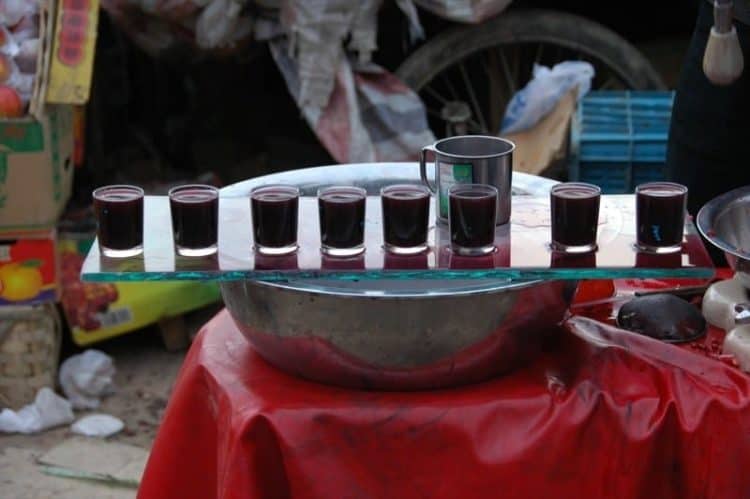
Stands selling fresh, delicious, cleansing pomegranate juice line the edge of Kashgar’s night market. Vendors sell shot-sized glasses for 1-2Y ($0.15-$0.30). Avoid the rip-off artists by the Sunday market who sell for three times the going rate.
10. Mantang:
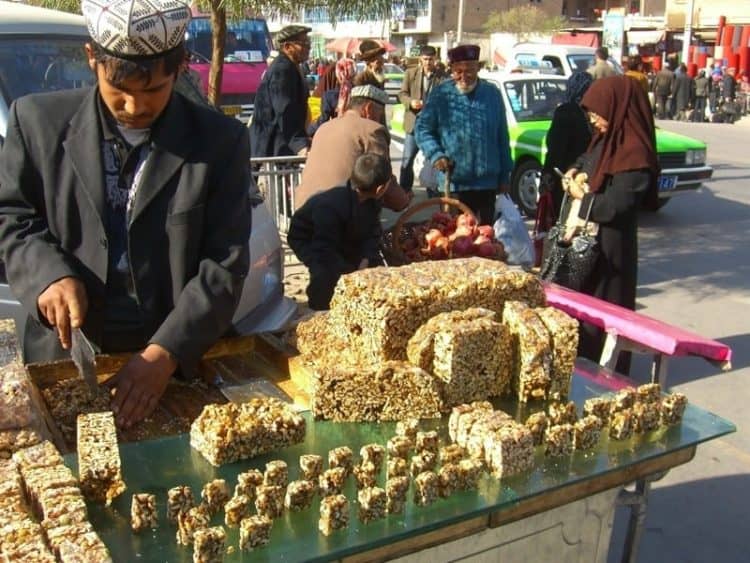
Pressed nougat featuring combinations of fresh honey, nuts (walnuts, almonds, peanuts, pistachios) and raisins. The equivalent of a natural power bar. Walnut and almond varieties were our favorites.
Other Typical Uighur Dishes
Opke:
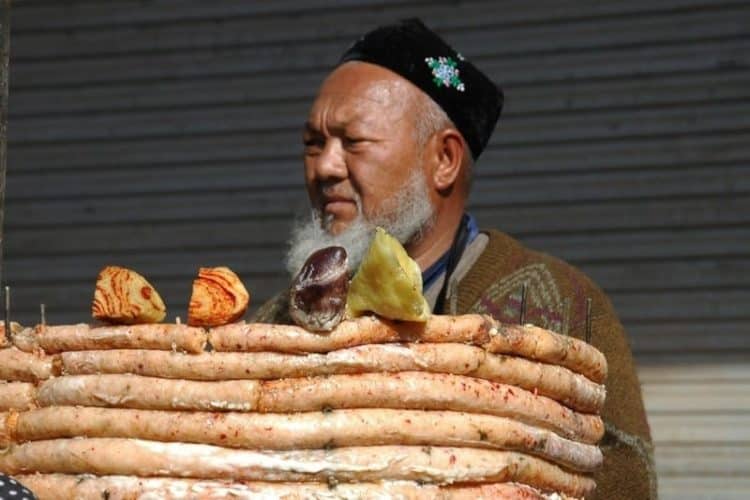
A clear soup swirling with goat head fragments and other fascinating bits. Correction (thanks, Elise!): Incorrectly named in the Lonely Planet, opke hessip is a dish of lung and intestinal sausage. Opke stands at the Kashgar night market Sunday Market are popular with the locals.
Goat Head Soup:
After our goat dining experience in Kyrgyzstan, we gave it a pass.

Hoshang dumplings
Looks a lot like its Central Asian cousin, the somsa. Although somsas look and smell delicious, the quality of meat used varies widely – from lean certainty to fat-laden mystery.

Polo (or plov, pilaf)
Rice simmered with spices and meat, and optionally carrots, chick peas and raisins. Look for the characteristically large polo pans. A favorite dish in Kashgar, but we got our fill of this while in Central Asia and focused on finding dishes in Xinjiang that were new to us.
Kebabs (chuanr or chuan’r):
You’ll find men fanning kebab skewers outside virtually every Uighur restaurant, filling the streets with mutton and lamb-laden curls of smoke.

Photo Essay: Xinjiang Cuisine
Eating Local in Kashgar
The Kashgar night market serves as an ideal starting point for Xinjiang cuisine and adventurous dining opportunities with the local Uighurs. The market is located behind the main square (near the mosque and large LED screen). Also check out Intizar Restaurant on the corner of Renmin Xilu and Yintizaer streets.
As you travel throughout China, keep an eye out for signs adorned with an image of a mosque and Arabic-looking script – sure indications that you have found a Xinjiang-style restaurant serving Uighur cuisine. They usually offer hearty, spicy and inexpensive fare – and a change of pace from ubiquitous Chinese soups and stir-frys.
Video: Kashgar's Night Food Market
Bearded men, women in headscarves, pulled laghman noodles, pressed pomegranates, a boy who prepares his own vinegar sauce, and two Hoshang dumpling makers doing a dance around a traditional ceramic oven. This is China's Kashgar night market.
Given the amount of attention we've paid to Kashgar and China's Xinjiang Province, you might think us obsessed, or suspect that we're being paid by the Kashgar Tourism Board. You can decide about the former, but we can firmly deny the latter.
But this is our last word on the place, at least for a while. Enjoy the video.
Elise, thanks for the correction! Since we didn’t find anyone who spoke English while in Kashgar, we matched food names to our photos and what we ate using our scribbled notes, the Lonely Planet, and other internet resources. Unfortunately Lonely Planet’s opke description has been used by many.
Is there a local name for goat head soup like in this photo? (Warning to vegetarians) Is opke the dish in this photo?
Any other Xinjiang specialties you can share?
I’m assuming you found your information about opke (opke-hesip) containing goat heads from Lonely Planet. I’ve seen it there myself. I want to point out, however, that this is actually incorrect. Opke-hesip is a dish of lung and intestinal sausage. ‘Opke,’ which means ‘lung’ in Uyghur, refers to lungs that have been filled with dough and baked. I believe the lungs are what are popularly but improperly perceived as goat heads (thanks to Lonely Planet).
This gourmet guide was brilliant! The pictures are great, i wish i could join you guys for this delicious sampling! Hmm not so much for the mutton fat chunks, loved the vegetarian dishes though…they transpire flavour and oriental aromas…I’m trying to convince my husband to follow on your trip footsteps, must be one of the greatest experiences in life! Keep walking…lovin’ your travel tales!!!
Raluca: So glad you enjoyed the Xinjiang food guide! Yes, the vegetarian dishes in Xinjiang were most satisfying (and the least amount of work).
Thanks so much for your kind words about our journey. Let me know if we can do anything to help convince your husband to start your journey : )
sorry to disturb.. i really like eat “mantang”. so lovely and sweet. do you have any information regarding this “mantang”. what i mean is the recipe. if u have, would u like to share 😀
@Mahmud: I wish I had a mantang recipe to give you. Unfortunately, I don’t. However, if you search for mantang recipe, something is bound to come up. If not, I imagine mantang takes nuts, honey, and the ingredients to make nougat (not quite sure what those are). Happy searching, happy eating.
Found your thorough run-down of Xinjiang cuisine after trying to figure out what this delicious cake is called – sold by Xinjiang guys near Beijing’s train station! It’s the perfect travel food.
Happy new year to you…
@Elizabeth: Small world! Glad this helped clear up the mystery of the delicious cake! Hope all is going well in Beijing! Thanks for saying hello!
Vey well written and presented article . A great introduction to people who have not yet tried uighur food. I had the opportunity to try it in Paris.
Thank you, Izzy. Uighur food is not particularly well known, so we felt we needed to do it some service.
Glad you had a chance to try it.
Hello,
I am trying to locate recipes for the following Uyghur food;
• Chu’Chura (or Chochura) – Tiny Dumplings in Lamb Soup
• Tawa Kebab (or Taba Kewap) – Stewed Lamb Ribs served with Nahn Bread
Can anyone help please?
Thanks
Sasha, unfortunately we don’t have any of those recipes on hand. However, hopefully someone in our community sees this post and might be able to help. Good luck!