Last Updated on April 26, 2024 by Audrey Scott
A checklist: four days, three ethnic village markets, stacks of smoked dogs, and one testicle stand. Guizhou Province exuded tradition; it was China at its most authentic and at times its most eye-popping.
We paid a visit to the province, described in guidebooks as one of China's most underdeveloped, to experience a group of ethnic village markets clustered around the town of Kaili. Although the timing of our visit did not coincide with any ethnic festivals (the standard draw for the relatively few tourists that visit the region), there was no shortage of everyday market pageantry and visual stimulation.
As China carves out its future, life across four villages in eastern Guizhou Province goes on.
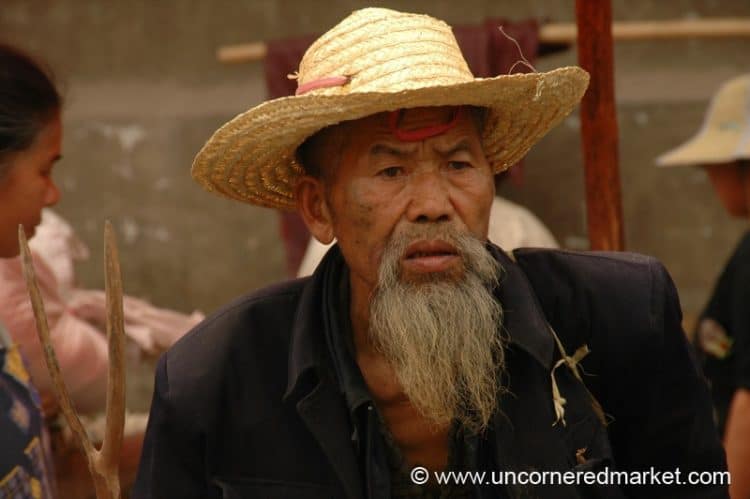
Chong’an: Get Your Dentures on the Street, See “The Beautiful Buildings”
The weekly market in Chong’an enveloped the entire village: fishermen assembled by the river, meat vendors (including the dog butchers) congregated in the center, ethnic hat and clothing makers gathered in small courtyards, and traditional medicine men, dentists and barbers lined the streets connecting it all.
A weekly gathering for Gejia and Miao villagers, the Chong’an market left no sales opportunity unturned. Hot body suction treatment and gut-wrenching open-air tooth replacement proved tempting, but we resisted.
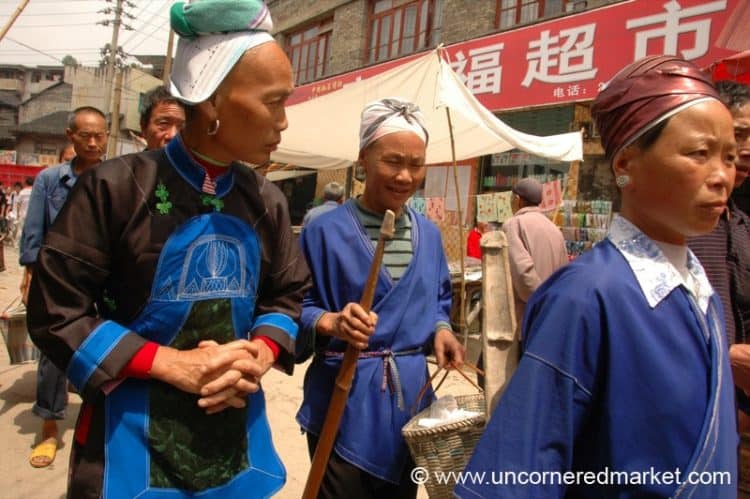
A local high school girl befriended us early in the day. Armed with some English skills and an electronic translator, she guided us through her town and the market. Intent on showing us “the beautiful buildings,” she led us to the main road headed out of town.
As we picked through a village slowly being bulldozed to find images of traditional life and architecture, the beautiful buildings appeared: brand-new mixed use concrete structures on the right and a government-built Miao-style village in wood on the left.
Nothing could be more emblematic of Guizhou, and to a greater degree, all of China.
Gedong: Testicle Stands, A Funeral and Late Afternoon Mahjongg
Minutes after our local bus exited the newly-built highway near Gedong, we made our way through a sea of ethnic Miao women navigating a muddy market area in their galoshes. Squealing pigs, indigo dye pots, chickens, ducks, dried fish, piles of incense, and stands devoted solely to animal testicles rounded out a stunningly authentic village market scene.
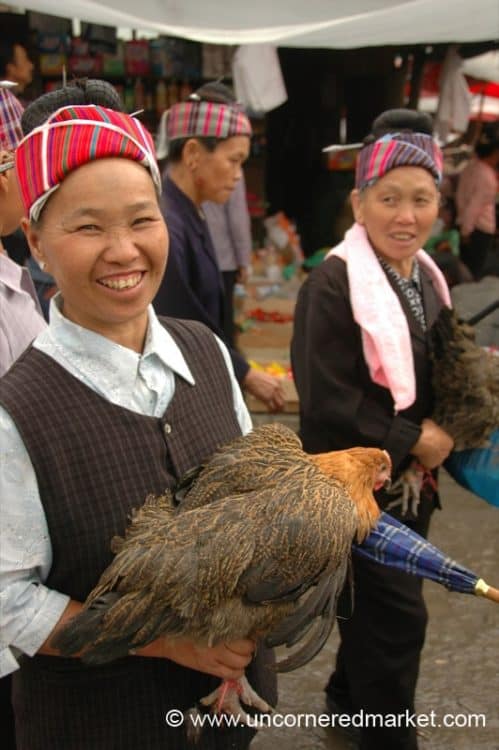
After drawing looks, shaking hands and holding babies, we headed into the Gedong old town whose traditional single-story houses stood on the hill behind. We were welcomed with curious looks and smiles as a group of locals attended a gathering to mourn the loss of one of their friends. Others played cards and mahjongg in the open front rooms of their family homes.
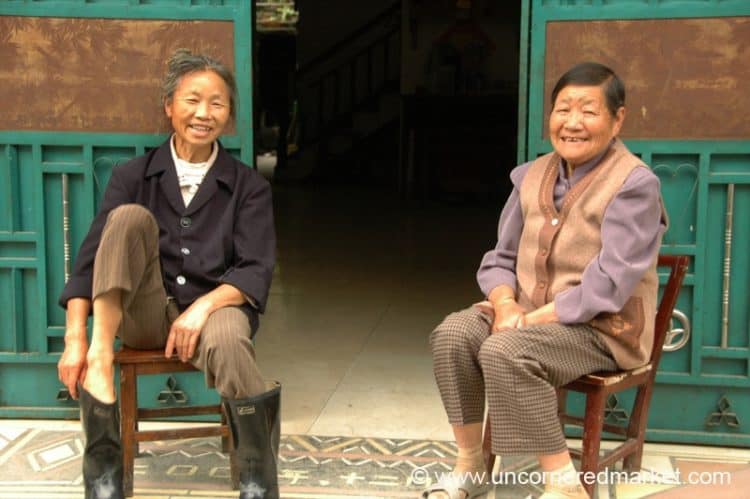
Gedong featured its own “beautiful buildings” formed in gray concrete and finished with decorative nods to the local traditional architectural style.
Those games of mahjongg will likely be moved to those new buildings in the coming years.
Xijiang: Postcard Views and a Redeeming Lunch
Having braved Guizhou’s rolling hills and switchbacked roads in a local bus, we arrived in the Miao village of Xijiang to the hum of cranes and heavy machinery. Clouds of dust rose from the valley as construction teams built a new tourist center and a string of souvenir shops along the main street.
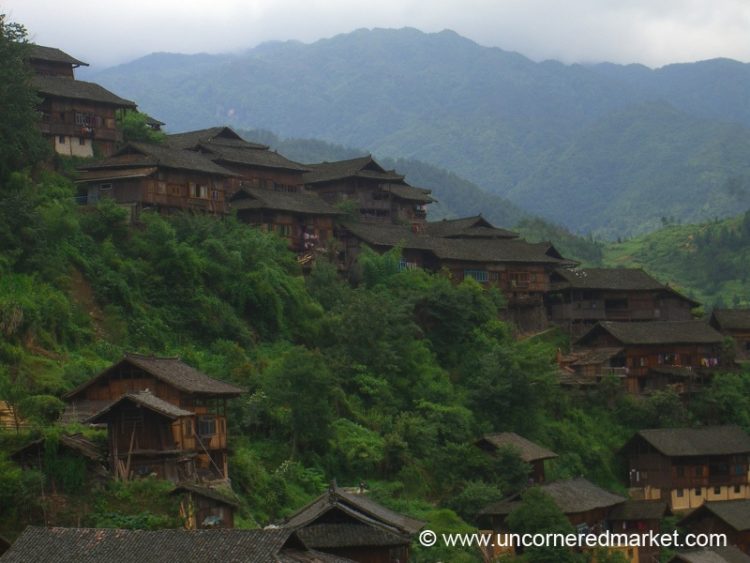
Xijiang had become the latest preference for Chinese tour buses visiting “ethnic Guizhou.” It was postcard-worthy: traditional wood Miao homes rested on hilltops and overlooked zig-zagging rice fields. But locals had grown noticeably tired and jaded due to the growing tourist traffic.
The redeeming human moment: lunch. A group of Chinese tourists from nearby Hunan Province beckoned us to join them in a what looked like a dining room of a local home. We pointed to “vegetarian” in our phrase book, followed the cook into the kitchen, and pointed at vegetables and tofu to emphasize the point. While the man of the group insisted on piling unidentifiable meat chunks in our bowls, his sister clucked at him that we were vegetarians. She thankfully persisted in removing the meat and replacing it with tofu and green beans.
We didn’t share a common language, but we managed basic conversation, beer toasts, tea and smiles. Upon departing, we exchanged contact information with open invitations to visit them in Shaoshan, the birthplace of Mao Zedong.
Zhouxi: Something Strange
The street market in the village of Zhouxi was in full swing when we arrived, but there was a strange, insular feeling about the place. It felt as if all the local Miao families were somehow connected in that “family tree doesn’t fork” kind of way. All joking aside, we wondered if the industrial center belching smoke nearby had something to do with the odd appearance that persisted throughout the village. The chronic burning in our lungs and noses indicated that it might.
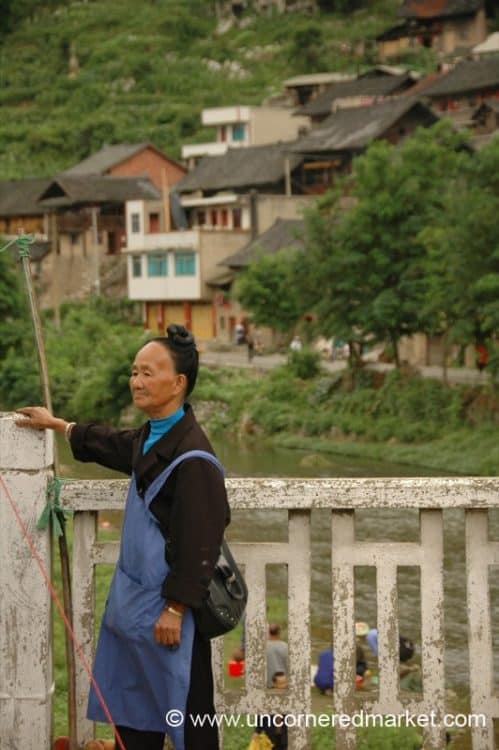
We were approached on a bridge near the outskirts of the village by two young men who spoke some English. Their intentions were clearly very kind. They invited us to lunch and to practice English, but something about their manic speech patterns made us feel uneasy.
We attempted to excuse ourselves from lunch – we weren’t at all hungry – but agreed to take some photos with them. The next thing we knew, we were roped into eating zongzi (sticky rice wrapped in bamboo leaves). Seated on the family sofa in the English teacher's living room, we unfolded our rice parcels as a roomful of people took in our every move.
Our host, the town’s English teacher, explained that his sister had died of cancer in her 20s and had left a young daughter behind. We again wondered about the effects of the nearby industrial plant.
We politely excused ourselves and expedited the photo session with the teacher and his adult students. The man who initially approached us bounced up and down in our faces as we departed, “I’m very exciting! You are my first Americans. I am so lucky!”
After eighteen months on the road and an endless string of unusual experiences, we’ve learned to trust our gut. This village spooked us. The banjo track from the film Deliverance looped in our heads.
There was nothing threatening happening, but the whole scene just hopped the strangeness threshold. Or maybe we were just over-stimulated. Anyhow, the return bus to Kaili couldn’t leave soon enough.
Kaili: Traditional vs. Modern Shopping
Not to be outdone by the surrounding villages, Kaili bursts with street markets – near the bus station, on side streets, in the old part of town. It was heartening to see traditional markets surviving in the shadows of shiny new shopping complexes.
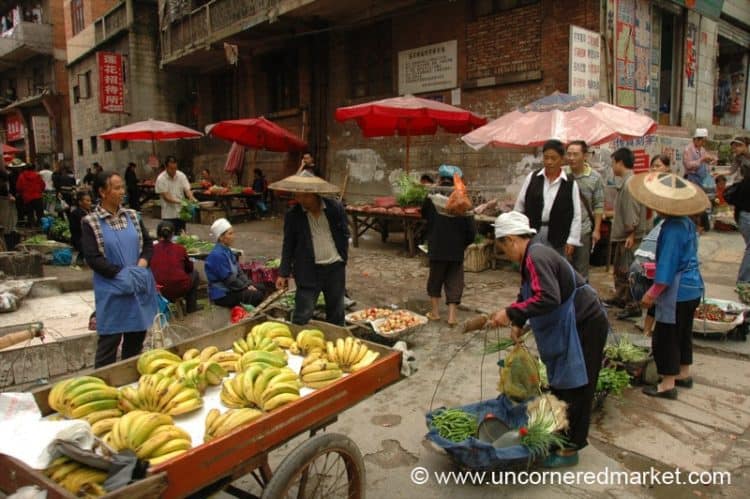
Maybe Guizhou’s traditional markets and culture will survive all those massive development projects after all.
We can only hope.
Photo Essay: The Markets and Villages of Guizhou Province
Kaili and Guizhou Travel Information: Transportation, Accommodation, Markets
- Finding Markets: Go to the tourist information office (CITS) on Zhongguo Guoji Luxingshe in Kaili and ask for the schedule of ethnic markets. Make sure you also ask them to write down the names of the towns and their corresponding departing bus stations (there are several in Kaili) in Mandarin characters.
- How to Get There: Kaili is on several main train lines. We arrived by train from Kunming and continued later to Shanghai. From the train station, take the local bus into town. Most buses to nearby towns and markets leave from the long-distance bus station on Wenhua Beilu.
- Where to Stay: We didn’t find a lot of choice in the budget range in Kaili, so we stayed at the Petroleum Hotel (or Shiyou Binguan) on the corner of Yingpan Donglu and Wenhua Beilu. We negotiated 70 RMB for a double room (ensuite bathroom). Make sure you get a key. It wasn’t the cleanest place we have ever stayed, but as long as we wore our slippers on the rug it was fine. There’s an unsecured wi-fi signal in the building. Book a hotel in Kaili.
- Where to Eat: There’s a great dumpling stand on Wenhua Beilu near the corner with Yingpan Donglu. Several soup stands operate on Yingpan Donglu. Then, there is fantastic and cheap hot pot. When a motorbike with four smoked dogs strapped to the back zoomed by us as we exited our hotel, we stuck with vegetarian options.
Your photos continue to inspire me and make me smile. I especially enjoy the photo above of the two older ladies smiling for the camera. They are so adorable!
Steven: We’re only able to capture a small percentage of what we see and experience, but we’re glad our photos are able to communicate so much. There was another older woman in this town (Gedong) who saw me unsuccessfully wash indigo dye off my hands in a public tap. She went into her home and brought me soap and a towel. Unfortunately, she was camera shy so we weren’t able to share her kind face and smile here as well.
Terrific tips & photos!
@Tracy: Thanks! Are you going to Guizhou?
In Guizhou, I especially liked the concrete galoshes videos, very good work.
@Lance: Glad you liked it. Guizhou was certainly a special place.
I am planning a trip to Gedong pretty soon. Can you tell me what to expect, facilities wise?
@Bob K: We traveled to Gedong and the various nearby villages from town of Kaili, so I cannot comment as to what you will find in Gedong. I also imagine it’s more modern than when we visited. In Kaila, we stayed at Hotel Petroleum. It was nothing special, not exceptionally clean, but at the time there was wifi in the hallway and we were thankful for that. Any more questions, please let me know.
Thanks for the tip. I was fortunate as my new in-laws in Jianhe made the necessary arrangements for accomodation. Only issue I had was the general lack of WIFI in many places and the “very” public toilet at the Kaili Railway Station.
@Bob: You are welcome. Glad it worked out in Guizhou. Always helps to have people on the ground to help make arrangements. I know those “very public toilets” you speak of and there are images in my head that I will unfortunately never be able to unsee.