Last Updated on February 17, 2018 by Audrey Scott
Rangoon, Burma. The name conjures the tropical blues of a steamy colonial outpost.
We wondered: would the current reality still match?
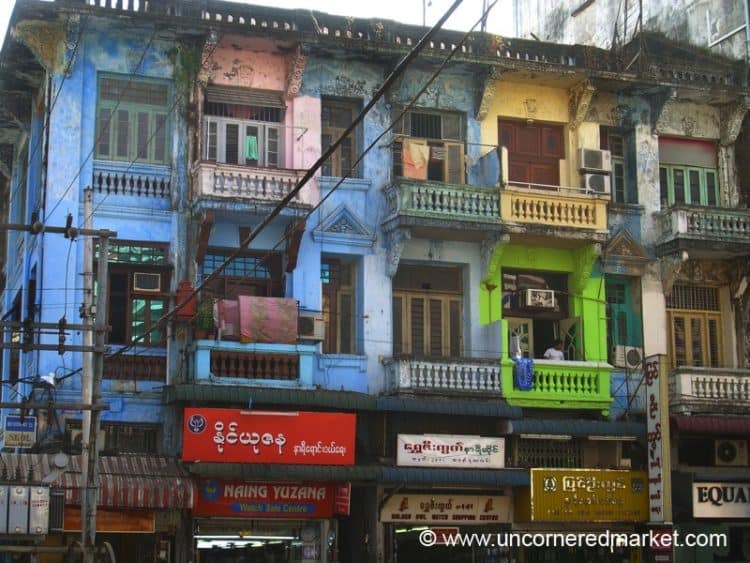
Streets of Rangoon
Aesthetically, Rangoon (aka Yangon) appears a sultry and poetic melancholy mash of faded glory. Aged sidewalks stand upended by the twisted roots of banyan trees. Crows with supremacy over sky and street peck amongst strewn garbage, fallen leaves and the ashes of long extinguished night fires. Grand colonial buildings, unsuccessfully defying the force of tropical deterioration and a lifetime of monsoon-to-dry season cycles, evince a certain beauty in their decrepitude.
A Delightful Intersection
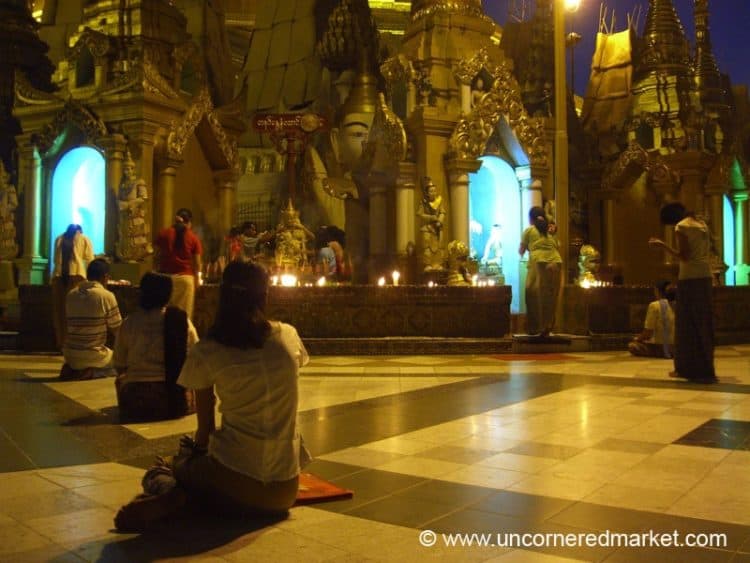
Burma (aka Myanmar) sits at the intersection of Southeast Asia and South Asia; nowhere is this more apparent than in the capital, Rangoon. Streets unfold into a spirited cultural mosaic of ethnic Burmese, Indians, and Bangladeshis.
Buddhist temples, Hindu temples, Muslim mosques, and Christian churches – all illustrative of Burma’s surprising religious tolerance and history – share physical and spiritual space.
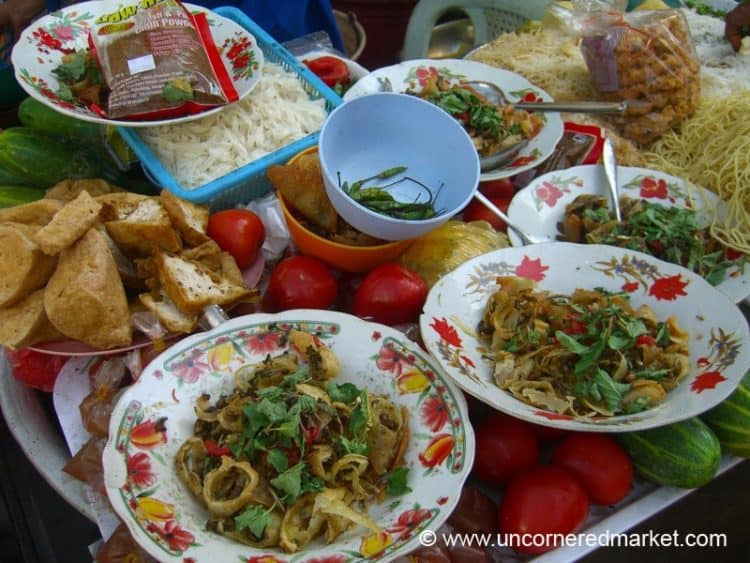
A Culinary Surprise
The food, too, delights. Like kids in a candy store, we reveled in colorful and tasty street food, stopping on almost every street corner to try something new for only a few cents. Bowls of crushed samosa soup, rice noodles with Burmese curry, and spiced cold noodles all convey cultural influences from across Asia.
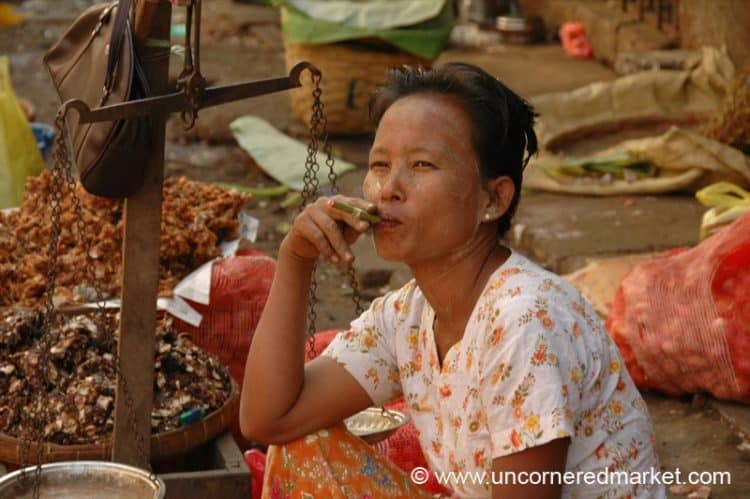
Burmese Spirit
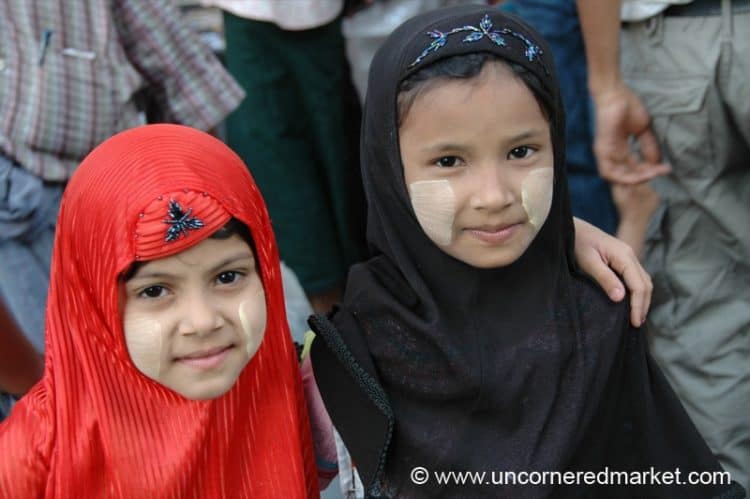
And the people. There’s a message and lesson in all those beautiful faces: they have little, their lives are difficult, and their government is oppressive – but so many of them find the excuse to frequently crack genuine smiles.
We found the people of Burma to be resilient, resourceful, humbling, and inspiring. Some of the kindest people we’ve come across in all our travels.
Over the coming days, you’ll notice these themes as we share our month-long journey through Burma in photos, food passages, stories and cultural observations.
For now, enjoy our photos from Rangoon.
Rangoon / Yangon Travel Information
What to Do:
- Take the Circular Train from the main train station ($1) for a very slow but wonderful journey around Rangoon. Enjoy market women balancing trays on their heads and dancing as the train trundles through the countryside.
- Visit Shwedagon Paya, Burma's most holy Buddhist temple, in the late afternoon. Join in with the locals and light incense or pour water over holy statues to reinforce your good fortune. Make sure you catch the broom brigade circling around the marble floors; remain until sunset to enjoy the waning light bouncing off the gilded stupa (over 53 tons of gold leaf!).
- Stroll through the fruit and vegetable piles of Theingyi Zei market (perpendicular to Anawrahta Road, across from Sri Kali Temple) in the early morning or late afternoon. We stumbled upon this market street on our first day in Rangoon and were overwhelmed by the the people, their smiles and the beauty of their vegetables. This market became a regular late afternoon stop for us.
How to Get There:
We flew Air Asia from Bangkok, Thailand to Rangoon, Burma. Uncertain about the length of our stay, we booked a one-way ticket and later purchased a one-way return ticket. We often use Skyscanner to compare prices and book flights.
Where to Stay:
Ocean Pearl Inn or Mother Land Inn (2) are similar in price. Mother Pearl is a bit smaller, more family run and closer to the center.
Where to Eat:
We ate on the street (mainly vegetarian) – samosas, soups, pancakes – with reckless abandon and never got sick. Head to Nila Biryani Shop (or one of its neighbors) on Anawrahta Road for cheap and filling biryani and dosai. In the evening, stop by the barbecue street (between Mahabandoola and Anawrahta Streets) for an endless array of grilled meat and vegetable skewers. Wash it all down with freshly pulled Myanmar beer.
For a mid-afternoon snack, follow the smell of freshly ground coffee at 128 Sule Paya (Pagoda) Road to Let Ywe Sin hole-in-the-wall cafe (a few doors down from Aroma cafe and Castle Internet Cafe). Two strong milk coffees and a beautifully light flan will run you a grand total of $0.80.
Exchanging Money in Myanmar:
ATM machines are now available so there is no longer the need to bring in cash (USD) and exchange money. Credit cards are accepted in some places.
Visa
The Embassy of Myanmar in Bangkok does a brisk business in tourist visas. Apply from 8 AM to noon and bring two passport photos, a photocopy of your passport and 880 BHT (around $25). Return three working days later in the afternoon to pick up your 4-week tourist visa. Be sure not to list any journalistic or humanitarian organizations in your application. The government of Myanmar maintains a hard copy and Microsoft Word “black list” of organizations they consider unwelcome or suspect.
Hey D&A!
Great post and photos as usual. What is the clay like substance that seems to be smeared on the cheeks of most of the people in the photos?
@Chip: The yellowish clay stuff on the faces is thanaka. The Burmese call it their “natural makeup” – they get the paste from rubbing a little water against thanaka bark. Then they apply it to the face using different designs. Women and children use it for cosmetic (beautification) purposes and to protect their faces against the sun. We’ve only ever seen this in Burma – it’s unique and really cute on the kids.
Highly informative.. thanks for the review and effort. Happy travels!
@Kahuna: Glad you enjoyed it. Rangoon is a fascinating city. Happy travels to you!
hi! visiting next month and this is reassuring! can’t wait to get there!
@sarah: Glad to hear it. Burma is terrific. Looking forward to hearing about your adventures there.
try to visit that unique country. Myanmar people are friendly, sweet and simple. There don;t have much crime compare to neighbor countries. If you love the culture, sure you should visit and you will find out the differences.
OH WOW! It is a beautiful country, amazing people and what nature. The people are out of this world. Making the most of their skills and abilities rather than relying on govt. Will write all about the adventures in a week or so!
@anita: Â We did visit Myanmar (Burma) already in January 2008 and truly enjoyed our visit. As you wrote, the people are some of the warmest we’ve met along our journey.
You can read from a list of our articles about our visit to Burma here.
A couple of Burma/Myanmar photo essays that might be of interest to you:
– Burmese people Â
– Burmese food and markets
– Burmese landscapes
@Sarah: We agree so much with you in how amazing the people are in Burma and how resourceful they are to create things when there is almost nothing to work with. Hope you enjoy your visit and good luck capturing the spirit of the country in your writings about it!
Whenever I think about travel to Burma I flash to the 1995 movie “Beyond Rangoon” and then stop thinking about Burma.
Thailand is going to be my first 3rd world country in January. Maybe after a while there I’ll feel bold enough to try Burma.
Rob – it’s worth it – i’d suggest make it the first stop! They deserve to get some external iinfo and u will be surprised with the landscape and resilience. I strongly recommend a visit!
@Rob: Haven’t seen Beyond Rangoon. Based on your comment, sounds like I should seek it out. Burma (Myanmar, if you like) is one of my favorite destinations, experiences across our travels. Exceptional people, rich culture, and the more I’ve traveled in that region, a clear bridge between the South Asian subcontinent and Southeast Asia.
Having said all that, Thailand is an excellent place to begin your travels in Southeast Asia. Check out that link for more ideas in Southeast Asia. One of the best places to experience (what was once) 3rd world and now features cities and towns at all stages of development, including what looks like the future.
@sarah: I agree with you. Of any in the region, Burma might also be the country to change a visitor the most.
@Daniel:
Somehow someone managed to put it up on youtube: http://youtu.be/uo-XheH6A6M
@Rob: Thanks. Convenient — I’ll have to check it out one of these days.
I am from Thailand but my parent are from Myanmar (Burma). I am now in USA. I am so greatful.
Hello again,
We met in Myanmar several years ago (I’m retired living in Thailand, you were living in Poland then). It was in Mandalay or Inle Lake, not sure which. Happy to see you are still going strong.. Found your site by accident when I was researching for my upcoming trip to Yangon. I remembered discovering this incredible little coffee house with AMAZING flan near Sule Pagoda, but could not remember name or exact location. Thank you, I tracked it down to your website through a picture of the flan. I will be revisiting Let Ywe Sin coffee house, and thanking you for the help. HAPPY TRAILS
Marshall, great to hear from you! I know from our Facebook conversation that you did end up finding this little coffee house with delicious flan. Hope your trip back to Myanmar was a good one!