Last Updated on January 7, 2022 by Audrey Scott
There we were at the dock in San Pedro bargaining for a boat to Santiago. The price seemed prohibitively high for a whimsical afternoon side trip on Lake Atitlan. Natasha, another traveler hoping to take the same boat, also questioned the price.
“You know, I have a car here. We could drive. You can just give me some gas money.”

Sounded like a reasonable alternative.
Just as we turned to leave, the boat ticket salesman's voice rose, “Carretera. Banditos. Peligroso.” (Highway. Bandits. Dangerous.) In other words: the highway is unsafe, so my boat is your only option. Assuming his opinion was a thinly veiled attempt to profit from fear, we dismissed it.
More Talk of Banditos
On the way out of town, we asked for directions. “Up there, right then left. But it’s dangerous. And there are bandits,” one taxi driver offered, without skipping a beat.
“Just up this hill and then a left. But are you sure you want to drive there? It’s notorious for bandits,” another man added in perfect English just a few blocks later.
We looked at one another, taking stock of our situation. Natasha attempted to reassure us, “I checked at my hostel. They said the road is in good condition. Otherwise I wouldn’t risk it.”
“So if there’s a bandito in the road, what would you do? Run him over?” Dan asked as he practiced his ducking skills.
“I guess so,” Natasha offered with an anxious laugh. “But, I can’t guarantee anything. So if you want to get out I completely understand.”
Dan and I sat there looking at each other, not quite sure what to do. We considered the odds. When was the last time anyone actually saw a bandito on this road?
Although personal safety was our primary concern, our photo equipment came a close second. Natasha too, for she’s a photojournalist. The compromise we negotiated with ourselves: hide our camera equipment in the trunk under blankets and bags.
Certainly no bandito would look there, now would he?
We Hit the Road
Initially, the road was superb – one of the Guatemala’s newest and smoothest. Our anxiety receded. Who could ever stop us here? We were virtually bandito-proof. But secretly we stole looks into the jungle and to the tops of hillsides for masked men.
Thirty minutes later, the highway crumbled into a hilly moonscape. We slowed and bounced to a crawl amidst huge clouds of dust. We couldn’t outrun anyone here. Roads like this dropped mufflers. Broke axles, too. I peered into the brush and coffee bushes each time we slowed, looking to see if anyone was approaching. I locked my door, rolled my window up.
Whenever a person appeared by the side of the road, I wondered suspiciously, “Now what’s he doing there?” Invariably, it was just a local carrying bags of coffee berries or a farmer returning from the fields. I wallowed in sheepishness because of my paranoia.
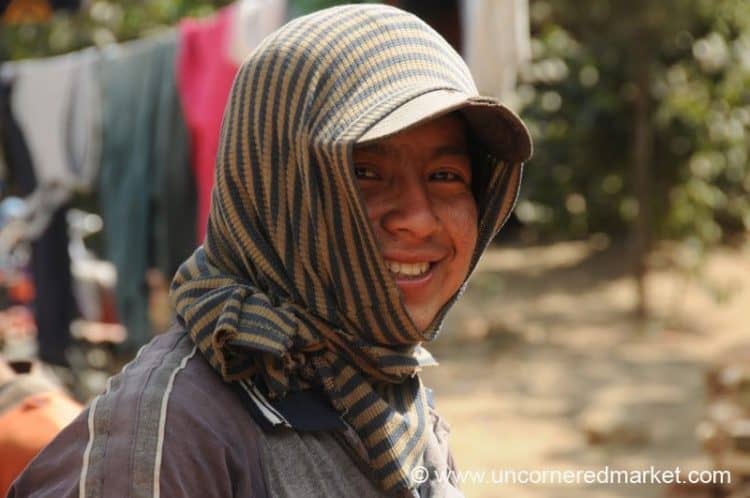
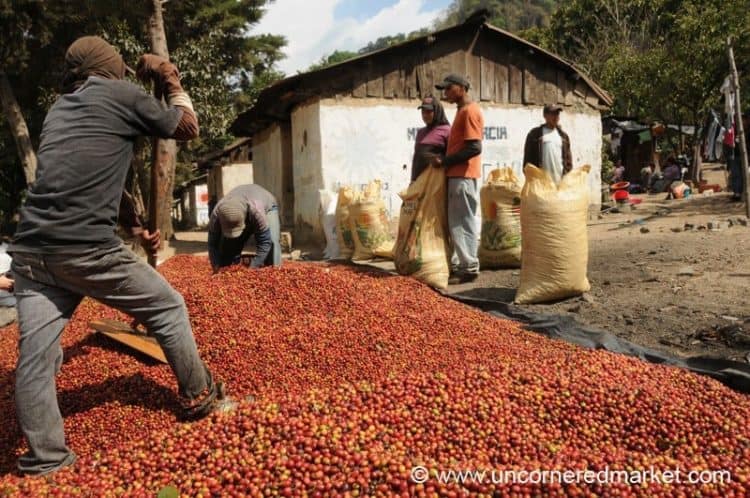
At the edge of one village, we pulled up to chat with and photograph some workers shoveling coffee berries into burlap sacks. Even the most innocent of scenes – men working, children playing, mothers cooking – couldn’t prevent a glance or two into the bushes to ensure the banditos weren’t coming our way.
The Road Hits Back
After enjoying Santiago, we piled back into the car. The return journey would be doubly difficult, for all those dusty moonscapes now pitched uphill.
At the first broken patch of road, Natasha drove like a champ – bobbing, weaving, and creating traction where there should have been none. But when the drive wheel finally began to spin freely, I could feel the tension rise in the car.
We kept the conversation going, chatting about the photojournalism projects Natasha might enjoy in places like Georgia (Republic of) and Xinjiang, China.
She deftly navigated the uphill, boulder-strewn dustbowl. Upon clearing it, she remarked, “I’m sweating. Thanks for continuing to talk to me through that ordeal – it helped take my mind off the situation.”
Silence is to fear what gasoline is to fire.
Fifteen minutes later we hit the hill. It was deeply rutted and covered in fine dust and stones. Natasha spun the wheel this way and that, making her way with wide turns. But halfway up, we were defeated. The drive wheel cried as it spun against a boulder. The cloud of dust was punctuated by the distinct scent of roasted clutch.
Natasha backed up to take another rutted approach.
We were going nowhere.
No more than 30 seconds later, a pickup truck full of passengers rode over the crest of the hill. They stopped, realizing our predicament. A group of locals and tourists (dressed in life vests, oddly enough) hopped off. One guy took the driver’s seat of Natasha's car. The others– together with Dan – pushed the car up and over the hill.
Video: Dust-Covered and Relieved
“It’s a minor miracle that you guys showed up when you did,” I suggested to one of the tourists in a life vest.
He laughed, “If our boat hadn’t broken down on the lake, we wouldn’t be here.”
One man’s misfortune is another man’s savior.
The remainder of the journey was pleasantly uneventful, but we breathed a sigh of relief upon arriving in San Pedro anyhow.
Travel Fear in Guatemala
Reflecting on the day's emotions, I realized that travel fear is relatively new to us. Aside from a rifle being aimed at us by Tajik army guys at the Afghan border and almost getting crushed at the Uzbek-Kazakh border, our travels throughout Asia were relatively – and fortunately – free from fear.
The risk of violence is higher in Guatemala. And the perception of that risk is higher still. Melodramatic local media plaster dead bodies on page one of the morning newspaper. And breakfast talk with locals, full of the latest busjackings, kidnappings, and murders doesn't inspire much confidence either. Those conversations offer unsettling parallels with the infamously dire travel warnings issued by the local U.S. Embassy and The State Department.
All of this is difficult to reconcile with the fact that our interactions with Guatemalans have generally been warm and welcoming. So instead of accepting the first dire warning, we consider data from all sources. After all, we didn’t travel to Guatemala (and Latin America) to sit in our hotel room and on tour buses. But we also don't want to tempt fate.
So are there really banditos on the road from San Pedro to Santiago? Or is this just a well-circulated local legend now taken as truth?
We may never know.
Hi, I understand this fear sensation, I was last weekend in Iximche, Atitlan and Xela, all this media news shooting from elsewhere make you paranoic, in my 36yrs living in GT i have not been involved (or know someone close to me) in an road-bandit situation but we still have a feeling something will happen.
BTW Xela, my loved city looked great, better than other visits, the Central Park Atmosphere was lovely and I felt really safe at night, i even bought a jacket of my team Xelaju 🙂
Take care, keep enjoying Guatemala
Hey Folks, Guatemala is a beautiful place with many wonderful people.. Anyone with interests in Central America might want to read the chapter on Guatemala in Stephen Kinzer’s book “The Brothers”
It is about the Dulles brother’s and their misuse of power while employed very high up with the US government AND
sitting on some BIG corporations (United Fruit) . Also check out torture manuals printed in Spanish that were given out to Latino soldiers while training here in the USA (Ft Benning Georgia School of the Americas).
I drove the distance from Oregon to Guatemala three times in the late 80’s into the mid 90’s. I took the bus or train through Mexico another 6 to 10 times during those years.
Wander safe, look for the truth.
Not being Guatemalan or having shared their experiences, I will never know for sure, but people in Guatemala are afraid. Whenever I’m in Guatemala, I can feel people’s fear. It starts affecting my dreams and thoughts in an almost tangible way. I really believe that the war was so terrible, so traumatic, and filled with so much unimaginable horror, that people have learned to live with fear. Even now that the country is not at war, the level of violence and degree of uncertainty that surrounds daily life ensures that people continue to live with fear and use silence as a protective mechanism. I think this culture of fear is a direct result of decades of mistrust, betrayal, lies, secrecy, impunity, and violence. I really hope that someday, the nation comes to terms with its past and can forge new social bonds that are not based on fear that can bind people together in a long lasting, significant way to rebuild the tattered social fabric.
Que la paz llegue a Guatemala.
Lisa Munro
Tucson, Arizona
Hey Lisa, The book The Brothers by Stephen Kinzer may give you a bit more insight I suggest you read the Chapter on Guatemala and maybe Iran and Indonesia . Not pretty what they did. Happy Trails…..
All that to save 20Q ($2.5)?
I’m not reading this web site ever again!!!
Dee Dee
Wow. That makes my freak out here in California over running out of gas seem pretty lame. Thanks for the perspective.
Also, I’ve wanted to head to South America but the reports of violence towards travelers does worry me…after reading this, I’m still not sure but feel like I am closer to that trip. Peace.
Violence against tourists is extremely rare. If you discard the inter-gang killings, the crime rate is about the same as Washington or Detroit.
Of course, if you visit wearing a halter top and short shorts and flash wads of cash around, you might be in for an adventure…
Mark
Thank you all for the comments and apologies for the late response – the last few days have been a travel whirlwind – Livingston to Flores to Tikal to Coban.
@Lisa: Thanks so much for your thoughtful comment and sharing your thoughts and experience regarding fear and violence in Guatemala. I completely relate to the fear and constant talk of violence doing weird things to your head. We’ve only been here short of two months, so I can’t imagine what it’s like to live with fear for decades.
Another American woman with close ties to communities around Lake Atitlan talked with us about the culture of silence and how there hasn’t been a sort of truth and reconciliation process after the war ended. I agree that a more open discussion and accounting of what happened would perhaps help the country come to terms with the atrocities of war and move onto a more peaceful future.
I also hope true peace may come to Guatemala and all its people.
@Norman: We have met people who have had friends and acquaintances (locals and foreigners) who had buses (both local and tourist shuttles) robbed by armed bandits, so we know that unfortunately there are real dangers. But, there’s a balance between being aware of the possible dangers and not letting it paralyze you (i.e., not travel anywhere) or become paranoid. It sounds like you’ve reached the right balance; we tried to do the same.
We spent over two weeks in Xela and enjoyed the feel of the city. Glad to hear you had such a good visit!
@Mark: Although price was the impetus to consider driving to Santiago, it was by no means the only factor in our decision.
We decided to visit Santiago at the last minute and were at best ambivalent when we arrived at the dock to inquire about boats. If the boat driver had quoted us a local price 40Q ($5) instead of the gringo price (120Q – or more than 150% of the cost of our accommodation), it would have made our decision an easy one: by boat. So if you want to know exactly, the decision to drive saved us 100Q (+60Q if you include the driver’s savings in the equation).
Having been on the road for 2.5 years, we are accustomed to occasionally paying tourist premiums for hotel rooms, transport, entrance tickets, street food, etc. However, a price of 3x the local price felt a little too opportunistic for our blood. That we had heard that the view from the road was beautiful (it was) and we were curious about the villages along the way added fuel to the desire to drive. In the end, principle and curiosity won out – and we drove.
I do agree that most violent crimes here are gang-related or targeted murders (e.g., a businessperson). However, as I mentioned above, we have met people here who know someone who was robbed on a bus by armed men or mugged. We also have a family friend who was robbed in her hotel room in Guatemala. And although we usually take U.S. State Department travel warnings with a very large grain of salt, the U.S. Embassy Guatemala postings regarding reported crimes against foreigners outlines a number of incidents that can be unsettlingly frequent and specific.
So, tourists are not exempt from crime. That said, the frequency with which locals, foreigners and guide books use the word “crime†and “dangerous” in conversation perhaps suggests that the situation is more unsafe than it really is.
If you take a look at the rest of the website, you’d see that I’m almost always in a field shirt and long pants. Dressing conservatively, protecting your possessions (e.g., do not put your wallet in an unsecured front pocket) and not walking around in the middle of the night are useful bits of practical advice for travelers everywhere. We’ve also found that heavily touristed areas (and their money flow) tend to attract unscrupulous types (eg., scams, pickpockets, etc.).
Safety in Guatemala is a complicated issue.
@Dee Dee: Sorry for making you anxious with our stories. Don’t worry, we are cautious on the road and have learned to trust our gut. And, the next few posts will be a bit more safe 🙂
@Sharon: Running out of gas and being stranded on a road in California would make me nervous, too!
If you check out our other stories on Guatemala that we’ve written – and will write – you’ll see that there is a lot more to this country than the crime statistics. We’ve been here for close to two months and have had no problems with crime so far. We have felt safe on local buses and in guest houses.
Compared with our travels in Asia, we tend to return in the evenings a bit earlier. We also don’t take night buses in Guatemala, something we wouldn’t hesitate to do in Asia. Other than that, the core of our style of travel has remained unchanged- we travel by local buses, spend time in markets, eat at street food stalls and local restaurants, talk with people on the street, and stay in budget accommodation.
It is important to be aware of the risks, but don’t let the crime reports discourage you from traveling in this region. Be aware and take the necessary travel precautions and you will likely be fine.
@Dee Dee: But you’ll miss all the beautiful photos. And all those pleasant stories that have nothing to do with our safety.
@Mark: Perhaps you’ll find it surprising that in a recent conversation with my niece, I agreed that Guatemala has great opportunities for Spanish language immersion.
@Audrey: Just to correct a misunderstanding, my comment about proper attire wasn’t a reference to your attire, but rather, an insinuation that when I hear stories about violence or theft against tourists it usually involves the type I described. In my time visiting and living here, I’ve yet to met someone firsthand who had the aforementioned experience who didn’t fall into that category.
Anyway, I’m glad it worked out for you.
@Daniel: I’m afraid that I don’t know exactly what you’re referring to, but as to Guatemala being a great place to learn Spanish, I’d have to agree!
@Mark: Having just returned from Flores, we had lots of experience with the kind of tourists you mentioned above – it was a bit overwhelming at times. As you are a new reader, I wasn’t sure if you had looked through the rest of the website to see that our style and reason for travel is a bit different.
I do agree that a tourist is more likely to run into trouble if he/she doesn’t dress and handle money responsibly, but we have met and heard of the exceptions. Like anywhere, traveling in Guatemala requires a balance of being cautious but not shutting yourself off to new experiences and interacting with locals because of fear.
Actually, THERE ARE BANDITS. Got held up by (at least) 3 masked and armed men yesterday and could barely escape. Colleague of mine got robbed last November. DO NOT TAKE THIS ROAD WITHOUT POLICE ESCORT (they will offer that to you if you ask for it). Better, take a boat.
@Guatemala Traveler: I’m so sorry to hear about this and that bandits are still active on this route. Thank goodness you escaped unharmed. Asking for police escort is a great idea – we didn’t realize it was an option. Thanks for letting us know and giving a warning on this route. Safe travels.
Excellent writing and recount of the road from Santiago to San Pedro. I _tried_ to take the same road but turned around after 3 guys with guns forced me to stop then robbed me =] Atleast they didn’t kill me or steal the motorcycle. This was August of ’08.
According to a Guatemalan motorcycle forum post I read, the guys were caught and stoned to death. My understanding was that this ocured in Jan this year.
@Guatemala Traveler — if you read this, go to my site and contact me. I’m interested in your details. Or Audrey, could you fwd me their email address?
@daveg: I read your account – sounds like a terrifying experience. Thank goodness you were able to get out with your motorcycle and without physical harm. We had been told by another woman active with villages in the Lake Atitlan region that it’s common for local villages to distribute their own “justice” when they catch a bandit or robber in the area. There’s not much faith in local police doing anything. Sad situation. Thanks for sharing your experience.
I sent Guatemala Traveler a message with your email address, so he can contact you directly.
Hola.
In the past, at least, there were plenty of robbers and robberies on the road from San Pedro la Laguna toward Santiago. If there aren’t any now, so much the better. Of course, among tourists, rumors are ageless–and yes, a boatman would prefer that you went by water–however, in recent years, the crime rate has risen so high that campaigning politicians now address it (they never used to); and certainly the lanchas on the lake are less prone to hold-ups.
Knowing the state of the road, and knowing that it’s pretty customary for bandidos (and kids asking for money, etc.) to throw rocks and other obstacles onto the thoroughfare, I’d say you were pretty lucky–lucky that you weren’t robbed, lucky that the car didn’t drop an axle get a couple of flats, and lucky that help came along.
By the way, I assume you knew that San Pedro has two boat docks–one for the boats to and from Panajachel, San Juan, San Pablo, San Marcos, etc., and another one on the Santiago-facing side of that point of land for boats dedicated to going to Santiago. As with all the public lanchas, the Santiago boat has a well-known standard price structure: one for locals (and cheap-ass foreigners who spuriously claim to be locals), and one for foreigners. I’m surprised you had to negotiate, and assume that maybe you didn’t know of the prices or accidentally engaged a boat from the wrong dock. (Note that the two-tiered price structure isn’t set up to rip off foreigners; the foreigner price rightly subsidizes the local price.) I can’t imagine a car making that trip for anywhere near as cheaply, if one takes fuel and physical wear-and-tear into account–psychological wear-and-tear are an added extra.
But hey, you made it–in retrospect, the rest is just juicier anecdote. When I spent a lot of time on the lake (a few years’ worth), there was a good chance of getting held up if one drove from Xela (Quetzaltenango) down into San Marcos la Laguna. After escaping one attempt, my friends never drove in without sticking their shotgun barrel out the window–that and their harmless, but lunatic-acting dogs, got them through unscathed.
What with the lake finally beginning to succumb to all the sewage and agricultural chemicals that have been dumped into it for decades (there have been severe algal blooms of late), I wonder whether robberies will go up or down. If/when the lake dies, tourism will go down (fewer available victims), but poverty will go up (greater need). Time will tell, I guess.
Safe travels.
Hi guys,
I am fairly familiar with the shores of Lago Atitlan, I am pretty certain that the photograph labeled ‘struggling up the hill’ is not on the road between San Pedro la Laguna and Santiago Atitlan, but the very winding and steep grade road from San Pablo la laguna (in the background) up the hills over the crest to Santa Clara la laguna.
Note that all these towns are Tz’utujiil Mayan speaking communities, but the town adjacent to Santa Clara la laguna called Santa Maria de Visitacion is a K’ichee’ Mayan speaking town.
Best,
Lach Duncan
@Lach: Thanks for catching the mis-label on the photo. We’ve corrected it.
Thanks also for the added context of communities and languages around Lake Atitlan. For certain, a culturally very rich pocket of the world.
Great info! 6 of us, in our own 3 off road RV/trucks head there in August 2011, driving from southern USA to Panama. We would love to know of recommendations of “Things Not To Be Missed!” We are all coming from Australia, and hard to get first hand info from here. Appreciate any ideas. Expect to see Lake Atitlan, Chichicastenango, & up to Tikal, then towards Belize.
If you have time, would appreciate any info. Thanks.
@Elizabeth: What a fantastic overland journey! As for recommendations, I’d say Lake Atitlan, Antigua, hills around Xela (great weekly markets), Tikal and perhaps over to the Carribean side. Good luck and safe travels!
Yes, I can say with absolute confidence there really are banditos along that stretch of road. I spent seven months on the east flank of San Pedro Volcano and banditos frequently came down from higher elevations to rob the Santiago farmers of their crops and passed through the property we cared for during the night prowling for anything of value. We were warned by close Guatemalan friends (both Tz’utujil and Spanish) to avoid climbing the volcano and that the safest area was to stay near the lake.
@Cassalona: When did you stay in the area of San Pedro Volcano? Thanks for your comment, perspective and addition to the discussion.
July 2011 – Feb 2012
I was in Guatemala for 6 weeks in 2007. Although there were daily reports of people being robbed. I never once felt threaten. Judging by the poverty, I would imagine most robbers are just trying to survive. It is a country where for most of the population the main goal of any day, is to earn enough to eat. I like to tell people who ask me about danger and fear during my travels, that if you use common sense and are friendly probably nothing will happen. I have been up ducted once and robbed 3 times in my life. I was up ducted in Germany where I live, and robbed all 3 times in France. Never in any of the so called “dangerous” countries I have visited.
@Dave: During our visit to Guatemala in 2009 there was an added element of drug crime in addition to regular robberies. Like you, we heard reports of people getting robbed and busjackings, but fortunately never experienced anything ourselves. Using common sense and staying aware of surroundings certainly helps a lot!
Sorry to hear of what happened in France and Germany. Goes to show that bad things happen in “safe” countries. We’ve been fortunate to never have any issues in any of the places considered “dangerous.”