Last Updated on April 26, 2024 by Audrey Scott
The Bolivian Salt Flats. If you haven't already been to the Salar de Uyuni in Bolivia, put it on your bucket list.
Vast, stunning, barren, surreal — and a stark, beautiful reminder of how small we humans are, particularly in the face of Mother Nature. That's southern Bolivia's Salar de Uyuni and the surrounding high deserts that float in pastels from 11,500 to 16,400 feet.
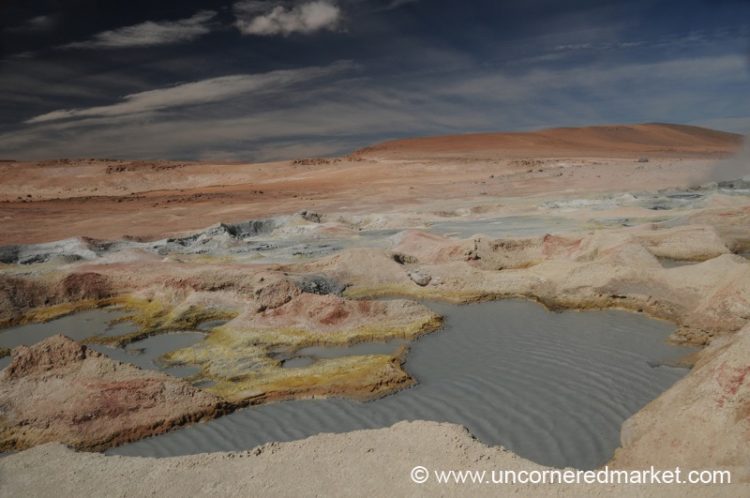
The beauty of motley mountains and chromatic lakes contrast with the hostility and harshness faced by people living in this environment. Only llamas, vicuñas and flamingos can really survive above 13,000 feet (4,000 meters). Agriculture is similarly limited to just about nothing; not even the rugged potato can make it at this altitude. Minerals are abundant, but extracting them is no easy task. It's no wonder we passed only a handful of sparsely populated villages across our 1,000 km (620 mile) journey.
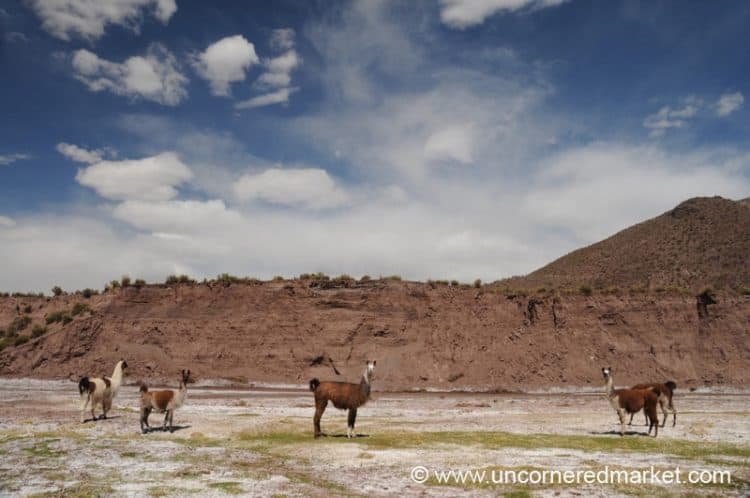
When we meet travelers headed to South America, Bolivia's Salar de Uyuni is among our top recommendations. And while the all-white salt flats are the goal, it's the 1000 km (620 miles) four-day jeep trip from Tupiza to Uyuni that features some of the world's most beautiful and otherworldly landscapes around. It's definitely worth taking the longer tour from the south instead of the shorter one from Uyuni as we were treated to a gradual build up over four days which culminated at the Salar de Uyuni, the world's largest salt flats.
Booking a Salar de Uyuni (Salt Flats) Tour
Choosing a Route: Most Salar de Uyuni tour-goers take a two or three day tour that begins in the town of Uyuni and ends in Tupiza. We chose a four-day trip in the opposite direction. Not only do tour companies in Tupiza have consistently better reputations, but their routes also feature a gradual build up over several days, from the red rock scenery in the south to the gaping white salt deserts in the north, with ever-improving lagunas (small lakes) in between.
Tour company: We took the advice of several travelers who had taken successful (i.e., no drunk drivers or food poisoning) jeep tours with Tupiza Tours. Tupiza Tours delivered everything they had promised: jeeps were well-maintained, food was good and varied, and there were no “surprises” or additional expenses.
Cost (2009): The cost of your Salar de Uyuni tour will depend mainly on how many people are in your jeep and what time of year you choose to travel. We booked one day before departure in Tupiza and paid 1,000 Bs ($145) per person for five people in the jeep. For a smaller group of four people, the cost was 1,200 Bs ($170). This includes all food, accommodation, transport, entrance fees, and return transport to Tupiza (if you choose). Note that accommodation during the first two nights is very basic (that's all there is). On the third night, you will likely stay in a hotel made entirely of salt (impressive and comfortable) and have access to a hot water shower (for $1.50) — a welcome relief after three days in the dust. You can apparently upgrade to a higher-quality hotel (also made of salt) on that final evening, but reports from other travelers did not make this option sound exceptional.
Getting there: There is a lovely and reasonably priced train that runs from Oruru to Uyuni (7 hours) or to Tupiza (12 hours) several times a week. We were not able to get a ticket in first class ($30) for the 12-hour journey, but we were pleased to find second class ($13) surprisingly clean and comfortable.
Wow, these photos are just stunning, and I really love the panoramas that you guys do – I can’t say that I have ever really seen these done so well! The colors of the Salt Flats actually really remind me of the Painted Desert in Arizona (minus the llamas!) 🙂
I am so glad you made it to the Salt Flats. I loved my trip there. Your photos were stunning, as usual, and really captured what you see! I was particularily glad to see the Green Lagoon, hot springs and start of your trip. I went the opposite route and it was snowing so hard by the last day–we couldn’t make it to the Green Lagoon. Roads were unpassable. So, thanks for sharing!!
I am so glad your driver wasn’t drunk like mine was. Will definitely pass on Tupiza Tours as a valuable tip to those travellers looking to head to Uyuni. Did you have to leave from Tupiza, or did they also book via San Pedro de Atacama? Great pictures and prose, as always. Jodi
I just happened to take a look at your site and really loved the pictures of the Salt Flats. It reminded me of our trip out to Death Valley this past summer. Absolutely beautiful! What were the temperatures like? Love, Jeff
Awesome Pics… Your blog is starting to become addictive…
Beuatiful – more happy memories.
gracias
One word – Gorgeous!
doesn’t look like you did that cheesy perspective photo everyone does…..awesome…
That 360 shot is even more awesome
Thanks all for the compliments on the photos. Honestly, the Salar de Uyuni did all the work. My individual responses are below:
@Shannon: Thanks. Glad that you enjoyed the panoramas. Although software is making them a bit easier to stitch, they are still difficult to execute properly. Glad we are making some headway.
Your comparison between the Painted Desert and the Salar de Uyuni is apt. So much so that our companion from New Mexico made a similar observation. Both are absolutely beautiful.
@Alleen: Great to see you here. I’m glad to hear that we captured the Salar. It was absolutely beautiful. But as we took the photos, we figured we couldn’t even come close to doing that landscape justice.
Snowing?! Wow, that would that make for some difficult going. What month was this?
@Jodi: Sorry to hear that your Salar de Uyuni guide was drunk. Unfortunately, we heard that is quite common. Fortunately, we got some recommendations from other travelers fairly early regarding how to avoid this. We left from Tupiza (where Tupiza Tours is based). I don’t believe they offer an option to leave from Uyuni. Although the Tupiza Tours Salar tour leaves from Tupiza, you have the option of staying in Uyuni (at the end) or returning to Tupiza — for the same price.
@Jeff: I was absolutely thrilled to see that you commented! Like I said to Shannon above, it’s amazing how the Salt Flats reminded us of Death Valley, The Painted Desert and New Mexico. We even traveled with a friend from New Mexico who joked “Now why did I come all this way to see to something that looks like my backyard.” (am paraphrasing here, Gaea!)
@Brian: Just “starting”? We were hoping you were in the throes of a full-blown addiction from which there is no escape.
@Matt: Thanks. I’d like to think we usually don’t do cheese. We did take some of those perspective shots (it’s like some sort of mandatory Salar de Uyuni rite of passage).
That said, we deliberately did not include those photos in this piece or in our Salar de Uyuni slideshow.