Last Updated on February 19, 2018 by Audrey Scott
On occasion, we are fortunate enough to have an experience or conversation that sends chills for its human quality. Our time with Zikra Initiative and the women of Ghor al Mazra’a in Jordan was one such experience.
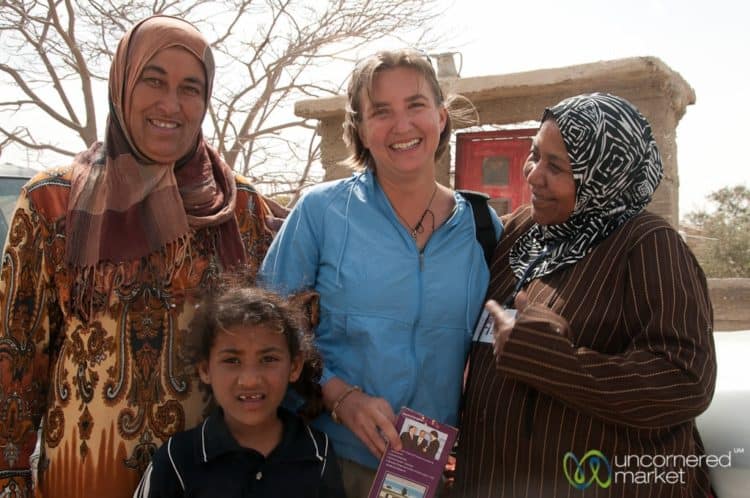
From the moment I passed into the courtyard, Um Atallah took control and led me to a seat on the ground near her. Two other women swapped their attention between their work and us, offering encouraging smiles. These were the women of Ghor al Mazra’a near Jordan's Dead Sea. And for a few hours, they shared a bit of their lives with us.

This is the second part and the final snapshot of my series on women we met in Jordan. You can read the first two snapshots here.
Let the Lessons Begin
Um Atallah, the clear leader of the group, sat me down and got to work with my education for the day. You see, at Zikra Initiative, a core element of the philosophy: “riches come in many forms,” means that everyone has something to share regardless of monetary wealth. The women of Ghor al Mazra'a shared with us their cultural wealth — their crafts, their cooking, their heritage, and a glimpse of their lives.
Without a common spoken language — or much need for one — we began. I learned how to make kohol (natural charcoal eyeliner), olive seed bracelets, intricate tassel knots on a Kuffieh (traditional male headwear) and al raha (using a wheat grinder made from two circular stones). Another woman, Amal, gave me a quick lesson on gallayet bandora, a Jordanian tomato-based dish, as we sat side by side over gas burners.
A note on names: It is common in Jordan for women to be referred to as “Um” or “Mother of” (usually of their eldest son, if they have one). In this case, Um Atallah means Mother of Atallah.
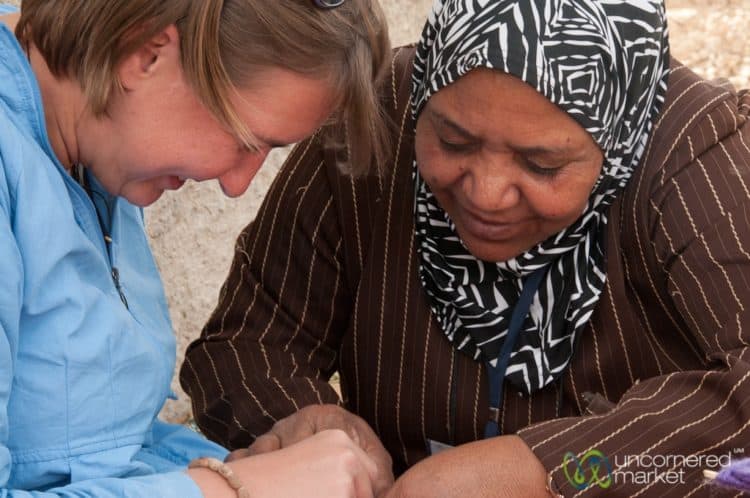
While I had clumsy fingers and a few difficulties here and there, my real challenge of the day came when I attempted make shrak, their traditional flat bread.
Making Bread, Easier Said
From a mound of worked dough, Um Asad pulled off perfectly sized rounds and laid them in a flour-dusted tin. Dan and I sat on the floor and watched her as she effortlessly tossed the dough to perfect thinness in a way that would make a pizza chef envious.
Her hint: “Move your hands like a bicycle, continuously. Don’t stop.”
It all looked straightforward enough, so I nodded “sure” as a ball of dough was passed to me. I mimicked her movements. Turns out that moving my hands like a bicycle with a ball of soft dough flopping in between is tricky. The dough worked to uneven – thick in some spots, bare in others. Um Asad watched the collapse and eventually came to my rescue, tossing my holey dough onto the saj, a hot iron griddle shaped like an inverted wok.

I tried again and again. Dan did, too. His bread was also full of gaping holes, some eerily shaped like Edvard Munch’s Scream.
Neither of us would be the day’s breadmaster. But that wasn’t the point. Instead, the idea was for each of us to learn, to try, to share, to appreciate.
As fascinated as we were by the women and their bread-making prowess — a skill that came so naturally to them — they were similarly surprised that some women (Jordanian women from Amman, in particular) didn’t know how to make shrak.
They began to realize that they had something rather second nature yet very special they could share with others.

There is great power in the simplicity of this idea. Everyone, no matter what her socio-economic position, has something of value to share with this world. From this simple principle, sources of pride and confidence.
A Forgotten Dead Sea Farming Community
Ghor al Mazra’a is a farming area. Around this time of year, tomatoes literally roll into the streets. The patches of green that dot the edge of Wadi Araba desert valley next to the Dead Sea struck us as beautiful from the first turn into it from the mountains.
An unlikely tourist spot perhaps, but I suspect the people living here have an interesting history to tell. Their complexion is darker, hinting at some ancestral roots further south along the Rift Valley in Africa. Sadly, however, discrimination has played out over the centuries and through some unfortunate circumstances, many families had lost their land and ended up as laborers on what were once their own farms.
As Rabee’ Zureikat, the thoughtful founder Zikra Initiative, explained, “This region is considered part of Jordan’s ‘poverty pocket'. Growing up as a city boy in Amman, I didn’t realize we had discrimination or poverty like this.”
Even though the Dead Sea resorts are only about 50 km away, this experience wasn’t at all reminiscent of a typical tourist village where visitors might watch local people execute traditional crafts. Instead, this was an exchange, an interactive experience. The women were on their own turf — at one of their homes in fact. They shared their skills and traditions with us and we shared of ourselves in return. We were on equal footing (actually, I think we were on lesser footing given how much we ruined the shrak.)
Lunch and the Upshot
As we sat on the floor of Um Asad’s house to enjoy a delicious meal of tomatoes, eggplant, and peppers — an all-hands effort scooped with healthy doses of shrak — I asked the women what they enjoy most about working with Zikra Initiative and the tourism exchanges.
“We like to meet different kinds of people,” said Um Attalah.
Um Asad followed up, capturing the exchange: “We can learn English. We teach you how to make shrak, you teach us how to say bread.”
Understanding and respect: two commodities this world could always use more of, to make us more humble and more human — to ourselves and one another.
More about Zikra Initiative
If you’d like to learn more about Zikra Initiative and its innovative approach to tourist exchanges, check out the Zikra Initiative website. A full day visit to Ghor al Mazra’a costs around $35; most of the money goes back to the community either in the form of microloans for the women or community development activities. For any visitor, this a human and cultural experience well worth the effort and minimal expense.
We were also fortunate to spend time with the founder, Rabee’ Zureikat, a down-to-earth visionary who’s found an approach to bring people of different backgrounds and socio-economic levels together in a setting that rather elegantly highlights the beauty of respect and equality. He also makes a clear distinction between the Zikra Initiative approach of cultural exchange versus the donor-recipient equation often found in voluntourism, which leads to an inherent inequality between participants.
It’s also interesting to note that most current participants are Jordanians from Amman. As Rabee’ tells it, many of them are citygoers, who like tourists, are often unaware of the traditional customs and diversity at work across their own country. (I’m sure we can all identify with this.)
Regardless of your time or budget, we recommend arranging a visit with Zikra Initiative. Hopefully, by the time you visit Jordan, Rabee’ will have set up other exchanges around the country, continued his work in the Middle East, and found a way to take his ideas worldwide.
Thanks for the beautiful description of the women of Ghor al Mazra’a.
I am the editor at an organization called Peace X Peace – http://www.peacexpeace.org Our mission is to lift women’s voices and strengthen women’s capacity to connect across divides. One way we do this is through a weekly publication called Voices from the Frontlines.
I would love to repost this article there. Please let me know if I have your permission to do so!
What an incredible experience!
Beautiful, beautiful! I love being able to (vicariously) travel with you. It makes me wistful for taking another trip off the beaten path with my family. Soon, I hope.
@Alicia: So glad you enjoyed this piece. These women of Ghor al Mazra’a and Zikra Initiative were so welcoming and inspirational. I will send you an email shortly about republishing – thank you for your interest!
@LJCohen: Thank you! Any idea of where you may take off with your family? We’re finding more and more organizations around the world doing interesting work like this in communities. It’s sometimes tricky to find them, but really great when you do.
@Andi: Thanks! This experience actually only lasted a couple of hours, but felt like days of experience and learning.
How wonderful! Those women truly are beautiful! Thank you for sharing them with us!
This reminds me of my wife’s family from Ethopia make a type of bread call enjeta. Thanks for the write up sounds like you had a wonderful experience.
Seems like a great way to experience some local culture, without ruining it in the long-term.
This is beautiful, and I’ve really enjoyed your series on the women you’ve met. Such great stories!
@Connie: It was a really wonderful experience – so glad you enjoyed reading about it as well.
@Kirk: I imagine it’s a similar process with enjeta, but I believe that bread is a little spongier. This is more like a thin naan. Very tasty.
@Matt: It’s exactly this that made us really appreciate the approach and work of Zikra Initiative. They are focused on finding value in the local and traditional culture to preserve it and share with others.
@Christy: While I enjoy beautiful sights and places, it’s experiences like this that help ground me and are the reason we continue traveling.
I have no words to describe the beautiful experience i was going thru as i was reading this publish. i closed my eyes for a few seconds and imagine myself in this place. i can literally smell the shrak thru my pc. Thanks to dedicated people like you we get to learn from people and places like Ghor al Mazra’a. i can imagine such great experience.
@Ruby: Thanks so much for your kind comment – it means a lot to me that you connected so much to these women and experience. Sharing like this is the goal of our website. We found the Zikra Initiative quite unique and really wish them success in creating more such community projects and tourism exchanges throughout Jordan (and beyond).
Beautiful essay on women of the Zikra Initiative. I enjoyed reading it. The ‘shrak’ looks like Indian rumali roti but much bigger – hence harder to make. They also roll it by hand, so it is harder to make. The food looks delicious.
Thanks for writing this article. These women need some publicity so that more tourist traffic would enrich their lives ( as well as enriching the lives of the tourists).
@Sutapa: Yes, the shrak is similar to rumali roti. Although I’m not sure if rumali roti is cooked on an inverted metal pan like this. The food here was delicious – so fresh, tasty and healthy.
We do hope that by sharing this story it brings more travelers to take part in this exchange and open up more opportunities for this community. It really was a great experience. We also have shared Zikra Initiative with numerous sustainable tourism organizations we’ve come across to look to this program as a model.
We can replicate this in the villages of Bangladesh. Our villages are treasure troves. I remembered in one of my visits to a village in Chapainawabganj, a north western district of Bangladesh with documentary film maker couple and travelers Bart Drolenga and Saskia Drolenga from Netherlands, we found women in that village embroider light quilt or kantha ( a Bengali word for quilt)with very intricate design and they looks almost like a carpet! Very neat and Beautiful! Saskia bought one in Tk. 5000 which was quite a decent price for a such intricate hand made artifact! I was very pleased that without a middleman the creator of this wonderful piece, a college going young lady got the fitting price for her labor and art!!! Beside that our women are good in Nakshi kantha, winter rice cake making which they can exchange with the rest of the world like women in Ghor Al Mazra. Our different indigenous communities also have rich culture, heritage and tradition to share! I wish I could start something like Zikra initiative here in Bangladesh too.
@Rizwana: I can definitely see replicating this in rural Bangladesh. And if the right organization was involved I could see it working in certain parts of Dhaka. The founding philosophy of Zikra Initiative is that everyone has something special to share and there are so many crafts, foods and cultural traditions that could be shared in Bangladesh. It’s a great experience for everyone – the traveler and the local community. Please let us know if you succeed in finding a way to set something similar up in Bangladesh.