Last Updated on July 26, 2020 by Audrey Scott
Oh, Bangladesh. To unpack this country is the stuff of lifetimes. But let’s begin with this: Bangladeshis are a curious lot. And there are a lot of them, as in 150 million or so, all living in a country the size of the state of Wisconsin.
Wisconsin!
Bangladesh doesn't get many foreign visitors, either. So if you do drop in and take a walk just about anywhere, chances are that you’ll be swamped in humanity. (God forbid that you actually stop moving, for you might not be able to move again.)
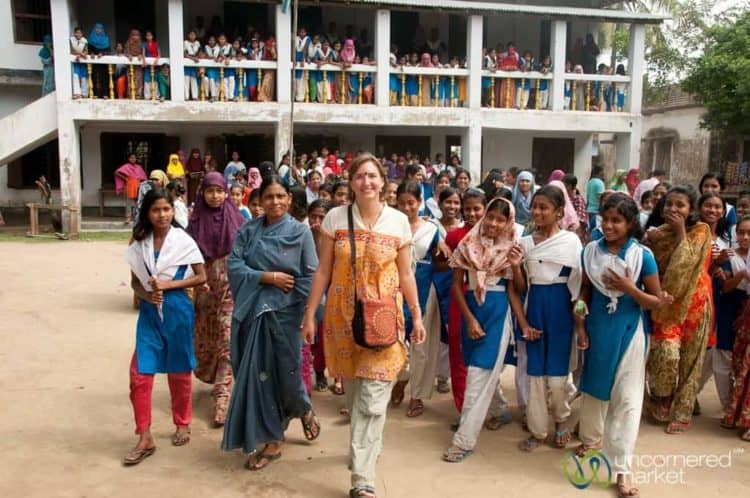
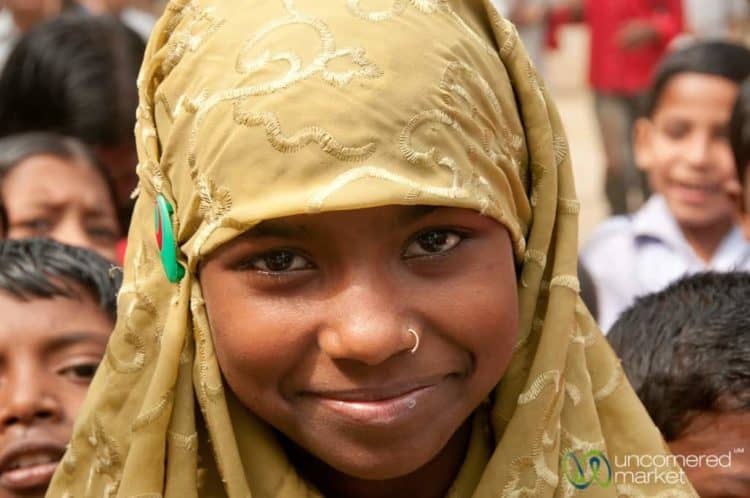
And people will ask many questions — that help them learn about us and that we believe say much about their culture. So we offer images of a few of the people we’ve met, the questions they’ve asked, and the way they’ve asked them.
1. Your country? Japan?
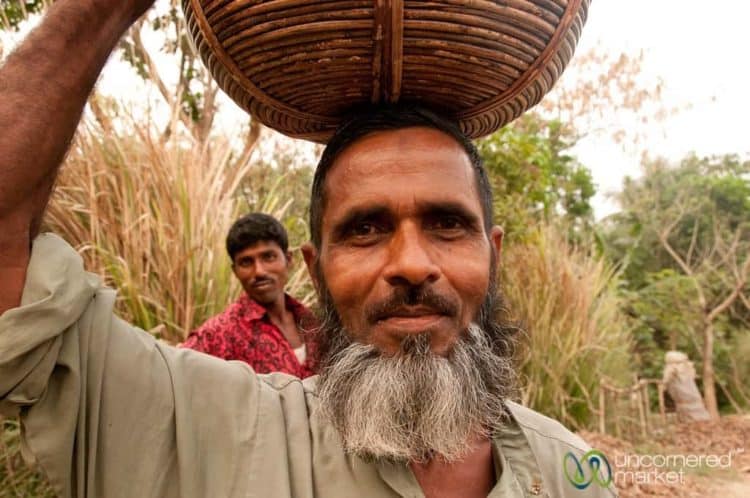
The Bangladesh version of “Where are you from?” echoes from rickshaws to shop fronts, from juice stands to lean-tos.
It took a while to get used to the drive-by nature of this question. People would emerge from out of nowhere, ask “Your country?” and disappear into the crowds even before they’d gotten an answer.
Bangladeshis would also often guess or offer “Japan?”
To which I wonder: Does this mean I'm turning Japanese?
Or maybe I just take a lot of photos?
2. What is your name?

“Audrey” confounds. A struggle for all to absorb and repeat her name. To make life easier next time in Bangladesh, she’s “Asmani.”
“Daniel” is also subject to occasional mangling, but is usually easy enough to yield sighs of relief.
Note to future parents: If you’d like to know whether the name you're considering for your child is travel-friendly, we're here to help.
3. What is your academic qualification?
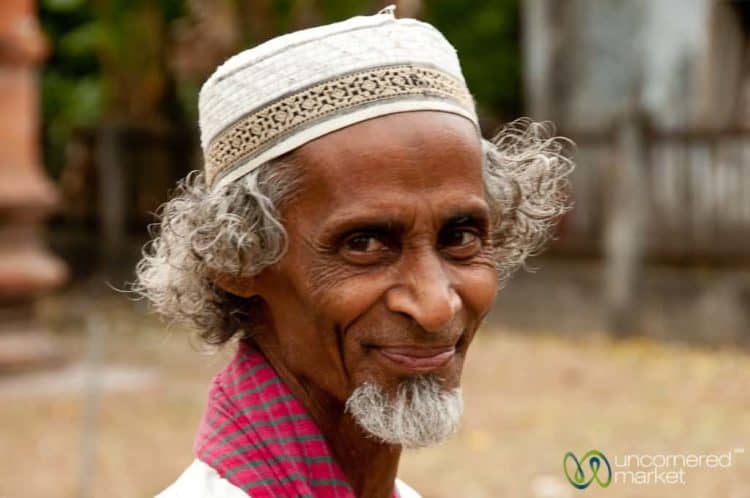
Another result of British-dominated formal English instruction.
In a country like Bangladesh where education is highly valued and pieces of paper with acronym-laden distinctions are prized, this is an important “I'm trying to figure you out” data point. What you study and whether and where you go to university in Bangladesh (and often times around the world) sets a path for the rest of your life.
Our degrees in economics seem to be widely accepted as a “good degrees.”
4. What is your occupation?

Yikes. Good question even for the native English speaker.
Things like “blogger, writer, photographer, website developer” get blank stares.
After all this, we’ve realized that most Bangladeshis don’t really want to know what we actually do, but rather in which category we do it: NGO, government, military, teaching, business. Having said that, I’m still not certain in which occupation box we belong.
“Business,” however, gets nods of approval all ‘round and moves the conversation on.
5. What is your relation?

Husband. Wife. Married.
Looks of surprise. Perhaps this has something to do with the fact that – particularly to Bangladeshis – we do look a bit alike. However, we suspect this has more to do with how we interact with one another and how we engage with people somewhat equally. In the local context – a conservative and predominantly Muslim one – we do not behave in public as a typical Bangladeshi married couple might.
While most people are excited and often relieved to hear that we're married, I’ve noticed more than a few disappointed faces amongst guys when they find out Audrey is not available.
6. Do you have children? How long have you been married?

Oy, vey. Can we just skip this one? What a tangled web we’ve woven here.
When Bangladeshis hear, “No children,” they’ll follow it up by asking the length of our marriage. In response to this, we’ve been reduced to fibs, shrinking our married life from over ten years to one or two years.
The reason?
When people hear ten years married and without children, we become the object of their pity. A line of questions suggesting “Who is the problem?” follows, along with advice regarding fertility testing, impotence, home remedies and even surgical procedures.
In Bangladesh, the concept of choosing to wait to have children or choosing not to have children at all does not compute. In this, our white lie saves a bit of discomfort and confusion – that is, until someone shouts “Honeymoon!”
I don’t even want to think what they’d have in store for that.
7. Have you been to Cox's Bazar?
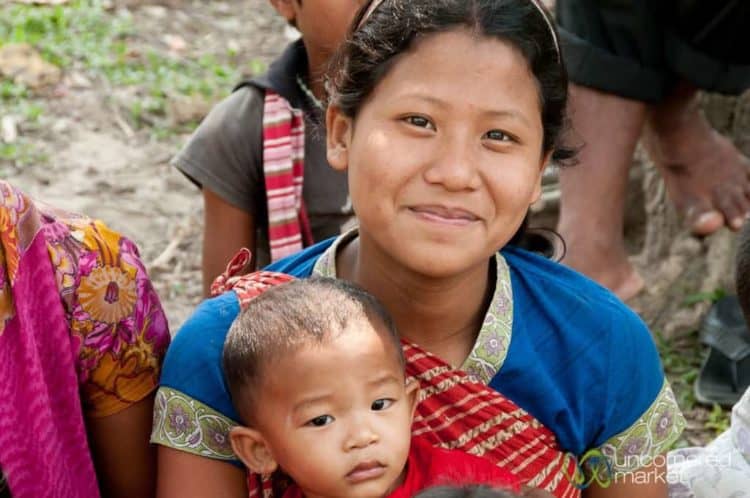
Cox’s Bazar, the site of the longest continuous natural stretch of beach in the world (120 km), is the premier vacation spot for Bangladeshis. Even Bangladeshis who've never been demand that we go.
If Bangladeshi people could put the same energy and focus into road safety that they put into promoting Cox's Bazar, perhaps I wouldn’t fear my own death on a road trip there.
8. What is your mother-in-law like?
Shanta, a woman who befriended us on a cross-country train trip, asked Audrey this one. It was one of the first questions she asked and she delivered it with a measure of urgency.
Shanta was relieved (as was I) when Audrey responded that her mother-in-law was very nice and that they got along well.
Why is any of this important in Bangladesh?
It remains common practice that newly married couples move into the husband's family home. The mother-in-law is like the queen of the house. She wields some power over the newlywed couple, including over some critical aspects of her new daughter-in-law’s life.
In this context, a woman’s relationship with her mother-in-law can be make or break.
An example of the power a mother-in-law can have: Audrey asked Shanta whether she planned to work after attending university and getting married. Shanta's response: “I hope so. It depends on my future mother-in-law. She decides. But I am lucky because she is kind. I think she will allow me to work.”
9. Do you have corruption in your country?
Asked rather naïvely by a young judge we met on the train.
We do have corruption in the U.S., it's just branded a bit differently and it's not quite as debilitating as the Bangladeshi variety.
To say that corruption is rife and possibly the single greatest issue affecting – and holding back – Bangladesh is not only our opinion, but also that of a wide swathe of people from across the socioeconomic spectrum. On this topic, Bangladeshis certainly seemed in agreement.
10. Are you Muslim?

Also a popular question. Approximately 90% of Bangladesh is Muslim. So Islam is one of the primary cultural influences on Bangladeshi society and culture.
Audrey was caught off-guard the first time she was asked by an older man dressed in traditional Muslim attire: “Are you Muslim?”
She answered, “No.”
“Oh, that’s OK,” He responded.
Refreshingly open: That anyone could be Muslim, and that someone in Bangladesh could also not be Muslim.
And that this was all OK.
—–
What are some of the more unusual questions you've been asked in your travels?
Loving this playful post and the way you’ve presented the infinite loop of curiosity that meets you at every turn. And as always, just terrific photos!
You can learn a lot about a culture from the questions people ask you. And even more from their shocked stares when you answer. Enjoyed the post and love the photos!
Very entertaining post! It reminds me of the questions we got asked in India. The marriage/children question is tricky for us too – how do you explain we’ve been together for 10 years but aren’t married (and don’t plan to)? We often resorted to a lie too.
Can you tell us more about the school that you visited (the one in the photo above with Audrey). For example: Did someone arrange the visit for you? Was it a public school? Are the schools generally segregated by sex for all ages? Did someone take you around to different classrooms and discuss what the girls are learning? Wonderful article, as usual!
Love reading this blog. Pictures are breathtaking. Dialogue is refreshing. Now if I could just see somewhere other than my backyard… 😉 Keep it up D & A!!
This is great, and certainly speaks volumes about the society you’re traveling through. I’ve never been to Bangladesh, but I know it’s very similar to India. And being an Indian American has allowed me to rarely hear these types of questions directed at me. Nice pictures too!
I really loved reading this. I found myself nodding along because of the questions or stories I get from my students. I teach ESL to immigrants in California, many of whom are from Moldova, Afghanistan, Uzbekistan, and Vietnam, and I get plenty of questions like these (Are you Christian? How many children do you have? Why are you working?). They always seem relieved when they find out I have 2 kids and am married. Family dynamics and corruption seem to be universal topics! 🙂
Some of these questions are rather forward! What was your reaction like the first time? I always find these cultural customs to be so interesting– how one question is perfectly acceptable socially but carries different implications in another culture (like the discussion on the length of marriage). In one of my classes, we also just read an essay on colonialism and the English Only policy in US schools. Question 3 stuck out particularly to me, as a result of this. The essay discussed how one result of this colonialism was a disconnect between language and culture– did you ever get a sense of this while you were visiting the schools?
@Jodi: Thank you. Certainly no shortage of curiosity in Bangladesh. An infinite loop it was.
@Stephanie (#1): Glad you enjoyed it. In Bangladesh there’s a lot to take in — from the people, their questions, their stares. Did I mention their stares?
@Erin: Some overlap with the questions we were asked in India, but also some distinct differences as well. I’d also say that the general level of intensity (of the crowds, and of individual curiosity) was quite a bit higher in Bangladesh than it was in India, which I know is almost impossible to imagine.
As for being together for 10 years and not being married, I’d suggest you play married. In Muslim countries, a must. In some, you might just find yourself in a spot of trouble if you don’t fib.
@Kathy: Thank you for your comment. Good question. We are going to write at least two other separate posts that address your questions in greater detail. In the meantime…we did a homestay with Eco-Connexion during which some reps of the organization took us to the school. But it would be possible to go on your own. The kids were beyond thrilled with our visit. Classrooms are small and packed. One class had 91 students in one room (actually only 57 showed up that day). Regarding segregation, it’s not Bangladeshi government policy, but kids tended to be co-ed in the elementary school grades and segregated in later years. But it really depends on the school.
@Stephanie (#2): Your comment made me smile, laugh — especially the bit about the backyard. Thank you 🙂
@Jenna: Family and corruption make the world go ’round. Thank you for sharing your experience. In this world, we all have a lot more in common than we think.
@Vivek: Thanks! Certainly there are some similarities between India and Bangladesh, but some surprising differences, too. We’ll elaborate in our upcoming posts about Bangladesh. So you aren’t asked such questions in the U.S. Would you like to be asked them more often?
@Roy: Well summed. And yes, completely innocent.
@Mike: Thank you for a very thoughtful comment.
Our reaction in Bangladesh was overwhelmed — not so much because of the nature of the questions, but the volume of people asking them.
By this point, we are pretty well accustomed to rather probing questions regarding everything from how much we make to the details of our sex lives. The world is not a bashful place.
Regarding disconnect between language and culture, context and tone are critical, but most of the time, we were happy just to understand the basic words and concepts people were trying to get across. Particularly when it comes to formal training of English, it’s as if the meaning of the words being taught have sometimes been lost. And so with it, the culture behind the words. But I suspect this is true with any language instruction.
While visiting schools, we usually interacted with groups (mobs) of kids, so we were less focused on the details of the conversations and more focused on effectively sharing our attention among dozens or hundreds of students. During our homestays and random family visits in the countryside, we had a greater chance to interact more deeply.
@Iain: I’d say we were equally curious of one another. The problem is that Audrey and I were well outnumbered.
Listening is a great tool. If people we meet are interested in asking questions, I’m more than happy to sit back and listen. Just by what people choose to ask, how they choose to ask it, and how they react, we are able to understand a great deal.
During our visit, we were also very fortunate to interact with people from everywhere and with varying levels of education. And when the opportunity presented itself, we asked plenty of questions and went very deep, always attuned to what would be interpreted as respectful.
And it served us well. We absorbed a great deal about life and culture in Bangladesh in a relatively short period of time.
@Jeannie: Because we were asked these questions so many times by so many people, this seemed like a natural way to present what we experienced. Put the people front and center. After all, that’s the main event in Bangladesh. Glad you enjoyed it. (Am also glad you experienced something similar in India!)
Interesting. I find in Asia people ask more intrusive questions but in an innocent way.
I love this post, I’m always so curious about what others are curious about. Thanks for the insight 🙂
What an excellent idea for a post!
It’s interesting how people in far away places are often more curious about you than you are about them. I’ve sometimes regretted allowing people I meet while travelling to do so much of the asking, but it’s easier: you know that they’re from Bangladesh and, if they’re old enough, married. And the basic outline of a person’s life is so narrowly defined by culture that if you asked some of these questions, you’d get the same answer again and again. It’s also hard to get used to asking questions that would be considered rude in the West.
This post left me shaking my head and laughing. The numerous times I’ve had to answer similar questions in India.
I think the benefit to this is the chance to ask the same questions. Time and again I learn so much!
Very unique way of presenting this alongside some intimate portraits. 🙂
Which part of Bangladesh are you guys visiting? I live in Dhaka, the country capital. And well things would have been quite different if these questions were asked by someone from the city. Enjoyed the question/answers though! I can totally imagine why villagers would ask you such questions and react in such a funny manner.
@Shannon: Glad you enjoyed it!
@Robin: Was definitely a funny experience. A little overwhelming at times.
We visited Dhaka (e.g., Old Dhaka, Lalbag, Kotwali, Shakhari Bazar, Chowk Bazar, New Market), stayed with a friend in Gulshan and had some business in Banani and Bashundara. Areas like Gulshan and Banani didn’t feature these kinds of interactions at all. But, Old Dhaka and walking through other parts of town definitely did – these places broke us in for what to expect in the rest of the country.
As for our travels through the rest of the country: we took the “Rocket” steamer to Pirojpur and then visited Bagerhat, Khulna, Rajshahi, Nattore, Puthia, Bogra, Joypurhat, Paharpur, Srimongal, Chittagong, Bandarban, Rangamati, and the dozens of villages in between.
@megan: Some might characterize this as a different sense of personal space (of both the physical and emotional variety).
The “Where are your friends?” question is probably the solo traveler equivalent of “No kids?” for the married set. Asked as if there’s something wrong with you.
The sunglasses question — I love it. On one hand, it sounds like a violation. On the other hand, I understand wanting to see someone’s eyes. They do tell a lot. But depending on the guy asking, I imagine a single woman could be more than a bit suspicious.
Yep, in some parts of the world people are a lot more forward than they are in the west 😀 I get asked the above questions all the time plus – why are you alone? Or “where are your friends?” (and that one really hurts when it’s called after you as you’re charging down the street having one of those terrible days in India that happen every now and again!)
Arriving in Cairo, the first thing the taxi driver from the airport asked me was what religion I was, followed by could I take off my sunglasses so he could see my eyes. Hmmm!!
Love this! In China I’ve gotten a few nosy questions- mostly about my marital status and my blonde hair. Lately though I’ve noticed a lot of Chinese students have been asking more political questions like why Americans are allowed to own guns! Never quite sure how to tackle that one.
Great collection of portraits! Such a difficult skill to master, you’ve captured the people very well. The first photo is one you’ll reflect on fondly in 30 years – it’s fantastic!
Really interesting post! cool questions and insight into the culture over there. I live in and blog about my life in Europe, but I don’t think I’ve ever experienced questioning like you! One thing that did surprise me in my travels happened while I was in the back woods of Norway. I was in the middle of nowhere, staying on a farm with a couple rooms for rent. There was an old woman living on the farm, and one morning at breakfast she just started chatting and chatting with me in amazingly fluent English! I was living in Germany at the time, where many people even in the main city struggle to speak out a good English sentence, and yet, this old woman in the middle of nowhere Norway could have spoken for hours. lol
Dan, Audrey, great story. The photos fit perfectly. I love the photo of Audrey at the village school. This makes me want to be there now!
When I was in Zambia a few years ago. I was walking through one of Lusaka’s markets. A rather old market stall holder asked me if I would marry him as I was “just his size”!
what an amazing idea for a post. love both the photos and the text.
its crazy how much you can learn about a person from the questions they ask about you.
Another great post you two!
The best (or funniest) question which I’ve gotten was the “What religion are you?”. Not because of the question, but the way it was asked. I was working in Istanbul in a gypsy neighbourhood with some children (who didn’t speak English) when one of the children asked me the question during the Muslim prayer call. He looked at me and went “you?” and gestured with his hand behind his ears the way Muslims do when they pray. I said no. Once again he goes “you?” and does chopping gesture to his index finger.
Initially I didn’t understand but quickly realised what he meant and I burst out laughing as that gesture meant being Jewish (Use your imagination for what that hand gesture). My translator later confirmed this. In the end I just gestured a cross to indicate Christian (as Agnostic was too hard to gesticulate!)
Unbelievably stunning photos on this one -WOW! The mother-in-law question floored me – made me think how different my life would be if my mother-in-law had more say so! -Veronica
Love the photos and the questions in this post. I was asked once in a Nairobi slum by a child if I was from China… as I’m standing by a friend of Chinese descent. I guess my blond hair didn’t quite answer the question for her 😉 Also traveling so much in Africa, I got asked A LOT, “Do you know Obama?”
Great post and photos. Traveling around Asia a lot of these questions come up regularly. I think my favorite is the corruption question. I’m sure I’ve never been asked that one!
Stunning shots of the people.
@Daniel – I was definitely suspicious! In the end I refused – better that he didn’t see me rolling my eyes at the ensuing “but you are so beautiful” proclamations. Sigh…!! 🙂
Great photographs here guys! Also, love the article of course. Enjoying everything that you’ve been posting on Bangladesh. It’s making me want to go there, whereas before I was decidedly on the fence.
Here in Korea, “where are you from?”, “how old are you?”, “do you have a girlfriend?”, and “do you like kimchi?” are the questions I’m asked the most frequently!
Yom
@Steph: Gun questions, now that’s new. We didn’t get those while traveling through China. Perhaps the questions you were subjected to were related to the latest round of “news” on CCTV?
@Cam: Thanks! We’ll definitely have a lot of people and gatherings to remember from Bangladesh in 30 years.
@WAdventure: Norway…cool. I asked Audrey to marry me just north of Tromso. Now there’s a question for you!
Based on traveling through Europe and living in Prague for 5 years, the questions were definitely of a different sort and never quite as forward, or as humorous.
@Brian: Thanks. If you are ever starved for attention, I know a few village schools in Bangladesh you can visit. Was quite an experience!
@Sarah: My reaction to this is somewhere between “Oh, isn’t that nice.” and “Hmm, creepy.” I’m guessing, hoping it was of the more innocent variety.
@jamie: Glad you enjoyed it. It’s amazing what we learn just by listening.
@Tony: Sorry about our gnarly comment system. Your story is hilarious. And truly unique. A perfect example of cultural differences and how people around the world communicate their way through them. I’m still laughing.
@Veronica: I suspect there’s a lot we take for granted in westernized societies when it comes to things like relative freedom, relative equality of the sexes, etc. I suspect a few readers are shuddering at their mothers-in-law making critical life decisions for them.
Am glad you enjoyed the photos.
@Laura: We definitely get the “Do you know Obama?” question. We also used to be asked “Do you know Michael Jackson?” Now that was an odd one.
As for the Chinese descent thing, I guess you were a victim of grouping (with your friend). I wonder what image of “China” (or any foreign country for that matter) the kid has in his head. Fascinating when you think about it. The world is small, but there’s still a lot of distance between us, particularly for some who don’t have the benefit/luxury of travel.
@Nancie: Thank you. Corruption is an interesting one, and definitely something that everyone can relate to.
@Sarah: Thank you.
@megan: LOL! I can appreciate your skepticism. Audrey can even more, I’m sure.
@Tom: Thanks! Glad we could help draw you away from the fence. Bangladesh has its rewards. And I’m sure all of the Bangladeshi people would be glad to see you 🙂
Do you like kimchi? Perfect. Everyone should be forced to answer that one.
Why I am not married at my age, is one of the question I get a lot especially in Asia.
@Sophie: So why aren’t you married at your age? (Just kidding.)
How old are you again?
Great post! I’ve had similar questions, and also give little white lies every once in a while.
When I tell people in Central America I’m single, they often want to introduce me to their daughter, cousin, niece, etc. Sometimes it’s fun to play along, but most times it gets old. Occasionally I’ll make up an imaginary girlfriend.
I also often say that I’m Catholic, rather than Agnostic, to avoid a long complicated conversation. 🙂
First of all, you just inspired to me travel around the world but sadly, stuck with studies 😛
Hope that you enjoyed your visit to my country 🙂
Your post, no doubt, is very interesting.
Never knew my country is the size of wisconsin 😛 new info for me!
Anyways, please do come back cuz we are all missing you here :D..
Btw did you visit the sundarbans ? By seeing the photos i presume you have been to Bandarban or khagrachari as well!!
@Matt: Thanks for the comment. White lies are essential on the road, aren’t they? I imagine the push to be married off in Central America, while charming in a way, can grow old. And when it comes to religion, your approach makes total sense — the simpler, the better.
@Mushfique: Cool that we could inspire you to travel the world. Once you are finished with your studies, right? We are in the midst of going through all of our photos from Bangladesh. There’s a lot there. We enjoyed it. We visited the Sundarbans and CHT, too including Bandarban, Rangamati and the hill villages near each.
I couldn’t agree more with something you said in a comment above– the world is definitely not a bashful bunch. The culture of PC and order in the U.S. makes us surprised that the rest of the world is so direct. And if our time on earth is short, why not speak to each other more directly? 🙂
@Jenna: I’m with you, so long as the directness comes from a good place (usually, it does). Regarding PC in the US, I appreciate it, but like everything else, it ought to be subject to balance. The original idea — showing cultural sensitivity and respect — somehow got hijacked along the way.
Life is short. Get to the point. I like that.
Easier said than done, though.
Awesome photography and some interesting questions. Here in China, when they ask me where I’m from and I say ‘Singapore’. They shake their head vigorously and tell me “no you can’t be from there. Singapore has only Chinese”. Lol. I look Indian.
Cheers
@Usha: Now that’s funny. Last time I checked, Singapore was flush with ethnic Chinese, Indian, Malay, etc. I suppose old bits of bad information die hard. Glad you enjoyed this. Thanks for stopping by!
If you have any query, i would love to response.
pls. check to know something more about our Bangladesh.
http://www.youtube.com/watch?v=Ppf-UA36ljE
@Shofiul: Thanks. I feel like we’ve got a pretty good base of first-hand experience. Stay tuned, more photos and stories about our 6 weeks traveling through Bangladesh to come.
I am a Bangladeshi who has traveled widely in Asia and USA and would like to say that there is nothing like Bangladesh! Incomparably contrasting, full of life, beauty and warmth. Missing my homeland from this damn Texas 🙁
I am a Bangladeshi. My hometown is Gazipur,Bangladesh. It is very close to the capital. I love the way Daniel described Bangladeshi people. Yes, it is very true that we Bangladeshis are very big-hearted and hostpitable. I miss my country and my family.The last time I have visited, it was 2007.Thanks a lot to Daniel and Audrey for sharing your experiences on the website.
@Ashik: Loving your comment, laughing.
@Kamal: You are welcome. I’m glad our article and experiences in Bangladesh could help bring back memories of family back home. Am hoping you get a chance to see them soon!
@Kamal: Great. Looking forward to hearing how it goes!
Actually I’m using some of your positive comments as a source for my public speaking class. This week I’m giving a speech on Bangladesh. My topic on this speech is Why you should visit Bangladesh. Thank you for your response. Kamal Siraji. Department of communication & Information science . The University of Alabama.
My pleasure !! Please keep in touch
Hi Daniel , how are you? My speech went very well . May I ask you where do you live? And do you guys have anymore plan to visit Bangladesh?.
@Kamal: Doing well. Currently on the road in Nicaragua, but we now have a base in Berlin after being fully nomadic for almost 6 years. We don’t have immediate plans to Bangladesh, but I’m sure we’ll get back one of these days.
It’s wonderful! Enjoy your trip.Yes maybe one day you will make it again.
hahaha.. Interesting!
I am a Bangladeshi and I can feel that this post is very much reliable. Bangladeshi villagers are mostly uneducated and their curiosity level is extremely high to foreigners. I was laughing while reading ” Are you a muslim?”, people can ask such rediculous question during their first meeting. It’s funny.
However, in bangladesh, visitors usually discovers poor and ugly things (as they are used to know it as poor). But why so? Why not finding which are more exotics. Bengali nature and culture are enriched. You will find it if you believe “Beauty is the eye of beholder”.
@Jabir: A lot of funny and curious interactions for certain. I’m grateful for interactions — humorous questions and all — provided they come from a good place. That certainly seemed the case for us in Bangladesh.
Indeed, beauty is in the eye of the beholder. Appropriate words for anyone, travelers especially.
Thanks for your comment.
I’m a Canadian-American Bengali currently visiting Bangladesh and the way you handled these questions with class really made me happy.
It brought a tear to my eye to see how open and nonjudgmental you guys were to the average Bengali.
Many people see Bangladesh as a dirty, poor, corrupt, chaotic, dysfunctional mess of a country, fellow Bengalis included.
But you and Audrey never once looked down upon anyone, always kept your cool no matter how ridiculous the question and were overall great people.
My dream in life would be to do exactly as you guys are doing, I wish there could be a way for us to work together someday.
I’d love to travel the world, and open the eyes of the sheltered masses to all the beautiful things there are to see and amazing people there are to meet on this little blue planet of ours.
Hopefully someday our paths will cross, until then keep up the great work guys, I for one have two new great people to look up to and can’t wait to read more about your travels !
Have a good one and safe travels !
Hi Sam,
Thanks so much for your kind comment. It really means a lot to us. When we travel our goal is to meet and learn from local people, and then share those stories to hopefully dispel some of the prevailing stereotypes. And in Bangladesh there was never any shortage of opportunities to engage with people who were so genuinely curious and excited to talk with us. It was such a wonderful experience.