Last Updated on August 27, 2020 by Audrey Scott
Ah, Bali food. Our relationship with Balinese cuisine got off to a rocky start, but a Balinese cooking class in Ubud, night markets in Sanur and simple restaurants called warungs conspired to change our minds and inform our palates. The result: an overview of the components of Balinese cooking, common Balinese dishes and where to find them when you visit Bali.
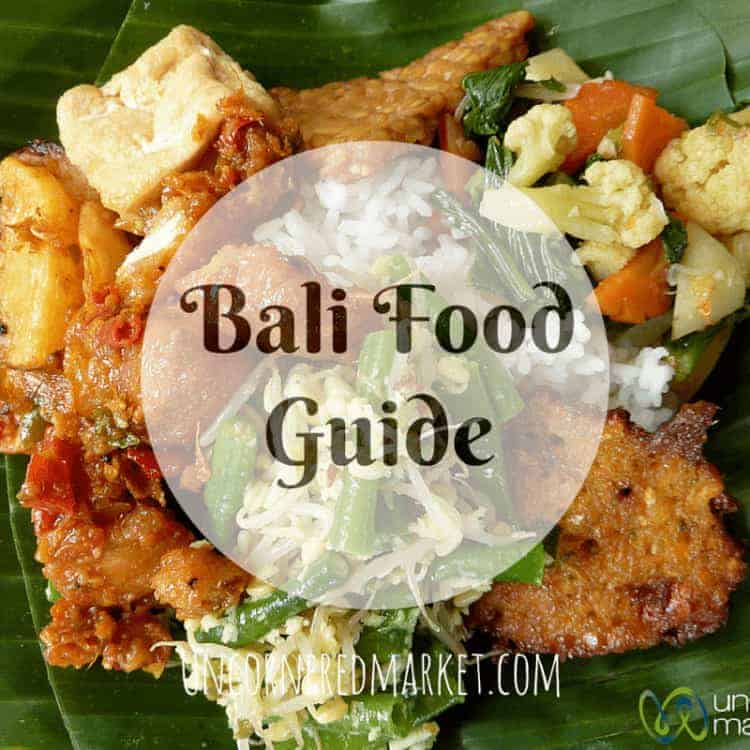
When we first arrived in Ubud, Bali we found a lot of restaurants geared towards foreign palates. Flavor and spice seemed in short supply, our stomachs often felt empty after eating. Menus usually consisted of uninspired combinations of fried rice, mixed rice, underwhelming curries and bland vegetable dishes. We were obviously making some bad choices, but we were also tapping a similarly unexceptional food vein on other parts of the island.
And just when we were about to give up on Balinese food, we discovered the real deal in a cooking course – dishes full of intensity, beautiful flavors and a philosophy and technique that made us want to run to the kitchen and fire up the pan. This was authentic Balinese cuisine, done well, flavorful and unique.
From there, we were inspired to go deep and eat well. This is what we found.
Bali Food: Ingredients and Philosophy
What's at the foundation of Balinese cuisine? To make the point during our Balinese cooking course, our instructor did something really simple but effective — he suggested we taste each of the basic components of Balinese cuisine in the raw, on its own that we'd just purchased at the fresh market in Ubud.
The point: know your ingredients.
Fragrant Seeds (Balinese 8-spice combination): white pepper, black pepper, coriander, cumin, clove, nutmeg, sesame seed, and candlenut.
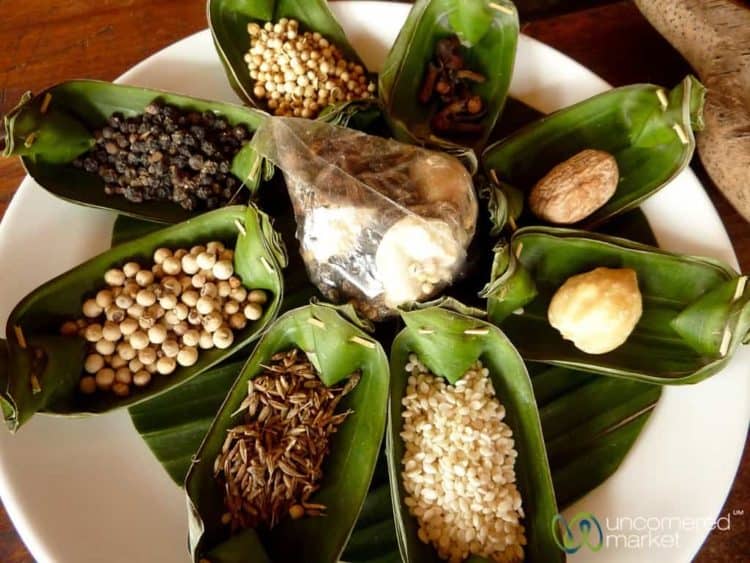
Fragrant Roots: shallots, garlic, greater galangal (what most of us think of simply as “galangal”), lesser galangal (more pepper, almost radish-like), turmeric, ginger.
Chili peppers: Tiny green and red Balinese chili peppers take center stage. Larger red peppers that most of us also consider hot, the Balinese consider “sweet.” Sweet.
Palm sugar: Balinese have a sweet tooth. They also enjoy combining spicy with their sweet. To do this, they use raw palm sugar. This is no ordinary sugar — it tastes like molasses, almost smoky. Go to the local market and you'll find palm sugar in a range of hues, quality and flavor depths.
Fish Paste: Like their neighbors across Southeast Asia, the Balinese also appreciate the role of fermented fish in their cuisine. Sounds gross. To many, it smells gross. But fish paste is absolutely crucial and delightful when used in cooking.
Authentic Balinese Dishes from our Cooking Class
Authentic Balinese food is not easy to find. As some Balinese we spoke to tell it, Balinese specialties are time- and ingredient-intensive, and as such they are usually reserved for special occasions and are not often found in ordinary restaurants.
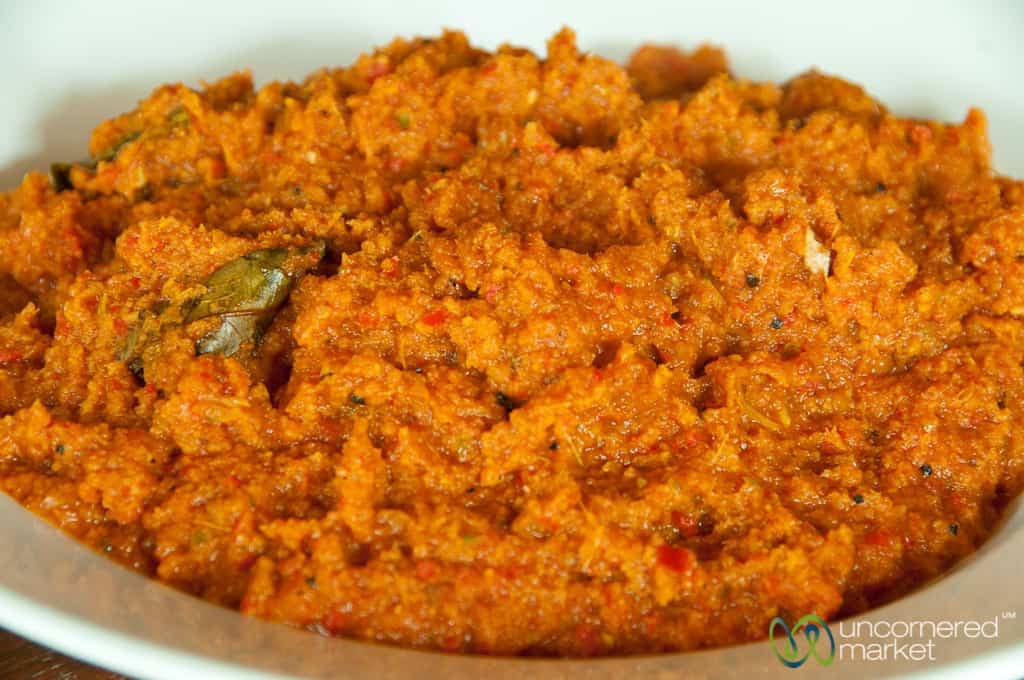
Basa Gede (or Bumbu Bali)
Balinese use either sambal, a chili-based sauce, or basa gede, a basic spice paste to give the best Balinese dishes their distinct flavor and kick. To make basa gede, put all the fragrant seeds and roots into a blender with a little fish paste. The result: a paste thinner than a Thai curry paste that can be used in myriad ways, as we'd find out in our cooking course.
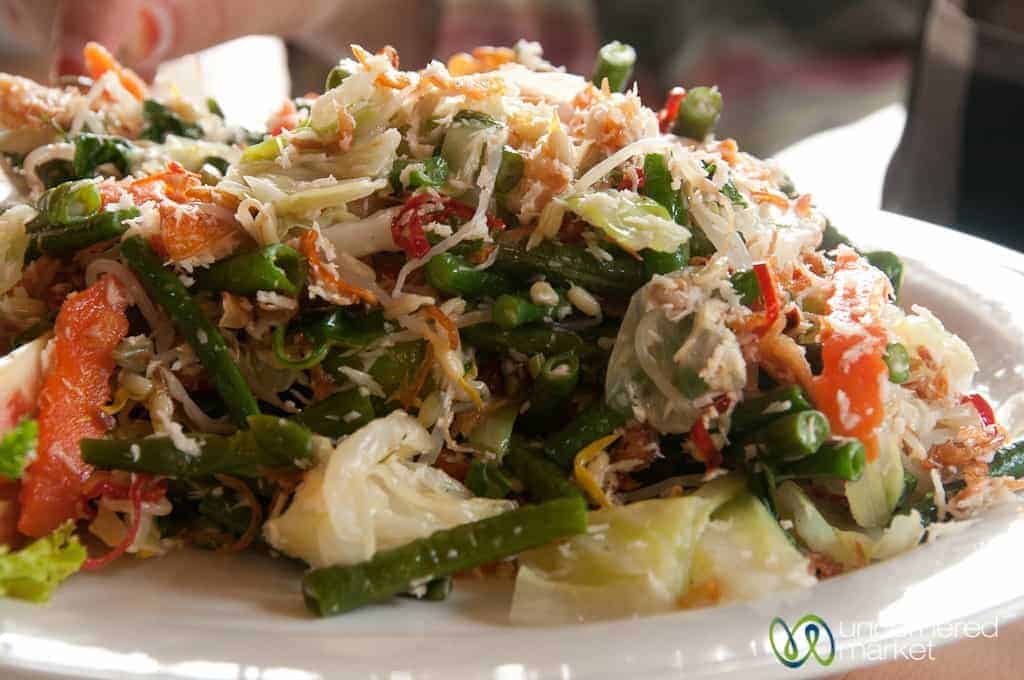
Sayur Urab (Mixed Vegetables)
We learned the hard way that not all sayur urab is created equal. The first time we tried this at a restaurant, we called it “boiled salad” or more accurately, a tasteless pile of boiled vegetables. Done correctly, it’s actually a delicious and healthy dish of mixed vegetables combined with grated coconut and a lovely, crunchy sambal of crispy golden-fried shallots, galangal, chili peppers and garlic.
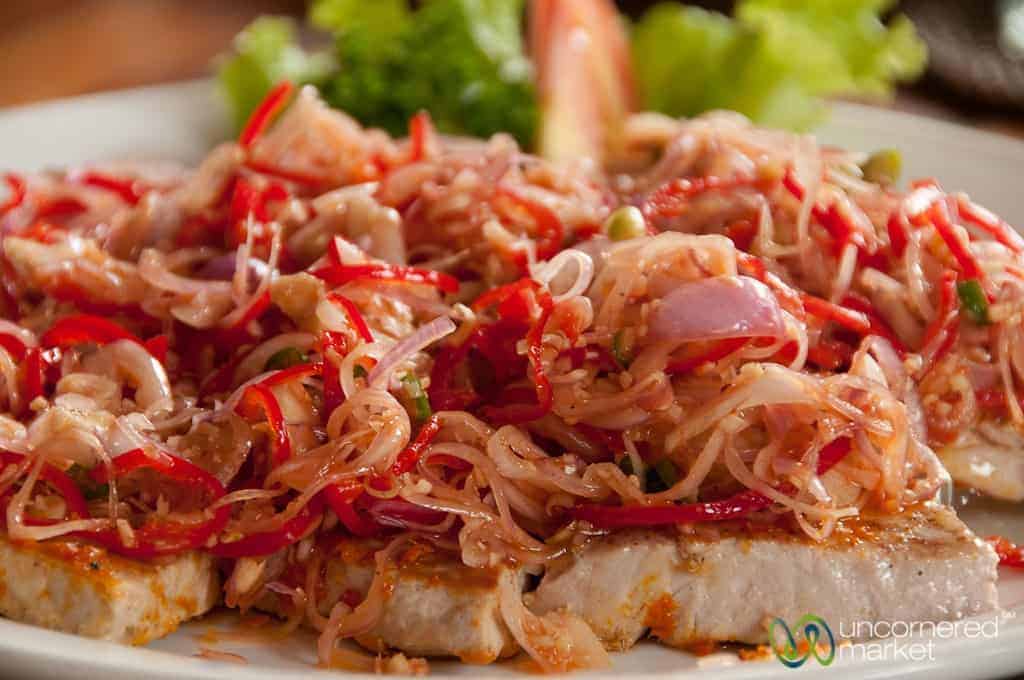
Tuna Sambal Matah (Seared Tuna with Raw Sambal)
Perhaps our favorite dish of the cooking course. Fresh tuna is covered with basa gede (Bumbu Bali) and seared in a hot pan. The “raw” sambal topping is composed of chopped shallots, lemongrass, chili peppers, and ginger all doused in lime juice. Yes, it tastes as fabulous as it sounds.
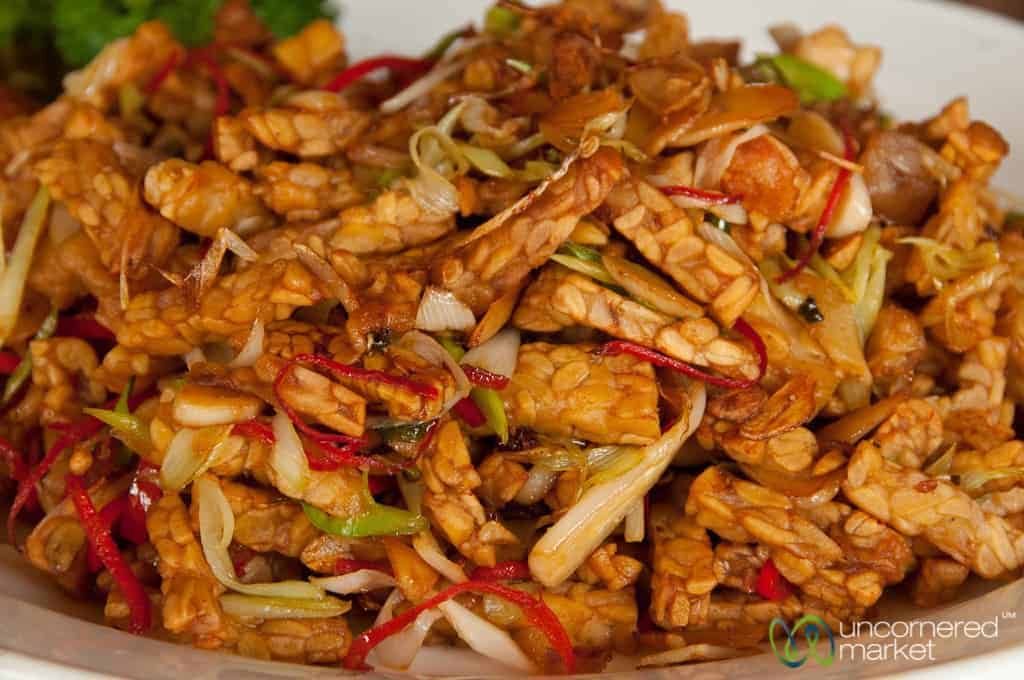
Tempe Manis (Tempe in Sweet and Spicy Sauce)
Tempe (or tempeh), boiled soybeans pressed and fermented, is a common ingredient in Balinese and Indonesian dishes. In tempe manis, the tempeh is cut into small pieces and fried until crispy. It's then tossed in a sweet palm sugar sauce turned with fried garlic and chili peppers. Great taste, a texture play.
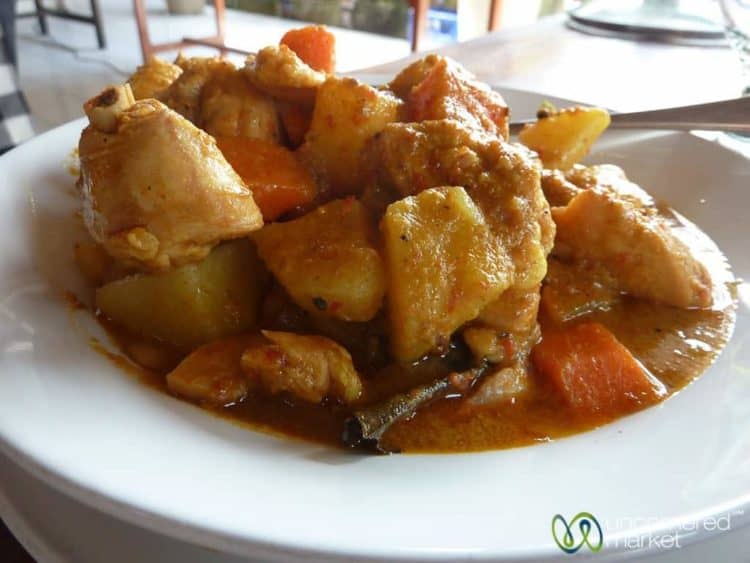
Opor Ayam (Chicken Curry)
Chicken, carrots and potatoes in a spicy curry sauce of basa gede and coconut milk. Delicious and rich.
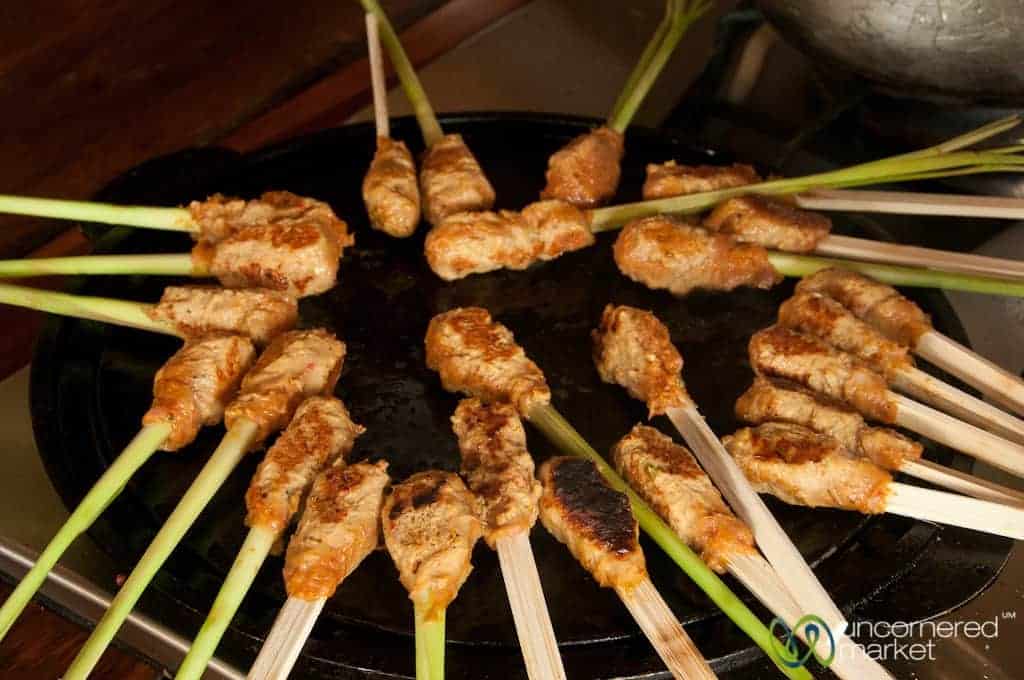
Bali Sate Lilit
A twist on what we know of as sate, or traditional Indonesian meat skewers. In sate lilit, a uniquely Balinese dish, minced or ground meat is blended with bumbu Bali and other spices. The minced meat mixture is then lumped and twisted around a wooden skewer or lemongrass stalk, and grilled.
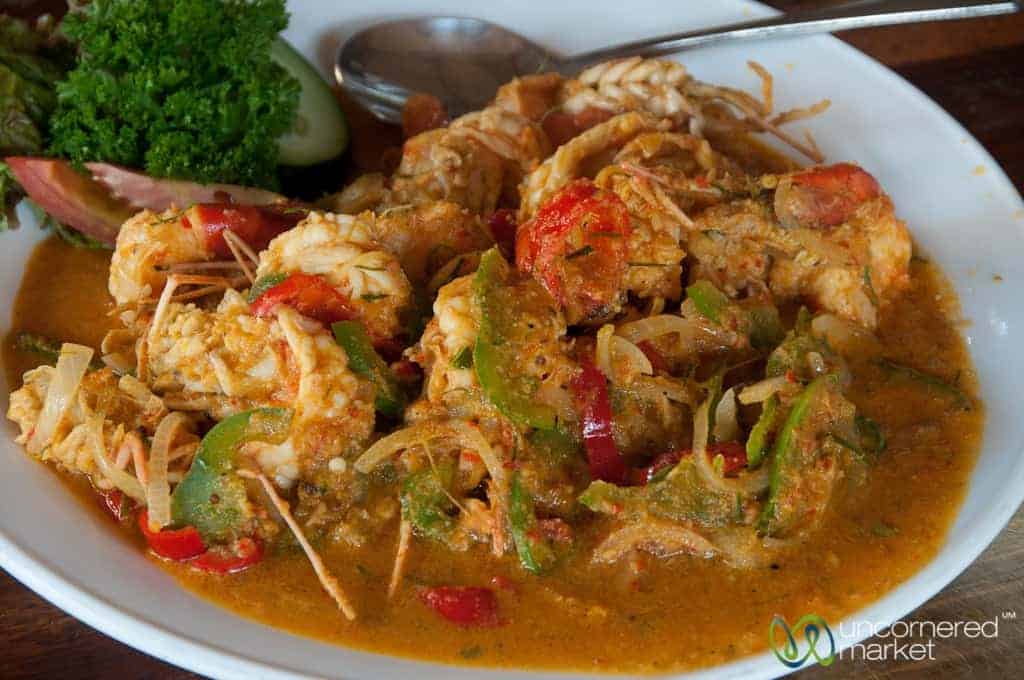
Sambal Udang (Prawns in Spicy Sambal Sauce)
The final crown jewel dish in our Bali cooking class, and it was over the top. Large prawns flash cooked in a spicy sambal made of sautéed onions, green pepper, and red chili peppers topped with bumbu Bali spice paste and coconut milk. A touch of palm sugar and chopped kaffir lime leaves round out the dish.
Bali Cooking Class Details:
Bumi Bali Restaurant, Monkey Forest Road, Ubud. 250,000 IDR ($30) for market visit, apron, cookbook and cooking (plus eating) all the dishes above. Only one cooking station, but everyone participates by taking turns.
You can also book in advance this Balinese cooking class in a local village or this Balinese cooking class that takes place at an organic farm. Both include visits to local markets and free pickup from your hotel in Ubud.
Popular Dishes in Bali
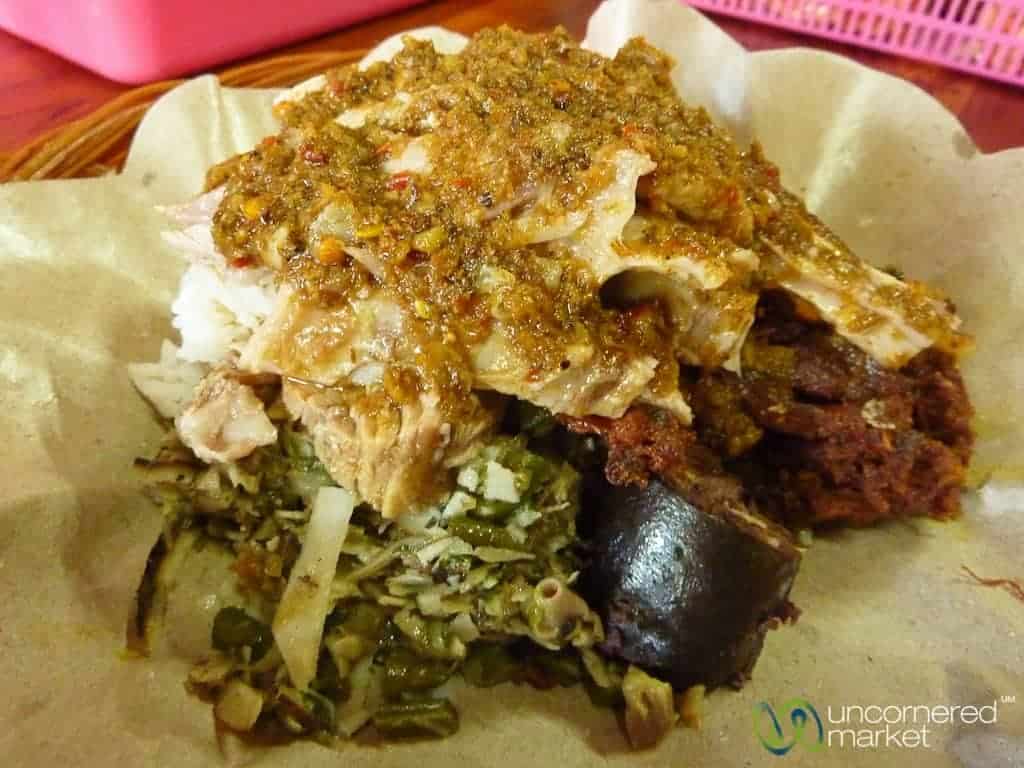
Babi Guling
Suckling pig, spice-rubbed and spit-roasted. Yep, as fabulous as it sounds. Meat is melt-in-your-mouth tender.
Where we ate it: Ibu Oka in Ubud (near the main market). Ibu Oka is babi guling central. Go early as it closes when the pork is finished for the day.
Bebek Betutu
Spice-rubbed duck slow-cooked in banana leaves. Like almost any meat in a banana leaf, the best bebek betutu is beautifully tender and the spices pronounced.
Where we ate it: Warung Enak, Ubud. 65K IDR ($8). A bit higher end than most places we tried, but Warung Enak features an extensive menu with descriptions of where each dish originated (e.g., Java, Sumatra, Bali, etc.). In other words, it's an education. Great décor and service too. Recommended for a splurge.
Beef Rendang
Pieces of meat slow cooked in a mixture of coconut milk, spices, and roasted coconut paste. The coconut milk is evaporated to the point of a dry fry, leaving a rich, thick spice crust. Yum.
Where we ate it: Sari Bundo (Jalan Danau Poso) and Retro Restaurant (Danau Tamblingan 126) in Sanur.
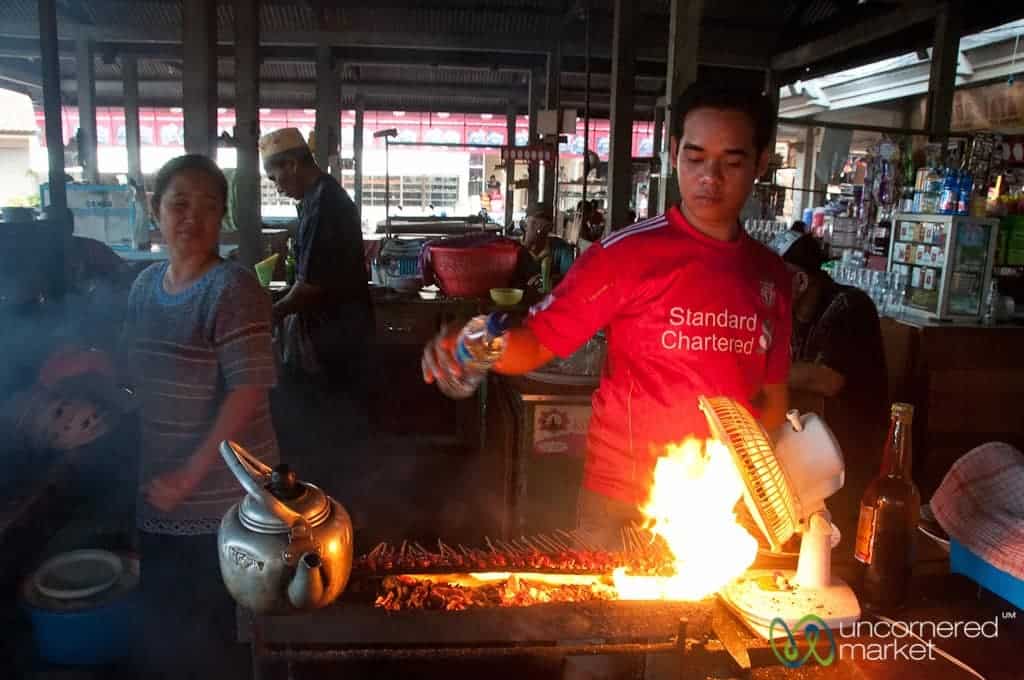
Satay (in Indonesia, Sate)
Pieces of chicken, pork, beef, fish, tofu — just about anything — on skewers and grilled over hot coals. Usually served with a rich peanut-based dipping sauce. Although originally from the Indonesian islands of Java or Sumatra, satay can be found in restaurants and markets all over Bali. We recommend trying something a little offbeat like tuna sate for a special treat.
Gado Gado
A fresh salad combined with mixed cooked vegetables and tofu, served with peanut sauce on top. Although not originally from Bali, this Indonesian dish is served in many restaurants. Ideally, vegetables should be crispy and fresh, although some restaurants serve it as a mush of overcooked vegetables with peanut sauce. Because of the brown peanut sauce on top, this is not a particularly photogenic dish. You'll have to use your imagination on this one.
Nasi Campur (mixed rice)
A plate of rice surrounded by several side dishes. When restaurants serve nasi campur, they usually choose the sides for you. At warungs, the more local street food type places on Bali, nasi campur is up to you. You pick which sides you want – sate lilit, spicy tempeh, chopped vegetables, spice-rubbed meat, chicken, tofu. You get the idea.
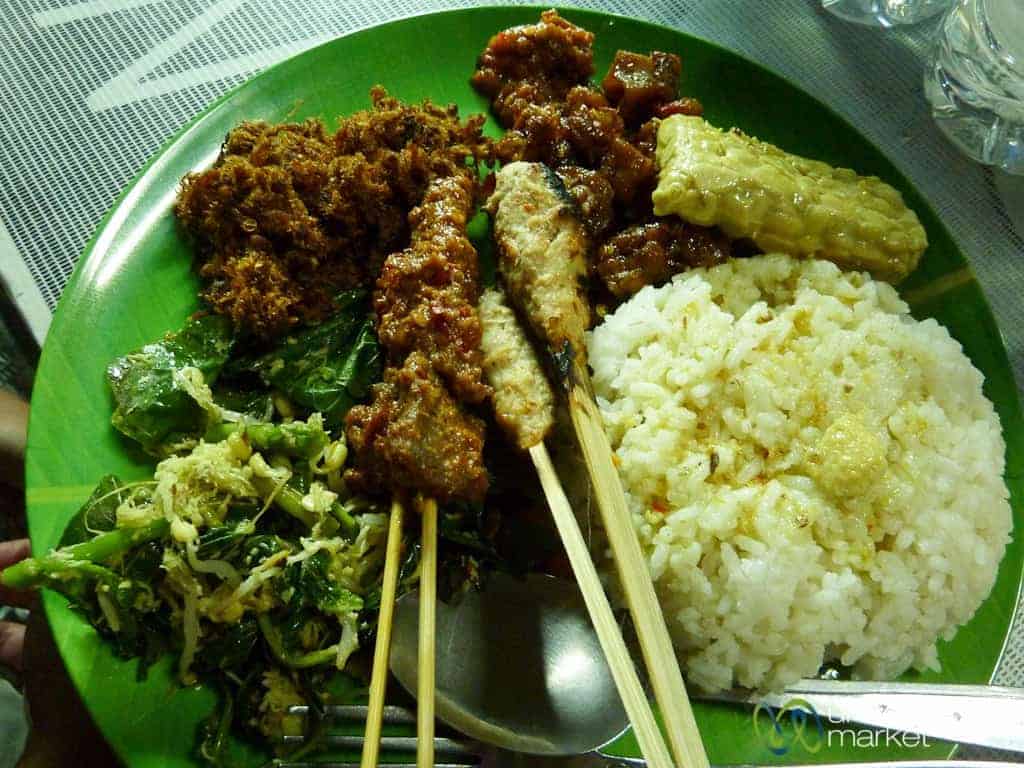
We found this dish particularly uninspiring at tourist-oriented restaurants, so try to make your way to a local market or warung to get something spicy with a more authentic taste.
Where we ate it: Night market and Warung Sari (turn right into alley at Jl. Danau Tamblingan #146) in Sanur, Warung Lokal off of Hanoman Street in Ubud.
Nasi Goreng (Indonesian fried rice)
What country in Southeast Asia doesn’t have its own version of fried rice? The Indonesian style features more spice and tomato paste than your typical fried rice. But at the end of the day, it's still fried rice.
Mie Goreng (fried noodles)
After flavorful char keow in Malaysia and pad thai in Thailand, we could never really get into mie goreng on Bali. It always felt like mie goreng noodles came from a Ramen noodle soup packet, even if they hadn't. And more often than not, there just wasn't a lot flavor. Maybe we just had bad luck. But, if noodles are your thing, there's no shortage of mie goreng to keep you going on the island.
Cap Cay
Sounds like chop suey, doesn't it? While we're not certain of the history, that's probably not a coincidence. A Chinese-style Indonesian stir-fry or stew made with cabbage and other vegetables, depending on where it's served.
Bumbu Bali Fish
Translated as “fish in Balinese sauce”, this dish consists of chunks of fish cooked in coconut milk and bumbu Bali spice paste. Rich and spicy.
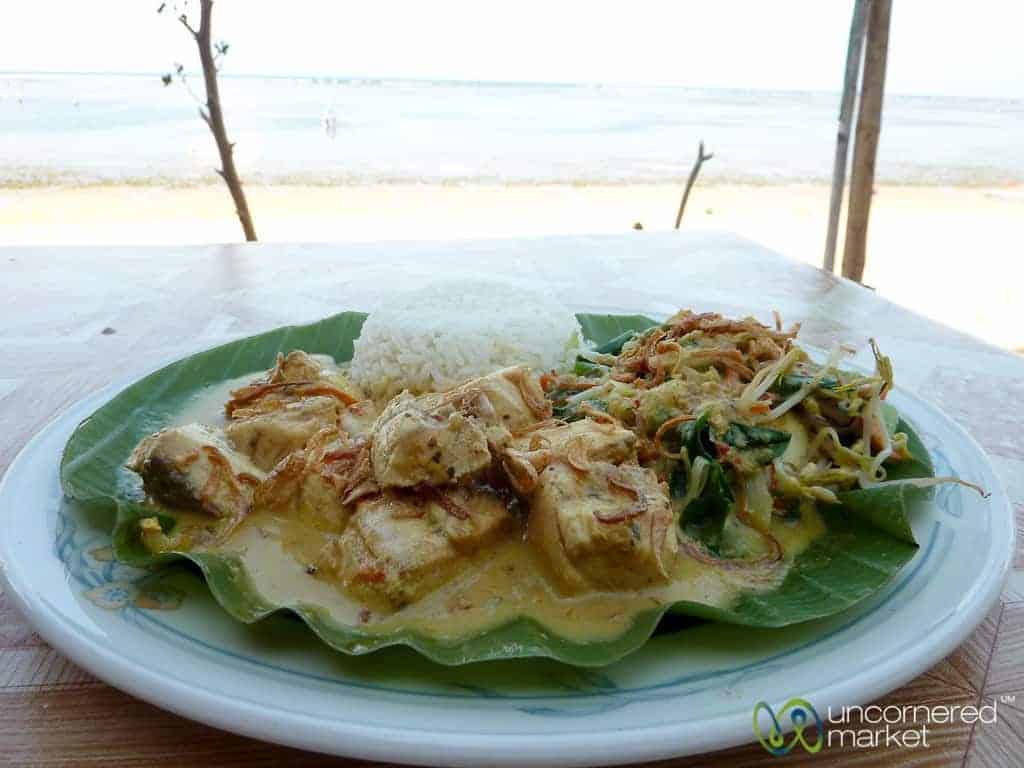
Where we ate it: Pantai Indah in Sanur. With a view of the beach (and supposedly the cheapest beer on the beach in Sanur) to boot, it’s difficult to beat for atmosphere.
Bakso
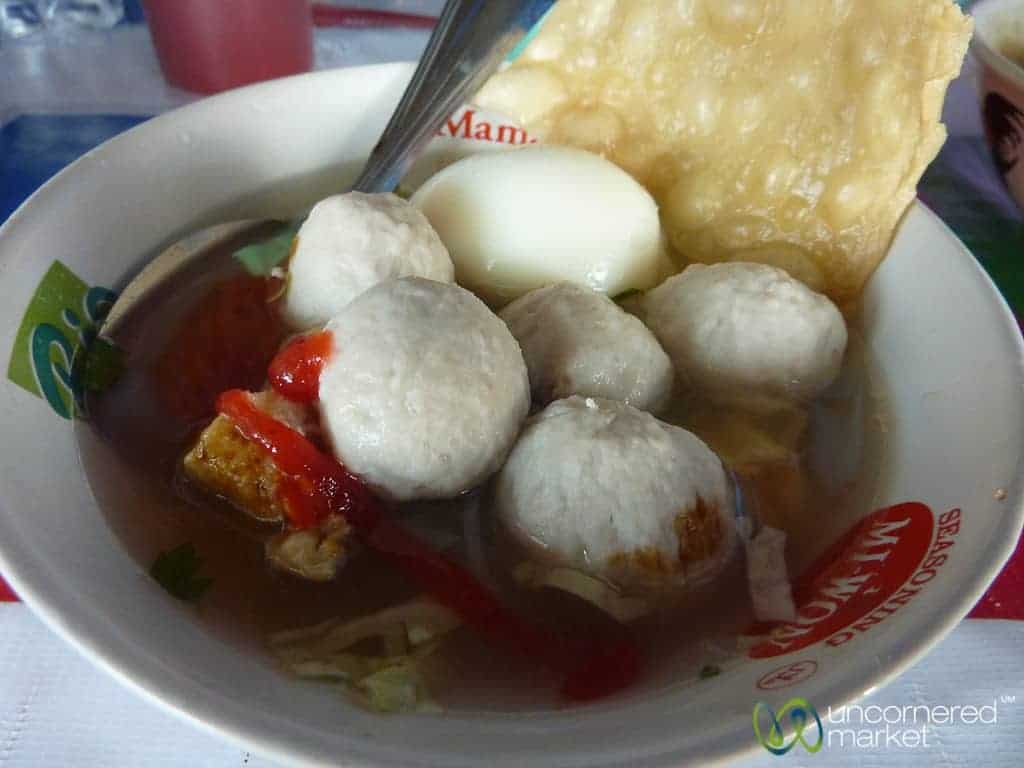
Bakso soup begins with broth and ends with Indonesian meatballs (usually made from ground beef and tapioca flour). Depending on the bakso stand, you'll find some noodles, tofu, and some herbs thrown in. Bakso stands usually offer a choice of condiments and hot sauce so you can make it just as you like it. Be careful with the local chili sauce; it’s incredibly potent. We learned this the hard way, with tears.
Nasi Jinggo
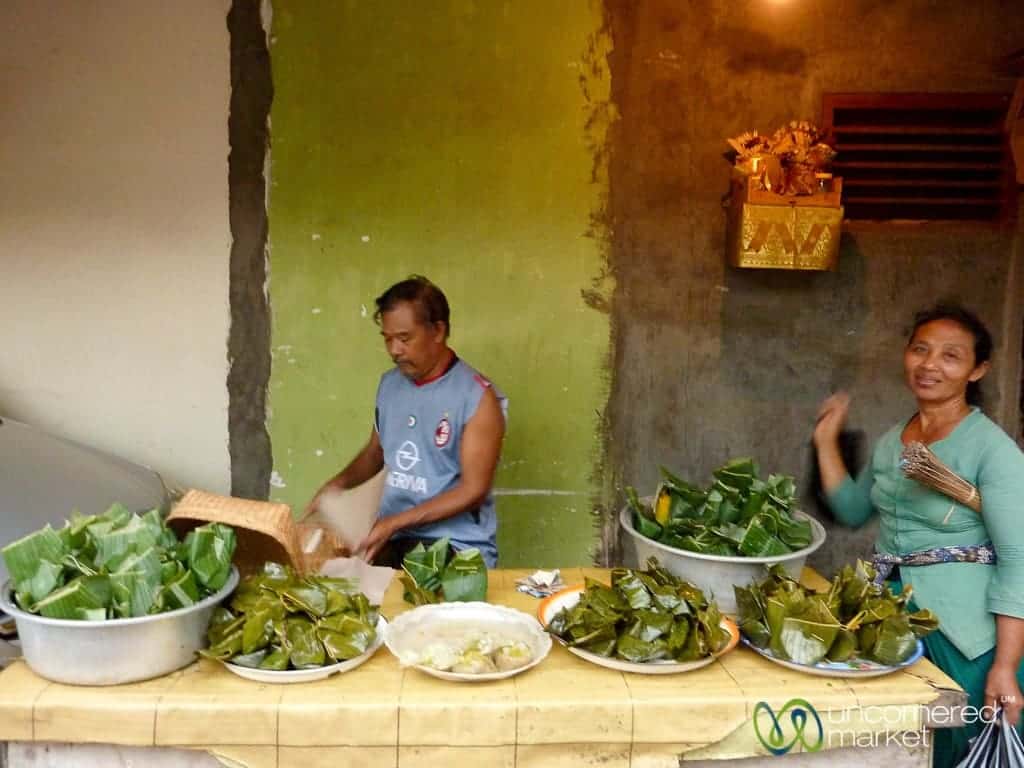
Savory dishes composed of very finely chopped combinations of various ingredients (green beans, green papaya, shallots, pork meat and pork skin, eggs and coconut) and served on top of banana leaves. Time intensive, nasi jinggo dishes tend to appear at ceremonies and celebrations, but if your timing is good, you can find them on the street (image below).
Balinese Desserts and Drinks
Bubur Sum-Sum (Rice Porridge with Palm Sugar Sauce)
Creamy porridge made from rice flour topped with a thick, molasses-like palm sugar sauce and grated coconut.
Bubur Injun (Black Rice Pudding)
Black sticky rice mixed and coconut milk. Our host family in Ubud would also occasionally serve it for breakfast.
Bantal
Sweet parcels of sticky rice, coconut, sugar and fruit (usually bananas, sometimes orange rind or even mango essence). Sri Rathi hotel in Ubud offered them for breakfast and all day long as a pick-me-up.
Luwak Coffee (Kopi Luwak)
Also called civet coffee or “poo coffee.” Why? Weasel-like animals called civets are let loose into coffee plantations at night to satisfy their predilection towards eating only high-quality coffee berries. The civets eat the coffee berry, but they only poop out the coffee beans. Their coffee-bean filled turds are collected and washed. The harvested coffee beans are then roasted over a fire.
The result? The most expensive coffee in the world. A cup of luwak coffee in London supposedly runs about 40 pounds ($65). On Bali, you can quaff a cup at a luwak plantation for about $4. A smooth cup of brew with surprisingly low acidity.
Practical Details for Traveling in Bali
- Find hotels, guest houses or hostels in Ubud, Sanur, or Lovina. Airbnb also has a good selection of apartments or homes to rent if you're staying in one place for a while. (Note: Get $25 off your first Airbnb rental.)
- To reduce plastic bottle waste, refill your reusable water bottle in cafes, restaurants and other businesses for free or a small charge. The Refill Bali map shows all the refill stations on the island. Very cool.
I’d go just for the coffee! You can’t beat a good cup of coffee — was it worth it???
I am drooling. It looks and sounds delicious, and I can just about smell the spices just by reading this 🙂
This is a must try food when you travel in Indonesia. I tried Satay already with my girlfriend in a restaurant and it is really delicious but as I was looking in your post and the images of foods, I think I need to try some of it.
@Amy: The coffee was good, but not enough to pay 40 pounds/$65 for an espresso in the West! If you try it, make sure you taste it first without sugar first for the full effect.
@Dean: Real Balinese food is really delicious and unique – the flavors and textures are wonderful. But, the trick is finding the right spots to get the real deal since the watered down version is lackluster.
@George: Yes, you definitely need to try something more than just Satay! So much good Balinese and Indonesian food out there.
WoW! I wish I hadn’t read this post on an empty stomach 😛 The cooking course looks fantastic. I must admit I’ve only tried a few of those dishes – Gado Gado being my favorite.
Your title is misleading 🙂 Most of them are not specifically Balinese cuisine. They are just usual Indonesian foods and some of them are from other island 😛
@Samuel: Imagine what it was like writing this and putting in the photos on an empty stomach! We’re really glad we decided to take the cooking course – almost skipped it because of the cost, but it really changed our understanding of Balinese cuisine completely. Gado Gado is quite good, although we did have a few rogue experiences where they overcooked the vegetables. Made us value good Gado Gado even more.
@Amalia: It is always difficult to title these posts that combine culinary influences from different areas. The common theme was that we ate all of these dishes in Bali 🙂 Our goal is to help people traveling to Bali know what to expect and look for in terms of food.
The dishes at the top of the article are traditional Balinese dishes from our cooking class. I know there are many more Balinese dishes, but these are the only ones we learned about. Some of the common dishes found throughout Bali do originate from other places in Indonesia, but they are the dishes most prevalent in the restaurants.
Thanks for the wonderful overview of Balinese food. I’d love to try cooking it–not sure where I’ll find the ingredients in France! I once stayed at a friend’s house in Jakarta for a week, and the food–done by her local cook–was absolutely the best I’ve ever tasted.
@Lynn: Eating food at home cooked by a local person is definitely the best way to experience and learn about a cuisine. You might be able to find these ingredients in France if you have Vietnamese or Thai shops near you. It might take some research, but when we lived in Prague we could get these ingredients at the Vietnamese market on the outskirts of town. In Berlin, there’s a similar Vietnamese center with Asian ingredients. If you try cooking any of these dishes, let us know!
@Mark: When you’re coming from Malaysia or Thailand, it’s hard for any cuisine to compete with that! But you’re right, getting to know some locals and finding the right local restaurants can completely turn around your impression of Balinese food. And with sambals, the thing that’s cool about them is that once you understand the concept and basic ingredients the possibilities are endless in terms of combinations and textures (e.g., crispy & fried vs. raw and soft). Hope to experiment a bit now that we have a kitchen for a few months.
@Adam: You’re right, not every warung is serving up good food. But, when you do find one that has great food it’s easy to return every day!
I can relate to you guys and initially being not overly impressed with the cuisine in Bali. Coming from Malaysia, the flavors just didn’t seem to nudge my taste buds enough.
Meeting up with a few local friends and getting some home cooked / local Balinese restaurant food did change things. There were some awesome combinations and I learned to really abusively utilize sambal!
These pictures made me hungry – I’m inspired to get off this computer NOW and eat lunch!
Great post. I’m a fan of Indonesian food and Balinese food in particular. Sometimes it’s quite confronting to get into a warung and try what’s on offer — and it’s not always good! But when you find the good stuff, it is very very good… yes.
The sambhal Udang (prawns in spicy sambal sauce) looks very similar to how prawns are sometimes cooked in West Bengal and Bangladesh as well. Coconut milk is also used for that dish. The Indian/Bangladeshi version is perhaps less spicy (less green chilis). In Bengali it is called ‘chingdi macher malai kari (curry)’ (yes, curry, Bengalis borrow heavily from English or vice-versa; I’m not a linguist, so I don’t know the etymology).
Although not having tasted sambhal Udang, I would not know….it just looks similar.
They say, “For you to immerse yourself with the culture, you must eat their foods.” I think that’s the best way to taste what the country has to offer aside from the scenic landscapes it has. The photos are pretty sumptuous and mouth watering. Those are really great shots. It makes me want to go to Bali to eat!
@Sutapa: Some of the flavors (and ingredients) in the sambhal udang are similar to a few of the curries we tried in Bangladesh and Kolkata, but the difference in flavor comes in the addition of kaffir lime leaves and fish paste. At least, I don’t remember lime leaves in Bengali food, but maybe I’m wrong.
It’s really fascinating to see how some cuisines incorporate different foreign culinary influences. For example, so much of Malaysian food takes inspiration from south India.
@Andrew: I’d add to the quote to say that one of the best ways to get to know the people of the place you’re visiting is to share a meal. Glad you enjoyed this piece and thanks for the kind words about the photos!
How long were you in Bali and tasting the bland food before coming across the cooking class? (And it seems you guys cooked up quite a storm there)–where did you find out about the class.
(Great pics!!)
@Vitra: We were Bali around ten days before we took the cooking class (with most of that time in Ubud). We had tasted OK food here and there, but nothing had knocked our socks off like what we ate during the cooking class.
The cooking class at Bumi Bali was recommended by our Gap Adventures tour leader. We’ve taken cooking classes all around the world and were really pleased with this one – starting the cooking portion of the class by having everyone taste the ingredients raw was a great way to understand the fundamentals of Balinese cuisine.
I guess it is possible to love and hate you at the same time! How could you put these photos up and write how delicious the foods smell and taste knowing I cant taste it. That is just wrong! The basa gede reminds of this paste made from chili powder olive oil and some other spices that my wife’s family use from Ethiopia.
@Kirk: Unfortunately, technology has not progressed to the point where we can click on a food image and the dish pops out. Maybe one day!
Interesting to hear about the spice paste that your wife’s family uses in their Ethiopian dishes. Do they use the paste on meats or in sauces? I know very little about Ethiopian cuisine right now, but hope to have an opportunity to learn more about it soon.
Wow! I should have known not to view this post on an empty stomach. I just came from Bali myself and was blown away by the spicy and extremely tasty food. I have to come back for more. Thanks for posting a very comprehensive article!
Most of Indonesian people like spicy,tasty and very hot chili sauce ( sambal ). Be careful with your stomach if you want to try the Indonesian food
@Lois: I know what you mean – it’s also tough for me to look at these photos on an empty stomach since we are far, far away. Glad to hear you had such a great food experience in Bali!
@Pupie: Balinese peppers are super spicy – even a small amount gave quite a lot of heat to a dish. Travelers should try the spicy sambals, but just be careful not to eat too much so that they don’t have stomach problems.
hmm…I do agree that it’s harder to find good local food in Bali…a lot of things were Westernised. In that sense, Bangkok makes for a better food haunt!
@Lilian: If I had my choice of food across Southeast Asia, maybe I’d do that. But the point of the piece is, if you find yourself in Bali, how to maximize your eating experience in light of all the Westernized food.
delicious! Indonesian food I love the spices used in the recipe.I would try to cook in my home
@riitaa: Cooking Indonesian food at home. Sounds like fun. You’ve got quite a lot of chopping ahead of you if you do.
@Sheila: Thanks for connecting on Twitter and commenting here. Welcome! Glad you had such great eating experiences during your quick Bali visit!
I absolutley LOVED Balinese food when when spent 3 days on the island as a ‘stop off’ on the way home to England from Western Australia. YUMMY!
Bali has very interesting food choices to offer. I like the way they present the food too. In a nicely cut banana leaf.
@MS: Bali food is definitely more interesting than we first imagined. Agreed — for presentation, you really can’t do better than a banana leaf.
I was in Bali a few years ago and I must say the food is amazing. @Mark, I agree with you, but for me I would prefer Thai over Malaysian food!
The best food I ever tasted in my life was in Bali, in a little restaurant at Kuta beach.
Second to that, was the food in Kuala Lumpur when we went off the beated track, down the alleyways in the city. We picked our food before cooking, showing us fish and veg beyond compare. Amazing! And so cheap!
@Sheila: Wow, best food you’ve ever had was in Bali. That’s quite an endorsement. Which dish was it?
I think we must have done the same cookery course, looking at your pics! Just got back from Bali and really fell in love with the food too, I’ve just written a little blog post about it myself – although it’s not quite as extensive as yours – http://worldinwords.net/the-food-in-bali-curries-seafood-and-noodles-oh-my/
@Delia: Glad you enjoyed Balinese cuisine. We just enjoyed a ricetable (reischtafel) in Amsterdam and were reminded of many of the flavors in our Bali cooking course. Glad you had fun!
Its really great to see a food blog on Bali, I have found that not a lot of people are into the Indonesian food. For me its really hit or miss, but your photos look delicious. beautifully done.
@Anika: I think many people aren’t into Indonesian food because they either don’t know much about it or have only had tourist-version Indonesian food (i.e., not a lot of spice or taste). We found that when we dug a little deeper, the traditional cuisine in Bali was really delicious.
Delicious! Food is a major reason I travel, and I’ve recently developed a taste for Indonesia food. Across from where I work in Taipei is a little Indonesian cantina. Delicious food, but mid-week I question its turnover. I’ve had some… digestive issues. But it also sells Indonesian ingredients, so I’ll take a look at these dishes and see if I can’t make something interesting out of them.
But I digress… Thanks for such a detailed post about Balinese food and the photos. I deeply want to go an visit that part of the world! Thanks again, and happy safe travels to you.
@Daniel: Always avoid restaurants without a lot of turnover – sorry to hear you’ve had some problems with the Indonesian place across the way. Hope you’re own cooking adventures into Indonesian and Balinese food go well – just as tasty and you know it’s fresh!!
What I love about food in Bali is its abundance of pork! Bali, being hindu majority, doesn’t have the same disinclination with pork as their muslim brothers in Java. And all the tempe you mention in this post makes me miss it so much! We don’t have them here in Australia. Well, we do, but it’s just not the same.
The copious use of pork in Bali given that it’s primarily Hindu is quite surprising. Hadn’t thought about that, and am also wondering why that is. Now off to poke around and do some research!
The pork is remnants of pre-hindu culture in Indonesia.. of course Hindus are supposed to be vegetarians.
We are heading to Bali at the end month, great overview of the food/restaurants we will defiantly be trying some of these dishes out!
Naomi, if you find anything else exceptional, please let us know. Have a great trip to Bali. Eat well!
Looking at those pictures and looking at your descriptions made my mouth water. I spent a month in Bali last year, and the food really was a mixed bag. Some of the dishes were out of this world! But not all … I was lucky enough to meet a woman who had opened a restaurant, and she was determined to serve the real deal She was a five star chef, but she went into the villages and temples and learned as much as she could. At her restaurant, she tries to stay as loyal as possible to traditional Balinese recipes and cooking methods. The lunch I had was spectacular!!!.
Thanks, Michael. Do you remember the name and location of the Balinese restaurant you are referring to?
I was on Bali last summer and really enjoyed the food there.
Especially the gado gado and satay 🙂
x
Good choices both, Stephanie. Haven’t had gado gado in a while. Time to return to Bali!
your photo of lawar is inaccurate… lawar often comes with babi guling. what you’ve pictured looks more like nasi jinggo; small “meals”which generally include rice with a pinch of noodles, chicken (or some other protein), tempe, a type of veg, and sambal.
Thanks, Rei, for this clarification and correction. We have corrected this in the article.