Last Updated on May 21, 2022 by Audrey Scott
This is a story about a baby turtle and how we helped to set him free. It's also a tale of working together and conservation gone right.

“Blood is heavier than water. The surface of this beach used to be covered in blood, turtle blood,” explained our boat captain, a former fisherman, as he pointed to a sandy beach just down the coast from where we'd launched in Mazunte, Mexico.
He continued, pointing, “See the ramp? It was used to send the turtle meat up for processing. We would take all the meat from inside the shells. Everything was used. Sometimes we processed thousands of turtles a day. The meat was then sent inland. That’s where the money was.”
But that was then, and fortunately this is now.
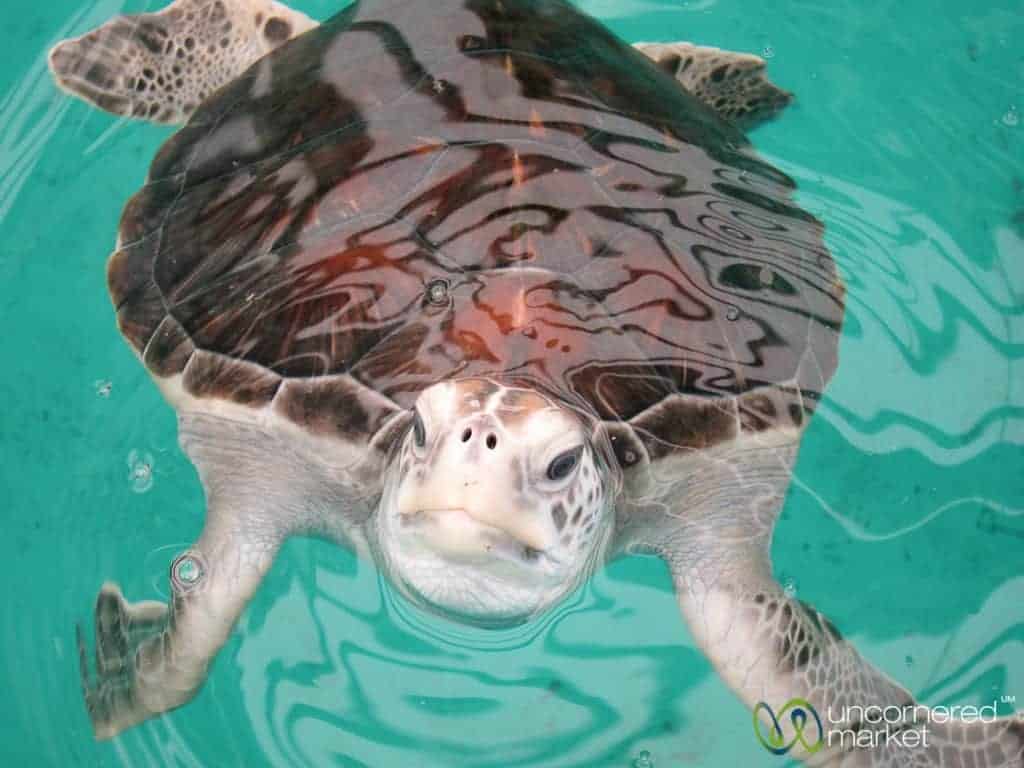
For the sea turtles of Mexico’s Pacific Coast, as well as for its people, this sad backstory comes with a happy ending — in the form of a little turtle like the one above having a chance to survive to full term, hatch into the world, and with a little help, make its way into the wild as nature intended.
From Turtle Harvest to Turtle Preservation
In Mexico, turtles were big business. If the turtle eggs themselves weren’t harvested, grown turtles and every last bit of their physical being were.
In response to declining turtle populations, the Mexican government placed a ban on turtle eggs in 1971, but it was largely ignored. An official ban on the harvesting of turtle meat and eggs followed in 1990, this time with greater enforcement. And although it’s impossible to put a full stop to turtle fishing, the turtle slaughterhouse has shut down and there are steep penalties for people caught trading in turtle meat.
During the transition, however, the Mexican government took into consideration those whose livelihoods depended on turtle fishing. In addition to helping families set up guest houses for tourists, the government encouraged turtle fisherman to offer turtle tours – for travelers to witness turtles swimming freely in the ocean — as an alternative and more sustainable means to a living.
These days, that same coastline where the ground was covered in blood now plays host to local families and tourists enjoying a day at the beach.

One bay over from where the turtle slaughterhouse had been located, the Mexican National Turtle Center (Centro Mexicano de las Tortugas) in Mazunte now offers tours to school groups and educates them about sea turtles and the principles of ocean conservation.
From turtle harvesting to turtle conservation in a little over a decade. Where there's a will, there's a way.
The Egg: Protecting Turtles from the Beginning
The center also monitors where various species of sea turtles lay their eggs and moves the eggs to protected areas along the beach. When the eggs are ready to hatch, the center then organizes “turtle liberation” (liberation de las tortugas) events at various beaches nearby.
When a turtle liberation takes place, they post signs around town announcing the time and location of the event. Everyone is welcome to participate – to learn firsthand about sea turtles, support the center with a voluntary donation, take a brand new baby turtle in hand, and release it to run free into the ocean.
Our Turtle Liberation
Just far enough back from the pounding waves of the ocean at Playa de Ventanilla, our turtle liberation organizer drew a line in the sand for us all to stand behind. He explained the conservation work of the center that helps protect sea turtles, from the moments when the adults deposit their eggs on the beach to when the babies are set free into the water.

Our organizer held up a large turtle shell, with the skull attached. “We found this two months ago. All the meat had been taken. People still capture sea turtles for meat. Our work is not finished.”
Then he went around with the basket of baby turtles, perhaps a hundred or more, to be released. They were tiny little things, crawling on top of each other, squirming to be free.

We could each choose one.
It was an oddly emotional event. In seconds, we developed an attachment to the baby turtles we'd chosen. They were so small, but surprisingly strong. Their instincts clearly led them; they wanted freedom to make their own way.

When we looked out at the water, the waves were so big and rough. They were more than we could take on. As tiny as our turtles were, we worried about how they'd ever survive.
But once we set them on the ground, they scampered toward the water with all their might. We were giddy, like proud parents, as we watched them disappear into the waves and swim away.

This would be the swim of their lives.
Not all of their brothers and sisters found the same initial fortune, however. Some hit the waves at the wrong time, were tossed about and landed on their backs in the sand. We took turns turning the lost turtles right side up, perhaps a little closer to the water to give them a head start on their life in the wild. After twenty minutes or so, all the turtles were in the water, the sun had set and we found ourselves on a natural high.

Sure, we had seen beautiful turtles in the museum earlier that day, but taking part in the launch of a baby turtle’s life into the wild was an entirely different experience. From blood on the beach to turtle liberation, an opportunity had been seized amidst challenge.
The following day, during our boat tour, we saw dozens of giant turtles swimming about, catching a breath at the water’s surface. Up, gulp, and back down. Large and graceful, they'd seen a few years.
We can only hope that when you take your boat ride someday, you’ll get a chance to see our turtles.
—-
Planning a visit to the Mexican National Turtle Center and a Turtle Liberation
If you are planning a trip to Oaxaca and the Pacific Coast, and especially if you have kids, consider paying a visit to the Turtle Center and timing your visit with a “turtle liberation.” Your kids will love you for it. And you will love it, too!
Because of the diversity of sea turtles in the area, you'll find different species laying eggs throughout the year. We were in Mazunte at the end of March/early April and there were liberation events almost every day. However, we’ve been told that May to July is the high season for turtle hatchlings.
Don’t pay attention to touts selling “turtle liberation” tours for 100+ pesos. This one is easy to do yourself. Check in with the Turtle Museum (preferably at the beginning of your stay in the area) and inquire about planned turtle liberations. The schedule and location will depend on the condition and quantity of the hatchling baby turtles.
Our event was at 6PM on Ventanilla beach, just around sunset (also a spectacular photo opportunity). A collectivo or taxi from Mazunte to the road that goes to Ventanilla (2 km) should cost 5 or 10 pesos ($0.40-$0.80). From there you have a pleasant walk for 1 km. For a ride that gets you down to the actual beach, plan to pay a little more (e.g., 40 pesos/$3.20).
What an AMAZING experience! These pictures brought the BIGGEST smile to my face! I hope to get up close and personal with some baby turtles next month in Dominica.
On Cozumel, where we live, we also have a successful turtle program. The main difference is the turtle nests are all along the uninhabited east coast of the island. The beaches are closed at sunset during laying and hatching season and the eggs are allowed to incubate and hatch in their natural setting. Every fall, volunteers help dig up recently hatched nests to count the hatched eggs and to rescue any stragglers who couldn’t dig out on their own.
It is truly an amazing experience!
Aww, they look so cute. Do you know if you can volunteer at the center longer term?
Awww cute! What a lovely story and a wonderful experience. Kudos to the Mexican government for not only saving the local endangered species but also empowering the people while doing so.
Awesome, awesome, awesome! Such a cool story, and such a cool experience for you guys. My daughter LOVES sea turtles– we just got back from visiting a sea turtle conservation program at the Bermuda Aquarium & Zoo– and would absolutely melt at the opportunity to do this. I’ve snorkeled with sea turtles (Hawaii and Mexico), observed a sea turtle operation (Jekyll Island, GA), and even hand-fed sea turtles (Bermuda), but being there for a baby turtle release is a definite must-do on my travel bucket list. I even have have a friend in Oaxaca, so I have no excuse not to… Thanks for sharing!
This is something I have always wanted to do- I’d love to find out about more turtle programs in Mexico- I know there is one on Isla Mujeres too. We went there last January and it was a great program!
Wow. I am so glad to hear that they are doing so much to help conserve these turtles. They are magnificent creatures.
This certainly is conservation done right.
It’s such a lovely story! So nice hearing taht there are people taking care of the animals in dangerous and trying to save them!
Excellent,
Nice photos,i like this story and great ending…
thanks for sharing informative post…
praveen
i hope u visit
Beautiful description and photos. And this would qualify as eco-tourism isn’t it? I mean this does employ people (even if you don’t pay the 100 pesos to get a guide, still it attracts visitors). Loved the story!!
They are so tiny! Would love to visit this turtle center. It’s too bad that it had to get to bad before this was established, but what they have going on now seems beautiful.
We had a similar experience in Puerto Vallarta. Things will change when turtle meat isn’t as valuable as the tourism which comes from turtle conservation.
@Tammy: And these turtles are even cuter in real life! When I posted this on Facebook, someone mentioned that she did volunteer at the center. Probably the best thing would be to contact the Turtle Center directly or one of the eco-lodges at Ventanilla Beach.
@Andi: I still get a smile each time I look at this little guy! Hope you have a similar experience soon in Dominica.
@Michael: Thanks for sharing information about the Cozumel turtle program. Sounds like a committed program that involves the community. And, it’s great that the turtles are able to lay eggs in uninhabited areas!
@Sunee: It’s the combination of conservation and working together with local communities on alternative incomes that makes programs like this successful. We hope other programs follow this example.
@Bret: If your daughter loves sea turtles, then she’ll love both the turtle center and the liberation events! The bus ride from Oaxaca (city) to Mazunte is rather crazy – 6 hours of mountain roads – but it’s definitely worth it for this experience of releasing a baby turtle into the wild.
@Jade: Seems like Mexico has quite a few turtle programs doing great work, from Mazunte to Isla Mujeres to Cozumel.
@Dean: The more time we spend with sea turtles, the more we are mesmerized by them. And yes, this is conservation done right with the input and investment of the community.
@Robert & Praveen: Thanks! It is a great story with a happy ending.
@Sutapa: Yes, we would say this qualifies as eco-tourism as the whole community is involved, from the tour operators to the Turtle Center that takes donations to keep going. Glad you enjoyed this!
@Sabrina: Unfortunately, that’s often how it goes – things get really, really bad before commitment and action is taken. But, it happened before turtles became extinct so their populations are returning.
@Lane: We couldn’t agree with you more – when communities benefit more from tourism money than from the sale of animal or turtle meat, that’s when sustainable change happens. Good to hear that Puerto Vallarta has a similar program!
Those baby turtles are so cute. Its the one time when human interference is a good things. All those people helping the turtles make it to the water, stop predators like birds from killing them. Your helping them have a fighting chance.
Neat-skeet of a story. bet the little buggers were cute as they paddled out.
I love this story! I would absolutely love to do this some day! I know the Riviera Maya has a similar program with turtle rescue, but I’ve never done it before.
Thanks for the post and certainly commendable of people involved in safeguarding the existing population of turtles in the wild. Community involvement & participation is the key success to conservation practices worldwide.
Love this man… really… really love it.. the photos.. nice photos… the story very informative… thanks dude 😀 keep up the Wonderful job!!!
@Nicholas: Yes, it’s a delicate balance. I considered the “human interference” but came to the conclusion that this time, it just might be worth it, even though some may argue that it’s not quite what nature had intended.
@Brimshack: They were indeed adorable.
@JoAnna: I’m sure you’d love it. It’s a great experience. And if there’s a similar program in Riviera Maya, I’m sure it melts the heart just the same.
@Abhishek: Community participation is key, but that the government realized this and facilitated it, is what makes this story unique.
What a nice story and adventure you were able to part it.
There should be more guided tours like this one. Are there other areas that have a similar turtle release program? Would love to see a list of other places since Mexico is not on my near future travel list.
@Chrissy: Based on a few discussions I’ve had in sustainable tourism forums on LinkedIn, there are other turtle protection and turtle release programs around the world. I don’t remember them all off hand, but I think there may be some in Malaysia, among other places.
Also, after posting this article to some forums, I think some other new turtle liberation programs might be launched!
I’m glad that there are still people like you. In China, they make baby turtles as decorations. They put them in a container with liquid and they say that the turtles will last for two to three months. Turtles in our country are already extinct because people eat them.
I hope someday I could also do something to help these little creatures.
@Jemma: Different people, different cultures definitely have different ways of looking at things, living creatures included. The best (or maybe least) we can do is educate and lead by example.
This is amazing. I am Mexican, and Mexico always surprises me. Looks like I will never finish it.
I had a similar experience a few years ago.
I saw a huge sea turtle wash up in Puerto Vallata and had heard of the turtle trade. Naturally, I thought that someone would grab it and try to harvest it, but when I returned, there were conservation officers that came out from seemingly nowhere. It is awesome that Mexico takes care of its natural beauty as much as its historical richness.
@Julio: We hope it remains this way and only improves. In the long run, it will not only be good for the environment and our humanity, but also for Mexico’s tourism business.
This is a great article, however, I do have to say that one must be careful. We are not supposed to touch baby Sea turtles because the oils from our hands affect their imprinting process. When a baby hatches, they imprint on the sand at that specific beach. That’s how it knows to return to that beach to lay its eggs when it’s an adult. If you touch the hatchling, the oils from your hands interfere with this process. I think many people don’t know this, and I didn’t know this until just recently. Many other turtle liberation groups keep the hatchlings in some kind of container or even a coconut shell in order to still be able to release the babies without touching them. Anyways, just something to keep in mind.
Thanks, Emily, for this information on how to properly handle — and not touch — baby sea turtles. I do think that more turtle conservation groups are becoming more careful about this and providing a way to release them without having to touch them with human hands.
Just to let you know, you shouldn’t touch baby sea turtles. Oils etc on your hands will kill them.