Panorama of the Week: The Tea Gardens of Bangladesh
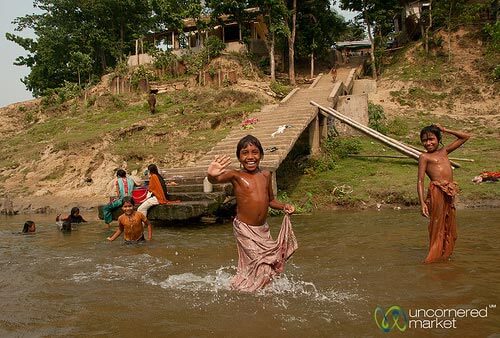
Have you ever wondered where your morning tea comes from? Continue Reading »
More than five weeks in Bangladesh? Is there really enough to do there?
– A typical response when we shared our Bangladesh travel plans.
Let’s face it. Reliable independent travel information about Bangladesh doesn’t flow quite as freely as it does for some other nearby countries in Asia.
Continue Reading »
Bangladeshi food in a home is the best – it’s cooked with the care and love of a woman’s hands. In restaurants, food is cooked by men for quantity.
– A Bangladeshi friend captures the crux of Bangladeshi food.
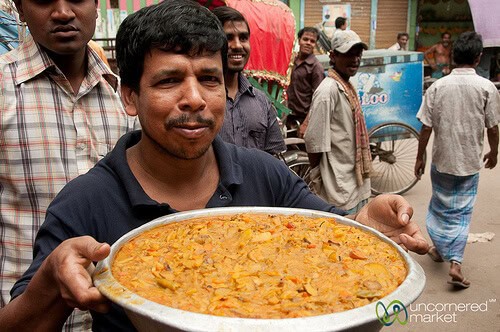
Sabzi. You know you want some!
Although you may not have realized it, it’s quite possible you’ve eaten Bangaldeshi food. Continue Reading »
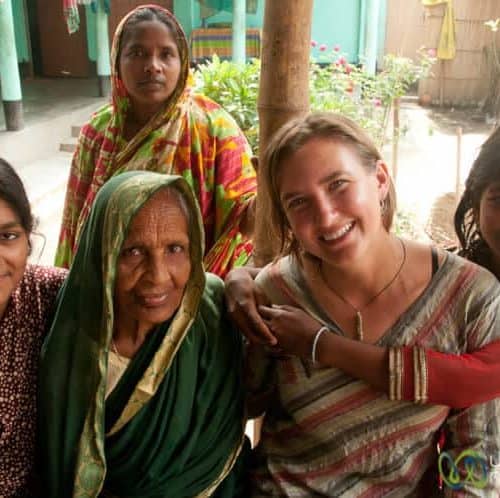
This is the story of a homestay experience in rural Bangladesh — and a young woman who hopes to be Prime Minister one day.

There I was in a traditional courtyard kitchen in a village in Bangladesh. Dirt floor, earthen oven. Mrs. Ali, our host mother, stoked the fire and minded several hot pans. It was time to slice the onions and my turn was up. Continue Reading »
What comes to mind when you hear the word “Bangladesh”?
Continue Reading »
Once upon a time, Buddhism was the prominent religion across the land that is now Bangladesh.
Although Buddhists only make up around 1% of the population today, you can find pockets of of Marma, Chakma and other ethnic communities practicing in the Chittagong Hill Tracts in southeastern Bangladesh. There are even a few Bengali Buddhists about. Continue Reading »
Oh, Bangladesh. To unpack this country is the stuff of lifetimes. But let’s begin with this: Bangladeshis are a curious lot. And there are a lot of them, as in 150 million or so, all living in a country the size of the state of Wisconsin.
Wisconsin!
Bangladesh doesn’t get many foreign visitors, either. So if you do drop in and take a walk just about anywhere, chances are that you’ll be swamped in humanity. (God forbid that you actually stop moving, for you might not be able to move again.)

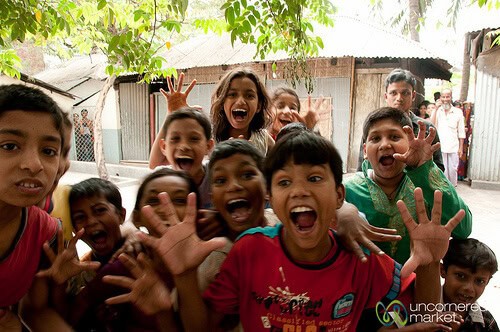
Audrey in the role of the Pied Piper at a village school.
And people will ask many questions — that help them learn about us and that we believe say much about their culture. So we offer images of a few of the people we’ve met, the questions they’ve asked, and the way they’ve asked them. Continue Reading »
Open the panorama below and you might be wondering, “Is that really Bangladesh??”
In scenes like this one at the indigenous market in the town of Bandarban, it’s easy to forget which country we’re visiting. Bandarban is part of an area known as the Chittagong Hill Tracts (CHT). CHT’s rolling hills in southeastern Bangladesh are home to over fifteen indigenous groups, many of which have their origins in far eastern India, Burma and Southeast Asia.
While the market had some unusual features for one in Bangladesh — a monitor lizard butchered to bits at the river’s edge, a huge pig sawed in half mid-market, massive sting rays hanging on hooks, and sacks jumping with plump frogs — something else stood out. Women. Continue Reading »
Have you ever set off for a destination not really caring whether you actually arrive?
The other morning, we hopped on rented single speed bikes (they looked like racing bikes, but rode like penny farthings) and headed off into the tea plantation hills of eastern Bangladesh. Our destination: Madhabpur Lake, 25 kilometers outside of our base of Srimongal.
We thought the lake would be nice, but figured the bicycle journey there and back would offer some interesting experiences and a new perspective on the people who lived in the villages and amongst the tea plantations.

As often happens, getting to the lake was far more interesting than the lake itself. And this got me to thinking: What was the purpose of the lake – the destination — in the first place? Continue Reading »
It’s just about impossible to imagine Bangladesh without the bicycle rickshaw. With colorful artwork on the back, hard-working drivers in front, bicycle rickshaws are not relics of the past, but the dominant form of transport throughout the country. The atmosphere of riding in one alternates between the peace of a slow ride above it all and the mania of a bob-and-weave in the thick of it (of the sorts that can make India look positively tame).
Besides its driver, what makes a rickshaw really stand out are its colors and artwork. In one Bangladeshi town in particular, Rajshahi, we noticed a theme in its rickshaw art: Dollywood*-style scenes of buxom women and brawny men.
Here’s a sample of what we found. Continue Reading »